

A thirty-eight-unit building in Montrouge logs three reports in ten days, all on the ground and first floors: a rat found dead in a toilet bowl, another heard "scratching in the bathroom wall" at night, a third spotted in the bathroom of a studio flat left empty for a fortnight. The pest control contractor comes out, lays bait in the basement, and finds neither burrows nor runs in the cellars. Three weeks later, a plumber called in for an unrelated job sends a camera down the waste stack: 4.20 metres below the foot of the stack, a disconnected joint opens a 6-centimetre passage into the backfill — and the backfill connects to an old, abandoned drainage connection.
When a rat turns up in an upper-floor flat with no trace whatsoever in the common areas, the most likely route is not the front door: it is the wastewater network. Rattus norvegicus, the brown rat, swims well and climbs well; soil stacks, individual connections and inspection chambers form a sheltered, temperate and never-inspected vertical network that links the public sewer directly to the sanitary fittings inside flats.
This article explains how a rodent actually climbs up a pipe, how to reach a diagnosis without breaking open a partition wall, which devices create a lasting barrier, and how the cost is shared between the owners' association, the occupant and the operator of the public network.
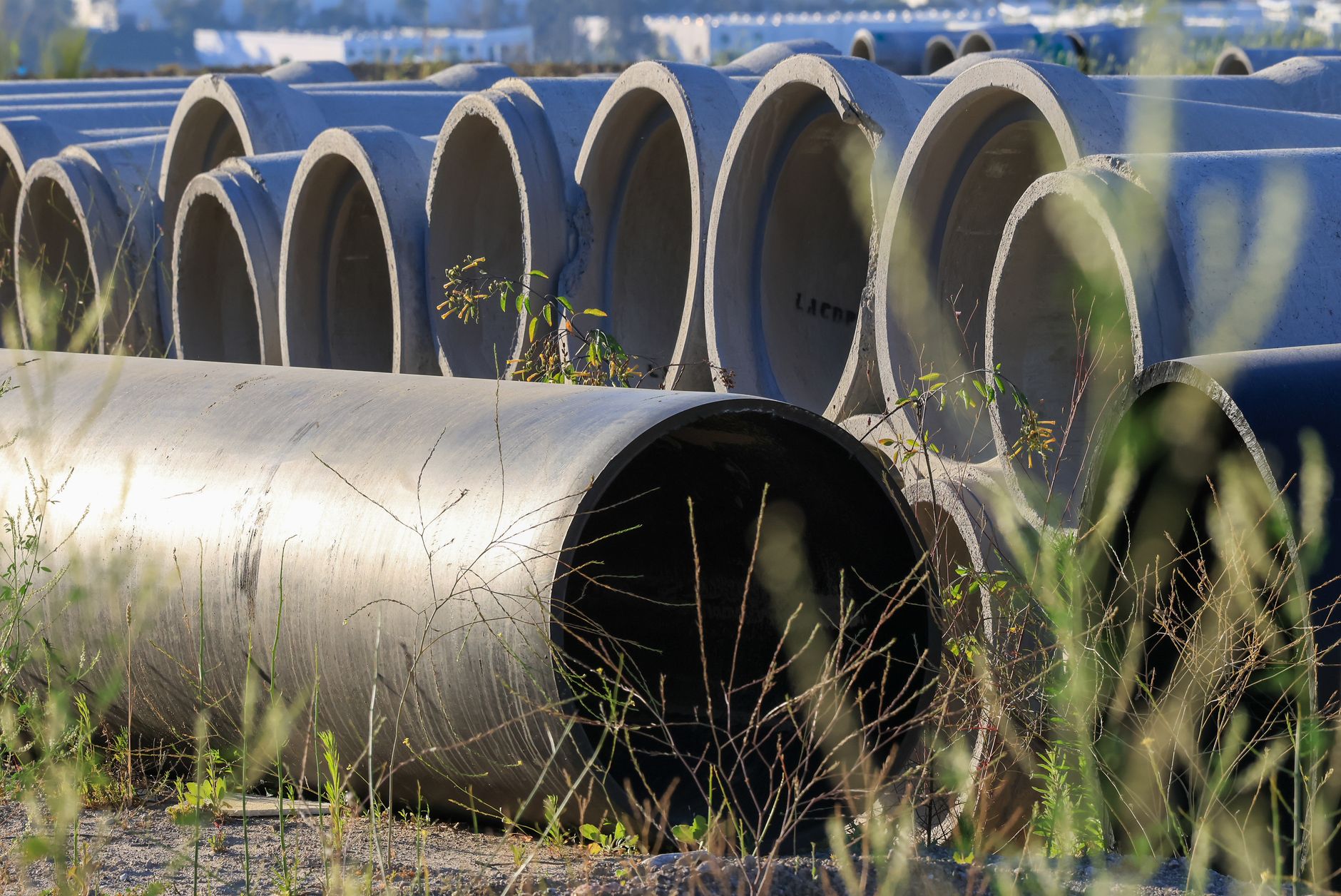 Large concrete sewer pipes stacked in an outdoor yard, surrounded by dry grass
How does a rat come up through the toilet?
An animal built for the sewer network
The brown rat is a powerful swimmer: technical literature credits it with the ability to swim several hundred metres and to hold its breath for around three minutes. It passes a toilet trap without difficulty, since the water seal is only a few tens of centimetres deep. It also climbs rough vertical pipework — cast iron, stoneware, concrete — by bracing itself between the walls, and a 100 mm diameter pipe offers exactly the purchase it is looking for.
Three routes account for the vast majority of cases encountered in the Paris region:
- Via the public connection. The Paris sewer and the département networks host stable populations. If the building's connection is cracked, crushed or lacking any non-return device, the animal climbs up into the private pipework.
- Via an abandoned duct. Haussmann-era and post-war buildings accumulate traces of former installations: toilet stacks removed during a refurbishment, decommissioned refuse chutes, rainwater downpipes connected to the combined sewer. An abandoned but unsealed duct is a dry motorway.
- Via a disused or fractured stack inside a service riser. A disconnected joint inside a landing riser puts the wastewater network into direct communication with a service void. The animal no longer needs water: it moves around dry inside the riser and emerges through a badly patched plumbing penetration under a washbasin or behind a wall-hung toilet. It is the same logic as vertical service risers, made worse by permanent damp.
The signs that point to the network rather than the cellars
An honest diagnosis starts by ruling out the classic hypotheses. We talk about a "network" origin when the following combination is observed:
| Indicator | Network origin likely | Cellar / outdoor origin likely |
|---|---|---|
| Location of reports | Wet rooms (toilet, bathroom, kitchen), various floors | Ground floor, cellars, bin rooms |
| Floor traces in common areas | Absent | Runs, droppings, gnawed holes |
| Noises | Inside wet-room partitions, at night | Suspended ceilings, skirting boards, roof spaces |
| Smell | Intermittent sewer smell in the toilet | Dry rodent urine smell |
| Basement bait take | Little or none | Clear consumption |
| Animals found | Wet, sometimes drowned in a bowl | Dry, along the walls |
In the Montrouge case, five of the six criteria pointed to the network. Yet the contractor had been treating the cellars for a month, because its intervention report had no box at all for the drainage network — a common blind spot in standard contracts.
Diagnosis: the camera before the hammer
CCTV drain survey
This is the reference examination. An operator sends a self-propelled or pushed camera down the soil stack from the roof, an inspection chamber or a rodding eye, and produces a measured report. What you look for:
- disconnected joints and missing seals;
- cracks and fractures in the collector at the foot of the stack;
- abandoned branch connections left open;
- back-falls and standing water that create a resting zone;
- nests and droppings visible in the upper part of horizontal branches.
A camera survey of one stack and its collector commonly costs between €400 and €900 excluding VAT in the Paris region, depending on length and accessibility. It is the expense that avoids demolishing three partition walls at random. Many managing agents order this survey first because it produces dated, located evidence, which can then be used with the insurer, the public network operator or the firm responsible for recent works.
Even before the CCTV survey, a trained caretaker can spot a great deal with a simple endoscopic inspection camera slipped behind the boxing of a wall-hung toilet or under a bathroom unit: greasy rub marks, droppings, gnawing on a PVC conduit. It does not replace the CCTV survey, but it makes the report more reliable before committing money. On the role of this on-the-ground relay, see our article on the building caretaker facing pest problems.
Smoke testing and dye tracing
Two useful add-ons when the CCTV survey is not enough:
- the smoke test, which puts the network under slight pressure of tracer smoke: the smoke escapes through any defect in watertightness, including inside a closed riser or a suspended ceiling, and reveals abandoned ducts;
- fluorescein dye tracing, which confirms which appliance is connected to which stack — invaluable in a refurbished building where the drawings no longer match reality.
 White toilet bowl seen from above during flushing, with swirling water and foam
The barriers that actually work
The rodent flap valve
This is the central device. Installed in an inspection chamber or on the collector, its flap opens for wastewater running downstream and shuts against anything moving upstream, so a rat cannot climb past it. There are two families:
- the mechanical stainless-steel flap valve, robust, fitted on an inspection chamber or on a cut section of pipe;
- the grille or louvred shutter for common diameters (100 to 200 mm), sometimes integrated into a connection chamber.
Points of vigilance that every managing agent should insist on in writing in the quotation:
The flap valve must be installed downstream of all the building's connections, in an accessible chamber, with an inspection and cleaning frequency written into the contract. A flap valve that is never visited silts up, blocks the flow and causes a backflow — in other words, water damage instead of protection.
Expect roughly €250 to €700 excluding VAT for installation per point, excluding civil engineering works. In a building with several connections, you need as many flap valves as there are outlet points: this is the detail that quotations most often underestimate.
Sealing penetrations and abandoned ducts
A flap valve is useless if the animal is already moving around inside the risers. The finishing work to redo, flat by flat:
- sealing of plumbing penetrations around washbasin, washing machine and wall-hung toilet wastes, with filled mortar or compressed steel wool — never with polyurethane foam alone, which is gnawed through in a few nights;
- fitting of a stainless-steel grille on accessible primary roof vents and on overflows;
- permanent sealing of abandoned branches with a mechanical plug, not just a plastic bag;
- replacement of cellar floor gullies with no water seal by trapped gullies with a flap.
For details of materials and inspection points, our complete method for sealing rodent entry points in apartment buildings remains the reference to attach to the specification.
On the "immediate measures" side for the occupant, two simple items make a difference in a flat at the bottom of the building: a heavy soft-close toilet lid kept down at night, and a can of fibre-filled rodent-proof expanding foam for temporary sealing while waiting for the plumber. These are stopgap measures, not a treatment.
What not to do
- Pouring rodenticide into the toilet or an inspection chamber. It is ineffective (the bait disintegrates), illegal under the rules governing the use of biocidal products, and polluting for the environment. The use of baits remains tightly regulated, as detailed in our piece on securing bait stations.
- Blocking a stack "to see what happens". You shift the problem onto the neighbouring flat and create a backflow risk.
- Treating without repairing. As long as the disconnected joint remains, recolonisation pressure is permanent: the sewer network is never empty.
Who pays for what: where the line is drawn
Public section, private section
The split is made at the connection. As a general rule in the Paris region:
- the public network and the part of the connection located under public land fall to the drainage service (local authority, public body, or delegated operator). This is who you report the presence of rats in the sewer to;
- the connection on private land, the collectors, the soil stacks and the primary vents are common parts of the owners' association within the meaning of Article 3 of the Act of 10 July 1965, once they serve several units;
- the horizontal branches serving a single flat, from the sanitary appliance to the stack, are generally private — the association's own rules always take precedence over the general rule.
Practical consequence: the CCTV survey, the flap valve and the repair of a disconnected stack joint are common-charge expenses, decided at a general meeting, or committed by the managing agent on grounds of urgency when the building's sanitary condition is at stake. Given how long notice periods are, the question of putting a contract or works to the vote arises from the very first serious report.
The regulatory lever
The departmental sanitary regulations require the owner to keep buildings in a proper state of cleanliness and to have the necessary rodent control work carried out. For rented homes, the decent housing decree and the 6 July 1989 tenancy Act oblige the landlord to hand over a flat with no rodent, insect or parasite infestation — a wastewater drain permeable to rodents falls squarely within that scope. An occupant faced with inaction can rely on the formal notice procedure against the managing agent or landlord and, where appropriate, on compensation for loss of quiet enjoyment.
 Aerial view of a yard with concrete sewer pipes and inspection chambers lined up on the ground
Insurance and third-party liability
Three situations in which the bill should not be left to the co-owners:
- Recent works on the network. Roadworks, a network diversion or a poorly reinstated jetting job often creates the opening. The same mechanism as the one described in our article on rats arriving after works next door applies, except that here the evidence is easy to produce: a dated CCTV survey report.
- Defective plumbing work. A stack replaced less than ten years ago with a branch connection left open falls under the ten-year structural warranty or the contractor's liability.
- Consequential damage. Gnawed electrical conduit, soiled insulation, water damage after a backflow: the water damage cover or the building's multi-risk policy may apply, provided the claim was declared promptly and the evidence kept. That is the point of the sanitary logbook.
The sequence that settles the case
An order of priority, to be turned into a schedule in any building:
- Days 1 to 3 — collect. A report form per flat: date, room, appliance concerned, noise or direct sighting. A powerful rechargeable LED torch is enough for the first inspections inside boxing and chambers.
- Days 3 to 10 — secure the occupied areas. Temporary sealing of penetrations in the affected flats, checking of traps, instructions to keep toilet lids closed, removal of any food source at the foot of the building and in the bin room.
- Weeks 2 to 4 — diagnose. CCTV survey of the stack concerned and of the collector, smoke test if necessary, identification of abandoned ducts. Insist on the video report and the measured drawing.
- Weeks 4 to 8 — repair and block. Repair of disconnected joints by lining or coupling, sealing of dead branches, installation of rodent flap valves on each connection, grilles on the vents.
- Months 2 to 6 — verify. Put activity indicators back in place (non-toxic monitoring blocks, tracking flour) in the risers of the flats concerned, and write a six-monthly check of flap valves and chambers into the annual contract.
- Final cleaning. Soiled areas — boxing, plumbing cupboards, adjoining cellars — call for a disinfection protocol, not a quick wipe. The disinfection page sets out what is justified, and our article on the protocol after a rodent infestation details the steps and the equipment, FFP3 mask and nitrile gloves included. A pack of disposable nitrile gloves and a disinfectant sprayer are part of the minimum kit to keep in the caretaker's lodge.
On the health side, remember that the national agency Santé publique France links leptospirosis to rodent urine and to damp conditions: wastewater networks are by definition the highest-risk setting. Any intervention in a chamber or at the foot of a stack must be carried out with hand and face protection, wounds covered, and immediate washing after exposure.
What to write into the contract
A standard rodent control contract almost never covers the drainage network. Three lines to add at renewal, or when drafting the specification for a pest control service:
- six-monthly inspection of chambers and rodent flap valves, with a photo report;
- mandatory reporting to the managing agent of any sign of activity in the network (droppings in a chamber, rub marks, jammed flap valve), within 48 hours;
- a CCTV survey allowance that can be activated without a fresh tendering process once a reporting threshold is crossed, to avoid the six weeks lost waiting for a quotation.
A building that has repaired its stack, fitted its flap valves and sealed its penetrations shifts into another league: recolonisation via the network becomes an incident rather than an inevitability. To get a survey, flap valve installation or a building-wide control plan priced up, the quotation request and the apartment building hub bring together the information to prepare before making contact.
Got a pest problem?
Our certified technicians are available 7 days a week. Free quote within 24h.