

A 72-unit residence in Villejuif sees rodent reports triple between March and October. Yet the waste room has been refurbished: resin floor, new door, floor trap cleaned out, two secured bait stations. What changed, nobody recorded in the pest file: in January the local authority installed a food-waste container in the courtyard, and the residents' committee added two extra yellow bins for lack of space inside. All three containers stay outside permanently, six metres from a cellar ventilation grille.
Recycling does not attract rats by nature. What attracts them is the way it is set up: extra bins moved out of the locked room, containers with poorly closing lids, warm food waste left for seven days, and a baiting perimeter that was never redrawn after the change. In the Paris region, the roll-out of separate food-waste collection required by the AGEC law and the Climate and Resilience law since 1 January 2024 has multiplied drop-off points at the foot of buildings, often with no technical thought given to pest protection.
This article describes what rodents actually find in each waste stream, how to audit an existing setup in an hour, which corrections produce a measurable effect, and how to charge the expense to the right budget line.
 Open waste container at the kerbside in front of residential buildings at dusk
What each waste stream really offers a brown rat
Food waste: the most calorie-dense resource on site
A food-waste bin concentrates what a general-waste room dilutes: peelings, cooking leftovers, coffee grounds, shells. Fermentation generates heat — 25 to 30 °C is commonly measured at the core of a well-filled bin in autumn — along with volatile compounds that carry several dozen metres. For a brown rat (Rattus norvegicus), that is the signal of a stable resource, renewed every day, in a plastic container it can gnaw through at the base within a few nights if the bin sits directly on the ground.
The aggravating factor is the collection rhythm. General waste goes out three to six times a week depending on the municipality; food waste, often once or twice. A smellier stream, standing for longer: cumulative exposure is far higher.
The yellow bin: underestimated, rarely empty
Packaging is not food waste — in theory. In practice, a residential yellow bin holds unrinsed trays, milk cartons, tins with residues, meal-delivery bags. That is enough to sustain a population of house mice (Mus musculus), whose daily food requirement is around 3 grams.
Above all, the yellow bin is bulky. It is the one pushed out of the waste room when space runs short — and it is at the base of the bin, in the 8 to 10 centimetre gap between the bottom and the ground, that shelters get established.
Glass and cardboard: the harbourage effect
The glass bank feeds no one, but its surroundings accumulate cardboard left on the ground, crates, bags. Corrugated cardboard is a first-rate nesting material: insulating, easy to shred, easy to carry. A pile of cardboard stored for three weeks against a courtyard wall amounts, for a pregnant female, to a ready-made nursery site. The same phenomenon plays out in cellars, as we detailed regarding cardboard stored in cellars and garages.
A simple rule applied by most technicians: a waste stream becomes an infestation factor as soon as it stands for more than 48 hours outside a closed container, or as soon as it rests on a non-washable floor.
Why adding bins cancels out a treatment that was working
The baiting perimeter has not kept up
A building's rodent control plan is built around runways and food sources identified at a given moment. Moving the resource ten metres — from the closed room to the courtyard — moves the runways. The bait stations remain in the right place on the 2024 plan, but in the wrong place in the reality of 2026. The rodent no longer needs to enter the waste room: it eats outside.
This is one of the most frequent causes behind those cases where "the contractor comes every two months and nothing changes". Checking the rodent control intervention report lets you verify it in two minutes: if the attached station layout plan has not been updated since the new bins were installed, the diagnosis is made.
Outdoor bins open a corridor into the building fabric
A bin in the courtyard draws rodents in from the public street. They do not stay at the bin: they explore the perimeter and find the weaknesses of the structure — wide-mesh cellar ventilation grilles, worn service-door thresholds, unsealed service ducts. Three weeks later, reports start coming in from the cellars and risers. The issue then merges with that of entry points to be sealed, which must be addressed at the same time as the overhaul of the recycling setup.
The waste room itself deteriorates
When the bulky bins go out, the room takes in bulky waste in their place, out-of-service bicycles, individual bags dropped outside any bin. You end up with the classic configuration described in our article on refuse chutes and waste rooms in apartment buildings: a non-washable, cluttered space where baiting becomes ineffective because competing food is everywhere.
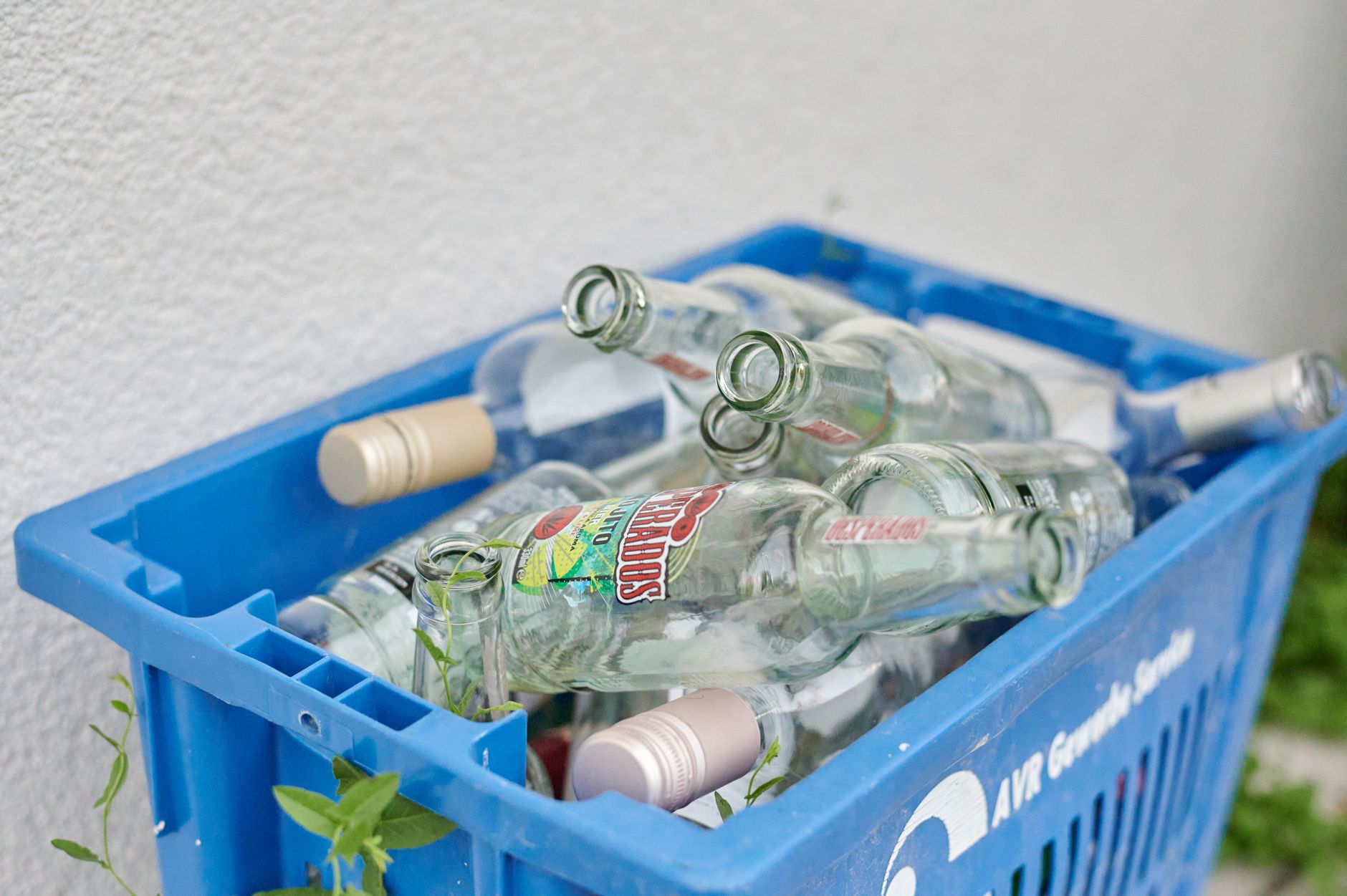 Blue recycling bin filled with empty glass bottles in front of a light-coloured wall
The one-hour audit: the checklist to use
To be done with the caretaker or building employee, preferably on the morning of the day furthest from the last collection — that is when the setup is at its fullest.
| Checkpoint | What to look at | Alert threshold |
|---|---|---|
| Number of bins vs room capacity | Bins standing outside permanently | 1 bin or more outside the room |
| Lids | Complete closure, hinges, latch | 1 lid not sitting flush |
| Bin base | Perforations, abrasion marks, droppings | 1 perforation |
| Ground under the bins | Bare soil, cracked asphalt, loose slabs | Non-washable surface |
| Distance to building openings | Cellar grilles, service doors, basement windows | Less than 5 metres |
| Surroundings of the glass bank | Cardboard, crates, bags on the ground | Any dumping present |
| Food waste | Standing time, bags outside the bin | More than 48 h |
| Washing frequency | Bins and floor, written record | Less than once a month |
| Baiting plan | Update date vs bin installation date | Plan predates the bins |
Anomalies should be photographed. A dated record, with photos and a rough plan, is the document that will justify a general meeting resolution or a formal follow-up with the contractor. This record belongs in the building's pest control logbook, alongside the intervention reports.
To track night-time movement without tying anyone up, two tools are enough: a thin layer of talc or flour spread along suspected routes (footprints and tail drags are readable in the morning) and, for larger sites, a motion-detection surveillance camera aimed at the bins. A focused-beam torch remains the basic tool for reading grease marks on skirting boards and perforations at the base of bins.
Corrections that produce a measurable effect
1. Bring every stream back inside or into a closed enclosure
This is the most effective correction, and the one most often refused on grounds of floor space. Three options exist:
- Enlarge or reorganise the waste room: wall shelving to free up the floor, removal of parasitic storage, wheeled bins lined up on a resin floor with coved skirting.
- Create a closed outdoor enclosure: metal frame, solid cladding, gate, washable concrete slab with a slope and a drain. The mesh of any ventilation grille must stay below 6 mm.
- Switch to underground or semi-underground containers: the tank is inaccessible and the deposit drum limits the accessible volume. One caveat: a poorly maintained drum and a dirty drop-off area recreate the problem at surface level.
2. Lift the bins off the ground and monitor their condition
A bin standing on a clean concrete slab, with 15 centimetres of lateral clearance to allow sweeping, still offers no protection to its base. Raised bin stands or supports are inexpensive and eliminate the shelter under the bin. Perforated bins must be replaced: a 2-centimetre hole widens within a fortnight and becomes a service entrance.
3. Lock the lids without blocking everyday use
Pedal-closing systems and gravity latches are available on most standardised bins. In an apartment building, the realistic compromise is to lock the food-waste and glass bins and leave general waste freely accessible inside a badge-controlled room.
4. Keep a written cleaning schedule
Washing the bins and the floor with hot water and a degreasing detergent removes the scent marks rodents use as landmarks. Monthly is the minimum in the Paris region; weekly for food waste. Thick cut-resistant protective gloves and a compact pressure washer for the waste room are part of a building employee's standard kit — buying them falls under ordinary running charges, not a works vote.
5. Put up instructions that are genuinely readable
Most dumping outside the bins stems from ignorance of collection days and of how to sort. A laminated signage panel showing the streams, the put-out days and the ban on leaving waste on the floor, placed in the lobby and in the waste room, cuts fly-tipping in ways several Paris-region social landlords have documented. The caretaker remains the decisive relay for this information, as we explained regarding the building caretaker's role against pests.
 Vegetable peelings in a bowl, next to a knife and a peeler on a white worktop
The regulatory framework to rely on
Three sets of rules give a managing agent or a landlord leverage to move the case forward.
- The règlement sanitaire départemental (departmental public health regulations), which requires the owner or manager to maintain waste storage rooms and to take the measures needed against the proliferation of rodents and insects. The articles on refuse deposits and rodent control are the usual legal basis in the Paris region.
- The French Public Health Code (Code de la santé publique) (housing fitness: articles L.1331-22 et seq.; general hygiene rules: L.1311-1 et seq.), which allows the mayor or the prefect to serve formal notice on the party responsible for an insanitary space.
- The AGEC law of 10 February 2020 and the Climate and Resilience law of 22 August 2021, which made a separate food-waste collection solution mandatory from 1 January 2024 for all producers, households included. ADEME publishes technical implementation guides for multi-occupancy housing that explicitly address the protection of collection points.
As for the building's own rules, adding an enclosure or an underground container affects the common parts: that means a general meeting resolution. The practical arrangements — quotes to attach, applicable majority, competitive tendering — are the same as for a service contract, as detailed in our guide to voting a rodent control contract at a general meeting.
Finally, in a mixed-use building with ground-floor shops, the bin question is often the central friction point: a restaurant generates food waste in volume and rarely has an adequate dedicated room. The sharing of responsibilities is covered in the article on rodents in a ground-floor business.
Who pays for what
| Expense | Usual allocation |
|---|---|
| Washing the bins and the room | Running charges (maintenance) |
| Replacing a perforated bin | Often the local authority (bins supplied) or running charges |
| Bin stands, latches, signage | Running charges, small amounts |
| Building an enclosure, resin flooring, underground containers | Works voted at a general meeting, common parts |
| Revising the baiting plan | Included in a properly drafted annual contract |
| Sealing entry points in the structure | Works on common parts |
The classic trap is to have a rodent control contract pay for what is in fact a design flaw in the collection point. A serious contractor flags this in writing; a contractor who bills extra visits without ever stating that the waste room is unsuitable should receive a formal follow-up, or even a formal notice where the manager remains inactive.
Three mistakes to avoid
- Baiting around the bins without fixing the bins. You get spectacular bait consumption and an unchanged population, because the food resource stays more attractive than the bait.
- Scrapping recycling to "solve the problem". Besides being illegal, it simply shifts the volume to general waste and fly-tipping.
- Handling the case without a written record. Without dated photos, without an audit checklist and without an entry in the logbook, no general meeting votes for works and no contractor changes its plan.
The sequence that works comes in four stages: documented audit of the recycling setup → correction of the container and the ground → update of the baiting plan by the contractor → check at six weeks with a bait consumption record. To build a contractual framework that factors in collection points from the outset, drafting the specification for a pest control service is the step not to skip.
An on-site assessment and a costing of the corrections can be requested through our quote form; managers running several residences will find the details of recurring services on the annual contracts page.
Got a pest problem?
Our certified technicians are available 7 days a week. Free quote within 24h.