

The 2026 back-to-school season is approaching, and with it the largest population movement of the year in the Paris region: between mid-August and the end of September, several hundred thousand students take possession of a university room, a furnished studio or a flatshare. In the vast majority of cases, that home was still occupied a few days earlier by someone else. Mattresses kept in place, bed bases screwed to the wall, furniture left behind, boxes stored in shared cellars: this is exactly the scenario that lets pests change tenants without changing address.
Warning signs are plentiful. In January 2026, reports of unsanitary conditions in student housing managed by a CROUS received national media coverage, and a survey relayed in early 2026 estimated that nearly two thirds of French people have already dealt with a pest in their home. Student housing combines every risk factor: high turnover, tight budgets, shared furniture, crowded common areas. The good news: a methodical twenty-minute inspection on inventory day is enough to avoid most nasty surprises.
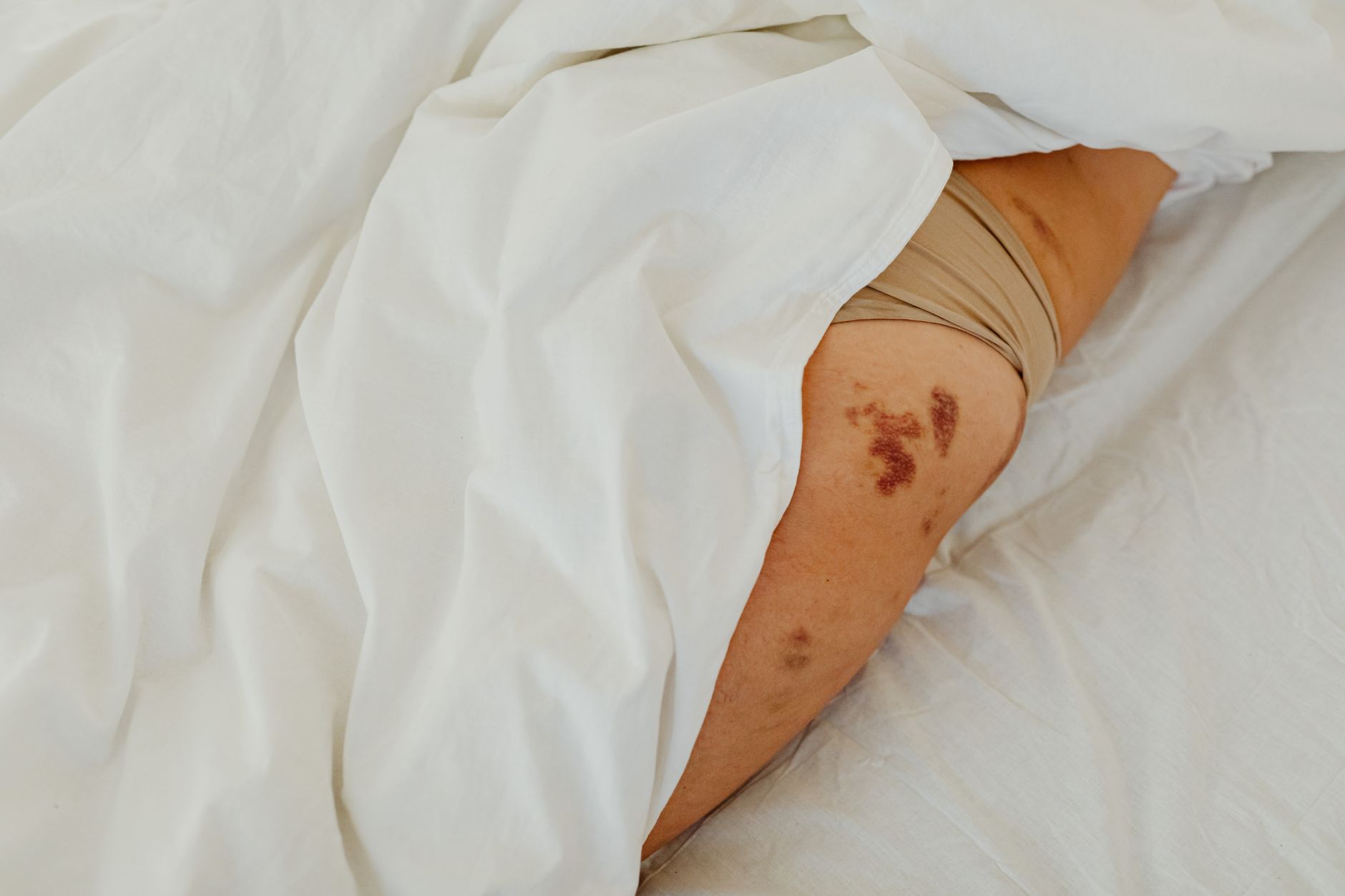 Leg of a person lying in a white bed, with redness and skin lesions on the thigh
Why September is the annual contamination peak
Bed bugs neither fly nor jump. Their only strategy for conquering new ground is passive transport: slipping into a suitcase seam, a travel bag handle, the leg of a dismantled bed base, a box of books. Every move is therefore an opportunity for them. In September, those opportunities number in the thousands within a few kilometres.
The three back-to-school vectors
- Second-hand furniture. A mattress found on the pavement, an upholstered headboard picked up at a car boot sale, a chest of drawers taken over from the previous occupant: these are the three items most frequently implicated in back-to-school infestations. Padding and untreated wood provide perfect shelters.
- High-turnover housing. University halls, summer sublets, short-term rentals converted into student accommodation for the new term: the faster the turnover, the less time there is to treat the property between two occupants.
- Common areas. Laundry rooms, bike storage, cellars, study rooms: in a hall of residence, an infestation hotspot in one room can reach neighbouring rooms through service ducts and skirting boards within a few weeks.
Add to this cockroaches, which follow the same logic but via drainage stacks, and mice, which take advantage of poorly maintained shared kitchens. Residual late-summer heat accelerates their reproductive cycles: according to reference research on Blattella germanica, a single female can produce several hundred offspring in a year under favourable thermal conditions.
The inspection protocol for inventory day
Don't sign anything before completing the checks below. Bring a powerful torch — a phone light isn't enough in the dark recesses of a bed base — and take time-stamped photos of anything that looks suspicious.
1. The bed, in this exact order
- Remove the fitted sheet and mattress protector completely. Inspect the four perimeter seams of the mattress, easing the piping open with a fingernail. You're looking for black dots the size of a pen tip (droppings), tiny dried blood stains, translucent skins (moults) or clusters of whitish eggs.
- Turn the mattress over. Sewn-on labels and side handles are classic hiding spots.
- Look at the bed base from underneath. This is zone number one. The fabric lining, corners, screws and wooden slats harbour the majority of hotspots.
- Visually dismantle the headboard. If it's upholstered or fixed to the wall, slide a rigid card behind it and shine your torch in.
2. The 3-metre perimeter
Bed bugs rarely move more than three metres from their food source. So check:
- skirting boards and any lifting wallpaper around the bed;
- the back and underside of the bedside table, and drawer runners;
- nearby picture frames, mirrors and electrical sockets;
- curtains, especially bottom hems and top pleats.
3. Signs of cockroaches and rodents
Open the cupboard under the sink: greasy marks, empty ootheca casings, a characteristic sweetish smell. Check behind the fridge and on top of wall units. For mice, look for droppings shaped like black grains of rice in cupboard corners, gnawed packaging, grease marks along skirting boards, and spot any unsealed pipe openings.
One simple tip: record every anomaly in writing in the move-in inventory, with photos attached. In the event of a dispute, that document is what will prove the infestation predated your arrival.
What the law says when a home is infested
The French legal framework has been clear since the ELAN law and the decree on decent housing: the landlord must provide a home free from any infestation of pests and parasites. In practice:
| Situation | Who pays | Action to take |
|---|---|---|
| Infestation found on move-in | The landlord (or the CROUS) | Immediate written report + photos, registered letter within 8 days |
| Infestation appearing during the tenancy in a multi-unit building | Often the managing agent / landlord if it originates in common areas | Report to the manager, request a building-wide assessment |
| Infestation clearly brought in by the tenant | The tenant | Professional treatment, inform neighbours |
In university halls, the process goes through the CROUS housing service or the residence manager. If nothing happens, remedies exist: the local council's municipal hygiene and health department (SCHS), the Regional Health Agency, or, in the worst cases, the departmental conciliation commission. The ADIL in your department provides reliable legal information on these procedures free of charge.
Protective measures from day one
Once the home has been cleared, a few simple measures drastically reduce the risk for the whole academic year. The aim isn't to live in fear — as several experts interviewed by the national press in 2026 pointed out, panic is a poor adviser — but to put lasting barriers in place.
Encase the bedding
This is the most cost-effective measure by far. A zip-up bed bug mattress encasement, fitted over both the mattress and the bed base, serves two purposes: it prevents any colonisation of the seams, and if an infestation was already present, it traps the insects, which will eventually die without a blood meal. Choose a certified "bed bug proof" model with a lockable zip, and leave it in place for at least a year without removing it.
Raise and isolate
Move the bed at least ten centimetres away from the wall and make sure sheets and blankets don't touch the floor: the bed then becomes an "island". Bed leg interceptor cups placed under each leg complete the set-up — their smooth walls stop insects climbing up and act as an early infestation indicator, since you'll see whatever they catch.
Monitor without paranoia
Pheromone detection traps or sticky traps slipped behind the headboard and under the bedside table let you detect an emerging infestation before it becomes visible to the naked eye. Check them once a month. For shared kitchens, cockroach gel bait stations — discreet and spray-free — are more effective and far safer than off-the-shelf insecticide bombs.
Storage: an underrated weapon
Clutter doesn't attract pests, but it gives them hiding places and makes any treatment ineffective. In an 18 m² studio, opt for:
- airtight plastic storage boxes rather than cardboard boxes, which are both food and shelter for cockroaches;
- clip-top jars for pasta, rice, flour and cereals, to guard against pantry moths and mice;
- a weekly waste clear-out, and never a bin bag left overnight in the living area.
The arrival ritual: treating your own belongings
You may have been staying elsewhere over the summer — in a flatshare, a hostel or a youth hostel. Your luggage is therefore a potential vector. Before putting everything away in the cupboards:
- Never put your suitcase on the bed. Unpack in the bathroom, on a tiled floor, or in the bathtub.
- Wash all washable textiles at 60 °C, then tumble dry for 30 minutes on high heat. Dry heat is the most reliable treatment: entomological data agree that eggs and adults are killed outright above 55 °C sustained for a few minutes.
- For non-washable items (shoes, bags, books), freezing at −18 °C for 72 hours in a sealed bag works, provided the freezer really reaches that temperature.
- Vacuum the suitcase, seams included, throw the vacuum bag away in a sealed bag outside, then store the luggage in a cover.
In a small home, a compact cordless stick vacuum is the most cost-effective hygiene accessory there is: it allows a daily pass over skirting boards, under the bed and behind furniture, where dust, crumbs and eggs accumulate.
What you must absolutely avoid doing
Every September, the same mistakes turn a localised hotspot into a full-blown infestation.
- Don't move your furniture into another room or to a friend's place. It's the surest way to spread the problem.
- Don't dump your mattress on the pavement without making it unusable and wrapping it up: you'll contaminate the whole neighbourhood.
- Never order insecticide from online marketplaces or informal sellers. Health authorities issued a warning in April 2026 about the continued circulation of a product banned in France, linked to several deaths. Any product used must be authorised under the European biocidal products regulation, and ANSES publishes the list of approved substances.
- Don't sleep somewhere else in the home. Switching to the sofa merely moves the food source and extends the infested area.
- Don't use "total release" foggers: they scatter insects towards neighbouring flats without reaching deep hiding places.
When to call a professional
Successful bed bug treatment relies on an accurate diagnosis, a combination of methods (dry steam at over 180 °C, heat treatment, approved products, diatomaceous earth as a complement) and at least two visits two to three weeks apart to cover the egg-hatching cycle. That's beyond the reach of any improvised approach.
Call in a pest control company (rodent control, insect control, disinfection) if:
- you have seen live insects, not just bites;
- traces are present on the bed base or skirting boards, a sign of an established hotspot;
- the property is in a multi-unit building — treatment must then be coordinated with adjoining flats;
- you still have doubts after two weeks of your own measures.
Always ask for a written quote, the names of the products used along with their authorisation numbers, and an included follow-up visit. For university halls, insist that treatment covers neighbouring rooms and common areas: treating a single room in an infested corridor is like emptying a bath without turning off the tap.
In summary
The start of term is a window of vulnerability, but also a window of opportunity. Twenty minutes of inspection during the move-in inventory, encased bedding, storage in airtight containers and an immediate written report at the first sign of doubt: these four reflexes are enough to protect the vast majority of student homes.
And if the problem is already there, remember that bed bugs transmit no disease and have nothing to do with poor hygiene. The real risk, extensively documented by health professionals, is psychological: sleep disturbance, anxiety, isolation. Acting quickly, informing your landlord in writing and bringing in a qualified professional remains the only strategy that works — for you, and for the neighbours on your floor.
Got a pest problem?
Our certified technicians are available 7 days a week. Free quote within 24h.
Read also
- Holiday Lets and Airbnb: The Anti-Pest Protocol to Apply Between Two GuestsRead the article
- Bed bugs at Soissons hospital: the A&E closed for 48 hours in July 2026 — what it reveals about healthcare facilitiesRead the article
- Bed bugs at the Résidence des Balkans (Roissy-en-Brie): tenants of a social landlord's nightmare in July 2026Read the article