

Late August 2026 is, in apartment buildings across the Paris region, the time of year when cockroach reports go through the roof. This is not just an impression: the German cockroach — Blattella germanica, the small beige roach measuring 12 to 15 mm that colonises kitchens and bathrooms — sees its breeding cycle speed up when ambient temperatures stay between 25 and 30 °C. After several weeks of heat building up inside walls, service ducts and bin rooms, a colony that numbered a few dozen individuals in June can count several thousand by September.
The problem, in a shared building, is that an infestation has no borders. A flat treated on its own becomes infested again within four to six weeks, because cockroaches travel along service risers, suspended ceilings and crawl spaces. Understanding this collective mechanism is the key to understanding why so many residents feel they have been "treating for nothing" for months.
 Macro close-up of a brown cockroach with long antennae on a white surface
Why apartment buildings are the German cockroach's ideal habitat
The German cockroach does not live outdoors in our climate. Unlike the Oriental cockroach, which tolerates cool cellars and sewer networks, the German species is strictly dependent on heated buildings. It therefore needs three things, and an apartment building supplies all three on a permanent basis.
Steady warmth, even at night
A detached house cools down at night. A concrete building does not. In August 2026, after a succession of hot spells, the thermal inertia of Paris-region buildings keeps plumbing risers and back kitchens above 26 °C around the clock. At that temperature, a female produces an ootheca (the small case containing 30 to 40 eggs) roughly every three weeks, compared with one every two months in a home at 20 °C. The colony's growth rate literally doubles.
A permanent water supply
A cockroach can survive several weeks without food, but rarely more than ten days without water. The permanent water sources in a building are countless: traps, condensation behind a fridge, shower seals, a leaking cistern, a defrost tray. That is why infestation hotspots are almost always found within two metres of a damp spot — and not near the food cupboard, contrary to intuition.
Invisible vertical motorways
This is the decisive factor, and the one residents understand least. Service risers (wastewater pipes, mechanical ventilation ducts, cable runs, heating shafts) connect every floor along the same vertical line. A poorly sealed hole around a downpipe is enough to create a permanent corridor between the 2nd and 5th floors. Add disused but unsealed rubbish chutes, suspended corridor ceilings and bike stores, and you get a network cockroaches use at night without ever crossing the visible common areas.
Rule of thumb among pest control professionals: when a flat has been infested for more than three months, you should assume by default that the neighbouring flats, the one above and the one below are affected too — even if their occupants have seen nothing.
Spotting an infestation before it goes building-wide
The German cockroach is light-shy: it flees illumination. When you see one in broad daylight, it is never a stray individual — it is a sign that the population has saturated its hiding places and that the weakest individuals are being pushed out into exposed areas. In other words: a cockroach visible in daylight = a colony already established.
The signs to look for, in order
- Droppings. Tiny black specks, similar to ground pepper, clustered in cupboard corners, behind hinges, on top of wall units and along skirting boards. This is the most reliable clue.
- The smell. An advanced infestation gives off a distinctive sweet, rancid odour caused by aggregation pheromones. It is most noticeable when opening an under-sink cupboard that has been closed for a while.
- Moults and oothecae. Translucent shed skins and small brown capsules 6–8 mm long, often stuck behind a drawer or under the worktop.
- Nymphs. Small black cockroaches 3 to 5 mm long with a pale stripe: their presence means breeding is happening on site, not that a single individual arrived in a cardboard box.
A proper check is done at night, head torch in hand, by suddenly opening cupboards after two hours of complete darkness. To get an objective measure of the scale of the problem before calling anyone, the simplest method is still to set out about ten sticky cockroach traps in sensitive areas (under the sink, behind the dishwasher, on top of the fridge, in the bathroom) and check them after seven days. Counting the catch gives you both the density and, above all, the location of the real hotspot: the busiest trap points towards the nest.
What the legal framework says: tenant, landlord, building manager
Many infestations get worse simply because nobody knows who should pay. The framework is, however, fairly clear.
| Situation | Who must act | Legal basis |
|---|---|---|
| Infestation limited to one rented flat, present when the tenant moves in | The landlord | Act of 6 July 1989, art. 6: decent housing, free of pests and parasites |
| Infestation appearing during the tenancy, linked to how the property is used | The tenant (routine upkeep) | Decree no. 87-712 of 26 August 1987 |
| Infestation affecting several units or the common areas | The building manager (syndic), on behalf of the ownership association | Act of 10 July 1965, duty to maintain and preserve the building |
| Established unsanitary conditions | Municipal hygiene and health department (SCHS) / ARS | Public Health Code, art. L1331-22 et seq. |
Since the ELAN Act, the absence of pests is explicitly part of the criteria for decent housing: a landlord cannot indefinitely push responsibility back onto the tenant when the infestation is clearly building-wide. In practice, the steps for a tenant are as follows:
- Document. Dated photos, trap counts, a list of the rooms affected.
- Report in writing to the landlord (and to the building manager if the common areas are involved), by registered letter with acknowledgement of receipt.
- Ask the neighbours on the same vertical line: three simultaneous reports change a building manager's reaction dramatically.
- Contact the municipal SCHS (or the ARS in towns without an SCHS) if nothing happens, enclosing the letters that went unanswered.
In Paris, the Service parisien de santé environnementale handles this type of report; in the inner suburbs, most large towns have an equivalent hygiene department. These services do not carry out treatment themselves, but their official findings usually force the owner or building manager to hire a pest control company.
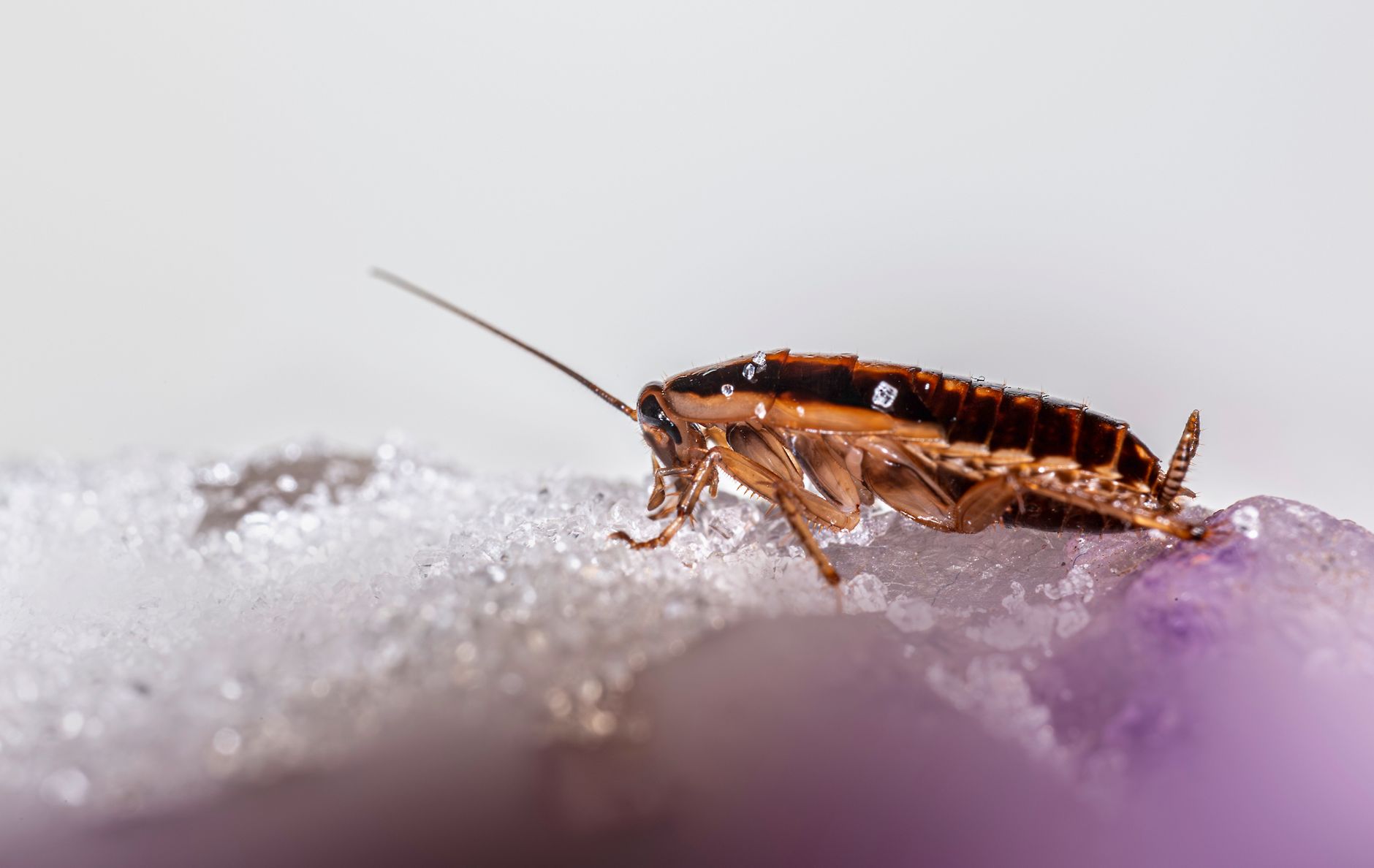 Close-up of a brown German cockroach resting on a white crystalline surface
The five mistakes that make an infestation worse
1. Off-the-shelf "knockdown" aerosols
This is the costliest mistake. An aerosol insecticide kills the individuals it reaches — around 5 to 10 % of the colony — and triggers a well-documented phenomenon: dispersal. The surviving cockroaches flee the treated area through the ducts and establish secondary colonies at the neighbours' or in another room. An infestation confined to the space under a sink becomes a flat-wide infestation, then a building-wide one. Professionals call this "blowing up the nest".
2. Foggers and automatic dispensers
Same logic, only worse: the insecticide mist does not penetrate the crevices where cockroaches actually live (under 5 mm), but it does coat every food surface and drives the insects towards the partition walls. ANSES regularly points out that these products, widely used in the home, have an unfavourable benefit/risk ratio for occupants, particularly where children or people with asthma are present.
3. Products bought outside legal channels
Recent news has been a dramatic reminder: insecticides banned in France are still circulating through informal networks and online marketplaces, with cases of serious poisoning recorded by health authorities. No product sold without proper French regulatory labelling, without a marketing authorisation number and without a safety data sheet should ever be used in a home. The risk is not theoretical.
4. Treating on your own when the whole building is affected
A high-quality treatment in a single unit works… until recolonisation. Reputable companies in fact make their guarantee conditional on treating the entire vertical line, or at the very least the adjoining flats.
5. Waiting for summer to end
Many residents hope "it will go away with the cold". That holds true for mosquitoes, but not for the German cockroach: it lives indoors, in a heated building. Autumn simply shifts the colonies towards the warmest parts of the building — boiler room, rubbish chute shaft, kitchens on the middle floors.
What actually works: a three-pronged strategy
Prong 1 — Starve the colony of resources
This is the part occupants control, and it accounts for 50 % of the outcome.
- Fix every leak, however small, and wipe damp surfaces dry before nightfall.
- Leave nothing out in the open: flour, cereals, pet kibble and biscuits should go into airtight glass containers or food-grade plastic ones with a seal. Open bags of pet food are one of the food sources most frequently found during inspections.
- Take the rubbish out every evening, and never store bags on a balcony or in a utility room.
- Vacuum skirting boards, the backs of large appliances and furniture joints thoroughly; throw the bag away outside immediately.
- Seal openings around pipework with sealant or expanding foam: it is the single most cost-effective step for cutting off the vertical motorways. A silicone sealant gun and a few cartridges are enough to block most of the passageways in a flat.
Prong 2 — Insecticidal gel, not spray
The benchmark professional treatment against the German cockroach is based on bait gels containing authorised active substances (fipronil, imidacloprid, indoxacarb, depending on current authorisations). Their advantage: the cockroach eats the bait, returns to its hiding place and contaminates its fellows through droppings and cannibalism. This is the "domino" effect that reaches individuals never directly exposed, including hidden nymphs. Well-applied gel — multiple small droplets, inside hinges, under worktops, inside ducts — produces an 80 to 90 % drop in population within two to three weeks.
As a complement, and for early-stage infestations, sealed cockroach bait stations offer an acceptable solution where children or pets are present, provided they are placed on the insects' actual routes and not in the middle of a room. They are no substitute for professional treatment of an established colony.
Prong 3 — Follow-up and the second visit
No serious intervention ends after a single visit. Oothecae are impervious to insecticides: the eggs hatch after treatment, generally between day 20 and day 35. A follow-up visit at three or four weeks is therefore essential, with fresh gel applied and monitoring traps checked. Any quote that mentions neither a follow-up visit nor a guarantee should be rejected.
 Brown rat with greyish-brown fur crouching on ground covered with twigs and dead leaves
Preparing your home properly before the visit
The quality of the preparation directly affects the outcome. The day before the visit:
- Empty the low kitchen and bathroom cupboards and leave them accessible.
- Pull the fridge, cooker and washing machine away from the wall.
- Do not clean surfaces with a degreaser just beforehand: it interferes with the gel's adhesion and wipes out the trails that reveal traffic routes.
- Plan not to wash skirting boards and cupboard interiors for at least a fortnight after the visit.
- Put away unpackaged food, clean crockery and pet bowls.
After treatment, it is normal to see more cockroaches for 48 to 72 hours: the gel disrupts the colony and individuals come out of hiding. This is not a failure — it is a sign the product is working. Whatever you do, do not reach for an aerosol at that point: you would cancel out the domino effect already under way.
Health: why this should not be brushed off
Cockroaches are not merely an aesthetic nuisance. The allergens contained in their droppings, moults and carcasses are recognised as an aggravating factor for asthma, particularly in children: it is one of the best-documented indoor allergens in the medical literature, alongside dust mites. On the digestive side, the cockroach is a passive mechanical vector: moving between pipework, bin rooms and worktops, it can carry salmonella, E. coli or staphylococci.
A heavily infested home also has genuine psychological consequences — sleep disturbance, social shame, giving up on having guests — as amply illustrated by testimonies gathered in the press in recent months, including from social housing and communal facilities. A HEPA air purifier for the bedroom can help reduce the residual allergen load for someone with asthma, but it obviously does nothing about the cause.
In summary
- A cockroach seen in daylight signals an already established colony, not a one-off.
- Late summer concentrates the annual peak: accumulated heat + accelerated breeding.
- In an apartment building, treating a single flat almost always fails: you have to think in terms of vertical lines.
- Aerosols and foggers disperse the colony instead of eliminating it.
- Professional bait gel + removal of resources + a follow-up visit at three weeks: this is the only protocol that holds up over time.
- Tenants: report in writing, get your neighbours to back you up, and contact your local hygiene department if nothing is done.
If you spot signs in your home or in your building's common areas, don't lose the weeks of September: at this time of year, every month of waiting multiplies both the population and the cost of treatment. An accurate diagnosis, carried out before the colony reaches the neighbouring floors, remains the most economical intervention — and the only one that offers lasting protection for the whole building.
Got a pest problem?
Our certified technicians are available 7 days a week. Free quote within 24h.
Read also
- Cockroaches in Professional Kitchens: The 6 Zones the Health Inspector Checks Before You DoRead the article
- Cockroaches in Restaurants: What a Health Inspection Really Checks, and How to Avoid an Administrative ClosureRead the article
- Cockroaches in household appliances: the hidden nest inside your oven, microwave and fridgeRead the article