

Late August 2026 marks, in Île-de-France as everywhere in mainland France, the time of year when wasps become genuinely troublesome. They circle plates, land on glasses of soda, invite themselves into apartment buildings' bin rooms and sometimes sting even though nobody has touched them. Calls for nest destruction soar, and emergency services record a seasonal peak in consultations for hymenoptera stings.
This is neither a mistaken impression nor an "exceptional year": it is a biological phenomenon with a perfectly predictable date. Between mid-August and the first cool spells of October, a common wasp colony switches from one mode of operation to another, and that switch turns insects that are largely indifferent to humans into insistent, irritable visitors. Understanding this mechanism means understanding why the very same measures that worked in June become ineffective in September.
 A rat poking its head out of a hole dug in damp earth
What happens inside a wasp nest in late August
In France, two species overwhelmingly dominate domestic nuisance cases: the German wasp (Vespula germanica) and the common wasp (Vespula vulgaris). Both build an annual nest, made of chewed paper, inside a cavity: under a roof, in a roller-shutter box, in an abandoned burrow, behind cladding, in a compost bin.
A cycle that reaches its demographic peak
The nest is founded in spring by a single queen emerging from hibernation. In April, the colony numbers a few dozen individuals. By August, it can number several thousand — up to 5,000 to 10,000 workers in the largest Vespula germanica colonies. The population is never as large as it is at this precise moment of the year.
Yet this demographic peak comes exactly when the colony stops producing brood. The queen reduces and then halts the laying of worker eggs, producing future queens and males instead. As a result, the workers find themselves with no larvae to feed.
The disappearance of the "sugary reward"
This is the key point, and it is rarely explained. Throughout the warm season, workers hunt insects (flies, caterpillars, aphids) to feed the larvae. In exchange, the larvae secrete a droplet rich in sugars that the workers consume. It is a constant exchange: protein for sugar.
When the brood disappears, this source of sugar dries up abruptly. Thousands of adult workers, which feed almost exclusively on carbohydrates, must then find their sugar elsewhere. They fall back on:
- ripe and fallen fruit (mirabelle plums, pears, grapes, figs);
- sugary drinks, sodas, juices, beers, wines;
- jams, pastries, ice creams;
- poorly rinsed recycling bins, cans, food-waste containers;
- cured meats and barbecue meat, for the remaining protein fraction.
Hence the impression of a sudden invasion of terraces. These are not "new" wasps: they are the ones that were already there, but that had no interest in your table.
Ageing, disorganised workers
Added to this feeding pressure is a behavioural factor: at the end of the cycle, the nest's social cohesion breaks down, the workers are old, and pheromone-based regulation weakens. The threshold that triggers aggression drops. An August wasp stings in response to stimuli that would have left it indifferent in June: a sudden movement, a vibration, the smell of perfume, proximity to a food source it is defending.
Wasp, European hornet, Asian hornet: don't confuse them
Many people instinctively call any large hymenopteran a "hornet". This confusion leads to disproportionate reactions — and sometimes to the needless destruction of useful colonies.
| Species | Worker size | Appearance | Typical nest | Behaviour |
|---|---|---|---|---|
| German / common wasp | 12-17 mm | Bright yellow and black, very narrow waist | Enclosed cavity: roof, shutter box, burrow | Attracted to sugar and meat, aggressive in late August |
| European hornet (Vespa crabro) | 25-35 mm | Russet, brown and yellow | Cavity, hollow trunk, attic | Not very aggressive away from the nest, active at night |
| Asian hornet (Vespa velutina) | 20-25 mm | Black thorax, legs with yellow tips | Spherical aerial nest, often high up | Aggressive within a 5 m radius of the nest |
The European hornet is a valuable ally: a single nest consumes several hundred grams of insects per day, including many flies and wasps. It is not protected under any national legislation, but several prefectural orders and numerous good-practice charters recommend destroying it only if it poses a genuine danger (a nest immediately next to a walkway, a school or a terrace). A nest ten metres away at the bottom of a garden, up a tree, can often be left in place: it will die naturally at the first frosts and will never be reoccupied.
Wasp stings: what to do, and what counts as an emergency
According to the French health insurance service (Ameli) and the recommendations relayed by Vidal, the vast majority of hymenoptera stings result in nothing more than a local reaction: immediate sharp pain, redness, swelling, itching. These symptoms subside within a few hours to two days.
Useful steps in the first ten minutes
- Move away from the nest or the area. A wasp that stings releases an alarm pheromone that recruits its nestmates.
- Check there is no sting left behind. Unlike a bee, a wasp does not leave its sting: if one is present, it was a bee, and it must be removed by scraping sideways (fingernail, rigid card) rather than pinching it.
- Apply a heat source (the glowing tip of an extinguished match held a few centimetres away, or a dedicated thermal device): the venom is heat-labile. A thermal sting-relief pen bearing a CE medical-device marking does this job cleanly and slips into a pocket.
- Disinfect, then apply cold (a gel pack, a cold damp cloth) for 15 minutes to limit swelling.
- Remove rings and bracelets if the sting is on a hand: the swelling can be considerable.
Situations that require calling emergency services (15 in France)
- A sting in the mouth, throat or on the tongue (a drink into which a wasp had slipped): risk of airway-obstructing swelling.
- Multiple stings — the order of magnitude used by toxicologists is around twenty stings in an adult, fewer in a child.
- Systemic signs within the hour: widespread hives far from the sting site, swelling of the face or eyelids, difficulty breathing, wheezing, vomiting, faintness, a drop in blood pressure. This is an anaphylactic reaction, a life-threatening emergency.
People already diagnosed with an allergy to hymenoptera venom have a prescription for an adrenaline auto-injector pen. Santé publique France and allergists stress that it must be carried on the person during the summer, not left in a medicine cabinet, and that any systemic reaction warrants an allergy consultation with a view to desensitisation. A compact first-aid kit in a hiking backpack or the car, with dressings, antiseptic and tweezers, saves a lot of improvising.
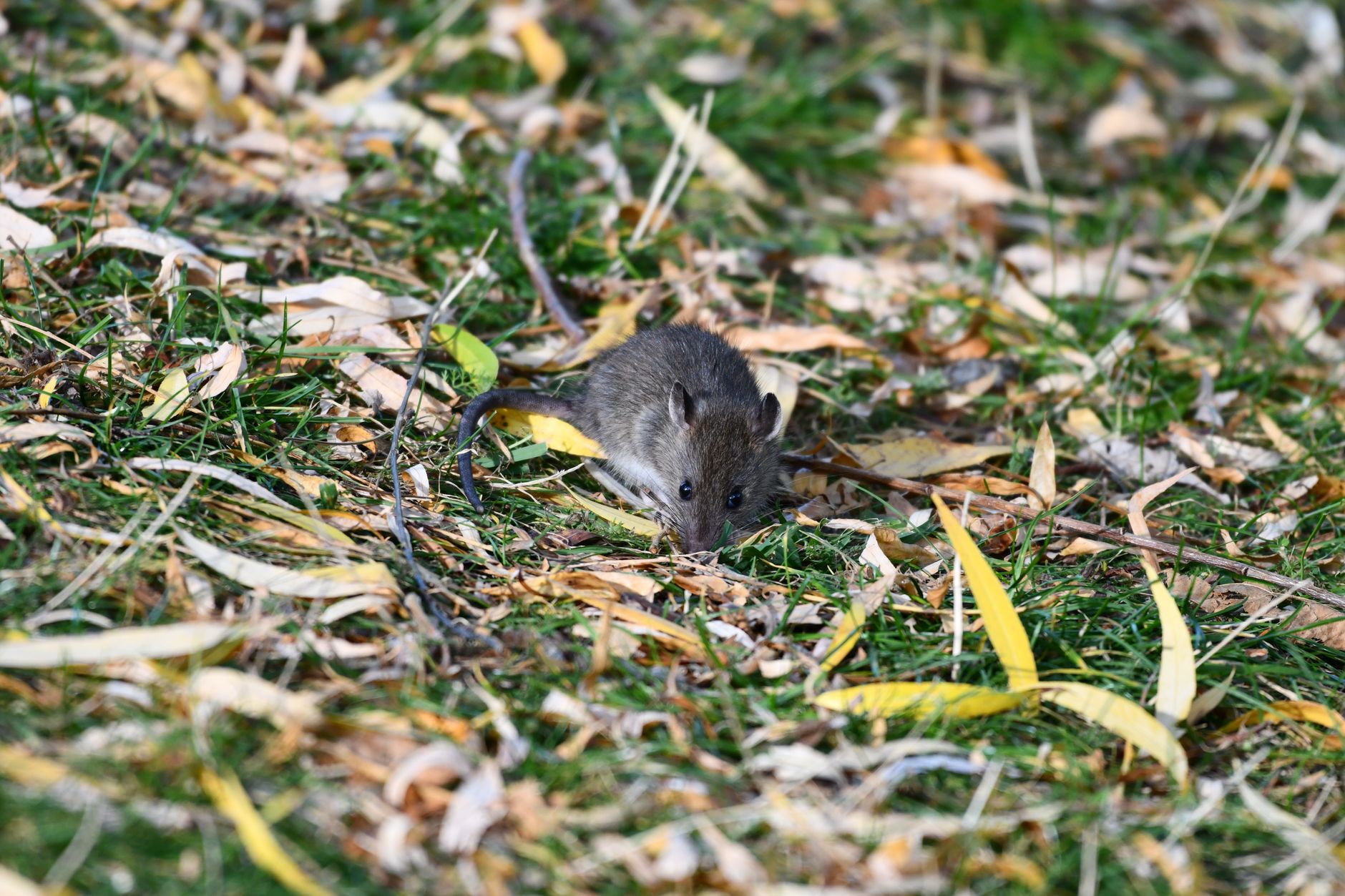 A long-tailed brown rat moving through the grass among dead leaves
Protecting a terrace, a garden or a business
The goal in August and September is not to wipe out the neighbourhood's wasps — that is impossible and ecologically questionable. The point is to make your space less appealing than the one next door.
Remove the sources, not the insects
- Always keep bins and recycling containers closed; rinse cans and bottles before throwing them away.
- Pick up fallen fruit beneath trees, daily if possible.
- Cover dishes and glasses. On a business terrace, mesh insect covers placed over carafes and bread baskets visibly reduce the comings and goings.
- Clean tables immediately after service: a puddle of syrup attracts dozens of workers within an hour.
- Avoid floral perfumes and brightly patterned clothing when eating outdoors — the effect is modest but real.
Traps: to be used with judgement
Sugar-baited wasp traps are effective at diverting the flow of insects away from a dining area, provided they are placed at a distance (8 to 10 metres from the table, never on it) and use a selective bait. The classic recipe combines beer or white wine (a repellent for bees, which cannot tolerate alcohol) with a little syrup or jam. A reusable wasp trap in clear plastic, emptied and rinsed each week, is more than enough; disposable models fill up within days and become counterproductive.
A word of caution: set out in spring, these traps capture large numbers of founding queens but also plenty of non-target insects (solitary bees, hoverflies, butterflies). OPIE and many naturalist organisations advise against early mass trapping. At the end of summer, targeted, temporary use is more defensible.
For professionals: anticipating the duty of care
A restaurateur, a hotelier, a nursery manager or a care-home director has a general duty of safety towards customers and employees. The INRS classifies hymenoptera stings among the biological and physical risks of exposed occupations (green spaces, waste collection, outdoor catering). In practice, this means:
- a visual survey for nests in June, before the colony becomes dangerous: inspection of attics, shutter boxes, terrace false ceilings, dense hedges;
- a written "what to do in the event of a sting" notice displayed in the stockroom;
- identification, within the team, of staff with known allergies;
- a contractor identified in advance for the intervention, rather than an emergency call on a busy Saturday.
Nest destruction: why DIY goes wrong
Every late summer, emergency services treat members of the public who have been stung dozens of times after trying to destroy a nest on their own. The scenarios repeat themselves: an insecticide aerosol emptied into a nest entrance under the roof from a stepladder, an attempt to block the opening, hosing it down, setting it alight.
A nest containing several thousand workers cannot be dealt with from a stepladder, in daylight, without protection. Falling is a risk at least as significant as the stings.
What makes the difference in a professional intervention
- The timing: intervening at dawn or dusk, when almost all the workers have returned. A daytime treatment leaves hundreds of foragers outside, and they will come back and remain aggressive for several days.
- The equipment: a full double-layer suit with a ventilated hood, and a telescopic pole allowing the powder to be injected from a distance without a ladder.
- The product: a delayed-action insecticide powder, deposited at the nest entrance, which the workers carry inside. It is this transfer that kills the entire colony, queen included — a simple contact aerosol only kills the individuals it reaches.
- The follow-up: activity must be nil within 48 hours. A poorly treated nest becomes active again and, above all, hyper-aggressive.
- Removing or neutralising the nest where it is accessible, so that the corpses and larvae do not attract moths, carpet beetles and rodents into an attic.
The cost of an intervention in Île-de-France generally ranges from €80 to €180 depending on accessibility and height. Some municipalities and some fire-and-rescue services (SDIS) now only intervene for nests posing a danger on public property: check with your town hall before assuming the cost will be covered. In apartment buildings, destroying a nest located in a communal area (roof, façade, bin room) is the managing agent's responsibility.
Getting ready for autumn: the nest dies, the queen leaves
Good news for anyone hesitating to intervene in September: a wasp nest is strictly annual. At the first frosts, the entire colony dies. Only the young mated queens survive, overwintering alone under bark, in a woodpile, in a window frame or an attic. They will never reuse the old nest.
That means two things. First, a nest discovered in early October at the bottom of the garden, with no foot traffic nearby, often requires no intervention at all: nature will take care of it. Second, real prevention happens in March and April, when a solitary queen is looking for shelter. At that stage, a fledgling nest is the size of a golf ball and can be removed with no difficulty or danger. It is also the time to deal with entry points: fine mesh over under-roof vents, sealing the gaps around roller-shutter boxes, insect screens on attic windows. A roll of aluminium insect-screen mesh, cut to the size of the vents, permanently solves the problem where insecticide sprays merely postpone the inevitable.
Finally, a word on coexistence. Wasps are not a scourge: an average colony takes several kilos of insects over a season, including many crop pests and fly larvae. A garden insect identification guide helps you tell a German wasp from a solitary bee, a harmless hoverfly or a European hornet within seconds — and to call in an intervention only when it is genuinely needed.
In short: in late August, wasp aggression is not an anomaly but the end of a cycle. Reduce accessible sugar sources, protect tables, keep something to treat a sting within reach, and leave occupied nests to properly equipped professionals. In six to eight weeks, the problem will have disappeared on its own.
Got a pest problem?
Our certified technicians are available 7 days a week. Free quote within 24h.
Read also
- End of wasp and hornet season: why October is the riskiest month, and what to do with the empty nestRead the article
- Wasps and hornets in late September: why colonies turn aggressive just before they dieRead the article
- Aggressive Wasps in September: Why Fallen Fruit in the Garden Triggers Late-Season StingsRead the article