

There is one category of call we receive without fail from the third week of August onwards, and it involves neither bed bugs nor rats. It almost always begins with the same sentence: "For the past few days I've been finding little grey creatures in the bathroom, and I have no idea where they're coming from."
These "little creatures" have names: woodlouse, silverfish (Lepisma saccharina), house centipede, oriental cockroach, sometimes millipede. Zoologically they have nothing in common — the list includes a crustacean, a primitive insect, a myriapod and a cockroach. But they share one absolute physiological constraint: they lose their body water at a dramatic rate in dry air. Their presence is never a sign of poor hygiene. It is a sign of excess water in the building fabric.
And late August, in the Paris region, marks the thermal tipping point that drives all of them out of their hiding places. Understanding that shift is understanding why an insecticide alone never resolves this type of infestation.
 Bedroom with a large bed, bedside table and lit lamps, dark wood flooring
Why it all kicks off in late August and early September
How the dew point works
Through the summer, the air across the Paris region is loaded with water vapour. As long as the walls, slabs and pipes stay at a temperature close to that of the air, that vapour remains… vapour. Nothing happens.
From mid-August, night-time temperatures drop below 15 °C. Buried structures — cellar walls, basement slabs, footings — cool first because they are in contact with ground that never warms beyond 12 to 14 °C at depth. The warm, humid daytime air meets these cold surfaces and reaches its dew point: the vapour condenses into liquid water.
The practical result: a permanent film of water on cellar walls, on the tiling behind a washing machine, on the ceramic cistern of a poorly ventilated toilet. That film is the equivalent of a drinking trough open 24/7 for every detritus-feeding creature in the building.
A €5 hygrometer placed in a cellar tells you more of practical use about a woodlouse problem than three hours spent hunting for a nest. Above 70% relative humidity, the population settles in; below 50%, it disappears on its own.
A simple indoor thermometer and hygrometer left in every suspect room for a week lets you map the problem before treatment is even discussed. Take readings morning and evening: it's the gap between the two that reveals a ventilation fault.
The second trigger: the back-to-school migration
There is a second, more mechanical phenomenon. Species that have spent the summer outdoors — woodlice under flowerpots, oriental cockroaches in drain inspection chambers and crawl spaces — seek out temperate shelter as soon as the nights cool down. They come up through pipework, cellar door thresholds, service ducts and air vents. It's exactly the same calendar as mice, but with a different cast of species.
Identifying exactly what you have
Diagnosis determines everything. Here are the five visitors we most often encounter in basements and wet rooms across the Paris region.
| Species | Scientific name | Appearance | What its presence means |
|---|---|---|---|
| Woodlouse | Oniscus asellus, Porcellio scaber | 10–18 mm, slate grey, segmented shell, 14 legs | Permanent contact damp, often infiltration or rising damp |
| Silverfish | Lepisma saccharina | 8–12 mm, silvery, tapered body, 3 tail filaments | Air above 75% RH, presence of cellulose (paper, wallpaper paste) |
| Firebrat | Thermobia domestica | 10–15 mm, mottled brown | Areas that are hot AND damp: behind ovens, boiler rooms, utility rooms |
| House centipede | Scutigera coleoptrata | 25–35 mm, 15 pairs of long legs, very fast | A predator: its presence indicates a population of prey (silverfish, spiders) |
| Oriental cockroach | Blatta orientalis | 20–30 mm, glossy blackish-brown, cannot climb glass | Sewerage network, cellar, damp crawl space |
Three clarifications that prevent a good many treatment mistakes.
The woodlouse is not an insect. It is a terrestrial crustacean that breathes through pseudo-tracheae requiring constant humidity. It doesn't sting, doesn't bite, transmits no disease and doesn't attack sound timber. It feeds on decomposing plant matter. Finding one indoors means there is damp wood, sodden cardboard or water-soaked render somewhere.
The house centipede is alarming, but it's an ally. This myriapod, resembling a spider with fifteen pairs of legs, is a nocturnal predator of silverfish, small spiders and fly larvae. Its presence is an indicator: if there's a house centipede, there is something for it to eat. Getting rid of it solves nothing.
The oriental cockroach, on the other hand, is a genuine health issue. Unlike the German cockroach, which lives exclusively in heated interiors, the oriental species moves between wastewater networks and communal areas. It mechanically carries enteric bacteria on its legs and body surface. It is the only species on this list that systematically warrants professional intervention.
The silverfish: the bathroom's discreet lodger
The silverfish deserves a section of its own, because it is by far the most frequently reported species in Paris flats.
A biology that explains its longevity
Lepisma saccharina is a primitive wingless insect that appeared long before winged insects. It lives two to eight years, which is remarkable for an insect of that size, and continues to moult throughout its adult life — up to sixty moults. That peculiarity is what makes certain treatments ineffective: a silverfish that has just moulted has a fresh cuticle, temporarily less permeable to desiccant powders.
Its diet is based on polysaccharides: starch in wallpaper paste, cellulose in paper, dextrin in book bindings, but also textile fibres, hair and skin flakes. The damage is real on paper archives, antique books and wallpaper, where it leaves surface-scraped patches and irregular holes.
What actually works against it
The rule is simple: silverfish cannot survive long-term below 50% relative humidity. The whole strategy follows from that.
- Bring bathroom RH below 55%: functioning mechanical ventilation, 10 minutes of airing after every shower, door left open.
- Remove stored cellulose sources: cardboard on the floor, stacks of old magazines, peeling wallpaper.
- Apply a physical barrier of food-grade diatomaceous earth along skirting boards, under the bath and behind storage units. This mineral powder works by abrading the cuticle, with no active molecule, and stays effective as long as it remains dry.
- Set out glue traps for crawling insects along walls for two weeks: it's as much a measuring tool as a capture tool. The number of catches per night tells you whether things are improving.
 Modern bedroom with a bare mattress on the bed, wooden headboard and wall-mounted air conditioner
Tackling the water: the only lasting treatment
Our technicians repeat it at every call-out: against damp-loving pests, insecticide is at best a sticking plaster. If the water stays, the population is back within three to six weeks. Here is the logical order of operations.
1. Find where the water is coming from
Not all damp problems are treated the same way.
| Source | Characteristic sign | What to do |
|---|---|---|
| Condensation | Misted windows, mould at the top of walls and in cold corners | Ventilate, heat, insulate thermal bridges |
| Rising damp | Horizontal tidemark 50–120 cm above the floor, white saltpetre, blistering render | Masonry survey, drainage, resin injection |
| Infiltration | Localised stain, worsens after rain | Fix the external cause (gutter, joint, waterproofing) |
| Leak | Stain that grows regardless of the weather | Trace the leak (plumbing, waste pipes) |
One point often overlooked in older Paris buildings: the mechanical ventilation system. A clogged extract vent loses up to 60% of its airflow. An annual clean of the vents and replacement of blocked grilles is sometimes enough to make silverfish vanish from a bathroom without any product at all.
2. Actively dry out spaces that can't be ventilated
Cellars, basements and windowless utility rooms cannot be dealt with by natural ventilation: opening a basement window on a hot, humid day lets water in, not out. In these spaces, a condensation dehumidifier with a built-in humidistat, set to 50–55%, transforms the environment radically in about ten days. For small spaces (cupboards, under-sink units, chests), refillable moisture absorbers are enough, provided the refills are changed as soon as they're saturated.
Beware one classic trap: a dehumidifier is no substitute for repair. It manages the consequence. If your unit is extracting more than two litres a day in a 20 m² cellar where no laundry is drying, there is a water ingress to identify.
3. Close off the entry routes
Damp-loving pests use very identifiable routes:
- Dry traps. A cellar sink or an unused shower will see its trap evaporate within a few weeks: the water seal disappears, and the pipe becomes a motorway for oriental cockroaches. Pouring half a litre of water once a month into each little-used drain solves the problem at zero cost.
- Pipe penetrations through walls and floors: fill with polyurethane foam then mortar.
- The bottom of cellar and garage doors: a brush strip or door seal stops woodlice, oriental cockroaches and, incidentally, mice.
- Crawl space air vents: keep them open (they dry things out!) but fit them with stainless steel mesh of 5 mm maximum.
4. Clean up the surroundings
Woodlice live outdoors. They come in when you offer them a continuous damp pathway from the garden or courtyard to the building. Three measures are often enough:
- Move piles of leaves, firewood and flowerpots at least 40 cm away from walls.
- Remove thick mulch in direct contact with the footings.
- Check that gutters discharge water away from the façade, not at its base.
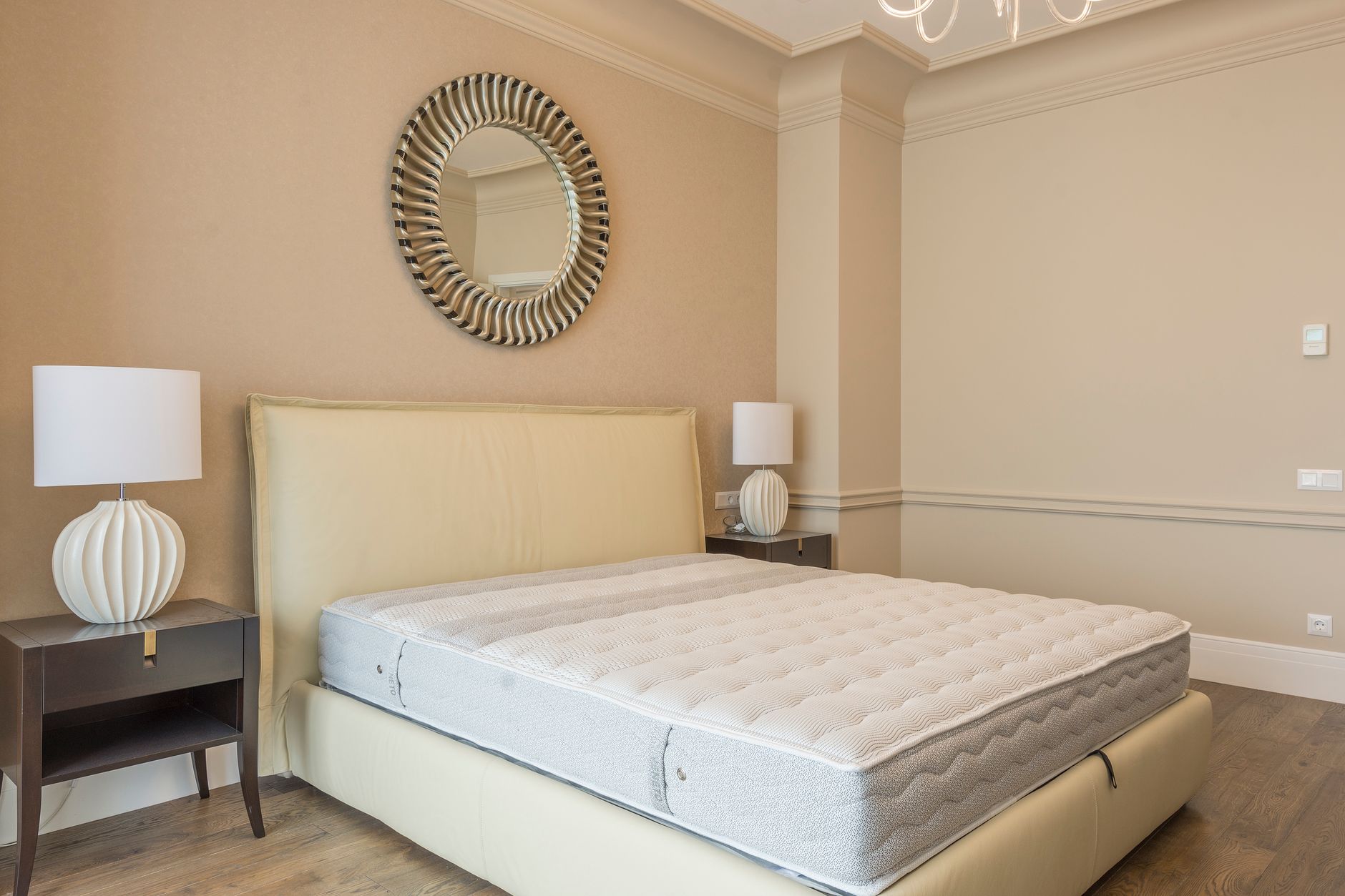 Bedroom with a bare mattress on the bed, bedside tables, lamps and a round mirror on a beige wall
What not to do
A few common reflexes that make things worse or achieve nothing.
Spraying a general-purpose insecticide everywhere. ANSES regularly points out that excessive use of biocidal products indoors exposes occupants — particularly children and people with asthma — for zero benefit when the cause is structural. Woodlice in particular are barely affected by space sprays of pyrethroids: their calcified shell protects them.
Sealing the cellar hermetically "to keep the damp out". This is the most common misconception. A closed cellar sees its humidity level rise, not fall. Ventilation, even modest, remains preferable — ideally night-time ventilation, when the outside air is drier in absolute terms.
Confusing silverfish with bed bugs. This happens more often than you might think in the reports we receive. The silverfish is silvery, tapered, extremely fast and found in wet rooms; the bed bug is brown, flattened, oval and hides within two metres of where you sleep. The two treatments have nothing in common.
Buying ultrasonic repellents. No published study establishes their effectiveness against crawling arthropods. France's consumer protection authority, the Direction générale de la concurrence, de la consommation et de la répression des fraudes (DGCCRF), has in fact already penalised misleading claims about this type of device.
When to call in a professional
Most "woodlice and silverfish" situations are resolved by controlling humidity, with no intervention needed. Three cases, however, warrant a professional survey:
- Confirmed presence of oriental cockroaches in communal areas or coming up through pipework. This is a building-wide problem, handled at managing-agent level, with coordinated treatment of the networks, the bin store and the service risers.
- A population that persists despite relative humidity being held below 55% for several weeks: this generally signals a hidden water source (a leak inside a partition, a flooded crawl space) that an on-site inspection can locate.
- Commercial premises subject to inspection: catering, bakeries, laboratories, healthcare facilities. Pest presence engages the operator's liability, and a documented pest control plan is required during inspections.
A final word on timing. The next four to six weeks are the ideal window: outdoor relative humidity is not yet at its peak, the heating hasn't come on, and populations are migrating rather than established. A dehumidifier switched on in late August produces visible results before the first autumn rains; the same unit plugged in come November will take three times as long.
Treat the water, not the insect: with damp-loving pests, this rule allows virtually no exceptions.
Got a pest problem?
Our certified technicians are available 7 days a week. Free quote within 24h.
Read also
- Boxes Stored in Cellars and Garages: The Pest Reservoir Nobody Inspects Before the HolidaysRead the article
- Clothes Moths: Why Pulling Out Your Sweaters in October Reveals a Six-Month-Old InfestationRead the article
- Firewood Brought Indoors in October: The Trojan Horse for Longhorn Beetles, Bark Beetles, Carpenter Ants and Field MiceRead the article