

There is one category of call we receive all year round, with no seasonality whatsoever, and it almost always opens with a downplaying sentence: "It's nothing serious, it's just ants." Then comes the detail that changes everything: "We've got them in the bathroom, in the electrical sockets, and the neighbour upstairs has them too."
At that point, we're no longer talking about the black garden ant coming up from the pavement in June. We're almost certainly dealing with Monomorium pharaonis, the pharaoh ant: a tropical species that now survives only inside our heated buildings, that completely ignores the seasons, and that has the most disconcerting trait in urban entomology — the worse you treat it, the more it multiplies.
It's a pest that gets very little attention, because it doesn't sting, doesn't transmit any spectacular disease and has never made headlines. Yet it remains one of the longest cases to close in a multi-unit building, and one of the rare ones where amateur intervention can objectively make things worse on a lasting basis.
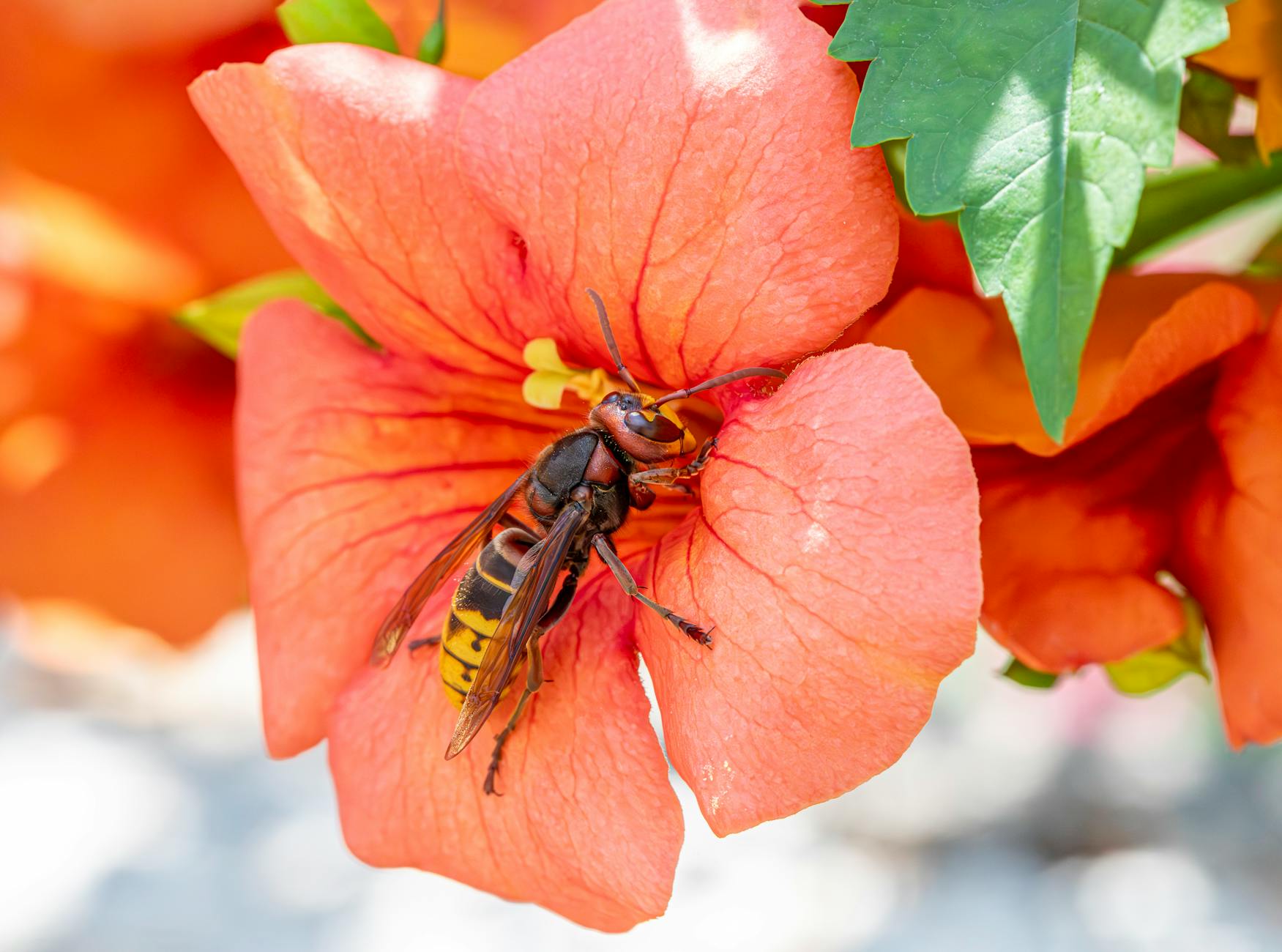 Hornet with yellow and black stripes resting on an orange flower, green leaves in the background
Identifying the pharaoh ant: three unmistakable criteria
A tiny, translucent insect
The first mistake is looking for an ant. The pharaoh ant worker measures 1.5 to 2 mm — barely bigger than a grain of semolina. Its colour ranges from honey yellow to light brown, with an abdomen that is often darker and translucent: held up to the light, you can sometimes make out the contents of its crop after it has fed.
By comparison, the black garden ant (Lasius niger), the one that invades ground-floor kitchens in spring, measures 3 to 5 mm and is distinctly black. The confusion is common and it carries real consequences, because the two species are treated in completely different ways.
| Criterion | Pharaoh ant (Monomorium pharaonis) | Black garden ant (Lasius niger) |
|---|---|---|
| Worker size | 1.5 – 2 mm | 3 – 5 mm |
| Colour | Honey yellow to light brown, translucent abdomen | Uniform brownish black |
| Seasonality | None: active all year round | Peak from April to September |
| Nest | Indoors: partition walls, service ducts, insulation | Outdoors: soil, terraces, joints |
| Number of queens | Several dozen to several hundred | Only one |
| Reaction to a contact insecticide | Colony splintering (budding) | Reduced traffic |
| Visible nuptial flight | No | Yes, summer swarming |
Activity that ignores the calendar
The second criterion is behavioural. If you see ants in January, at 7 a.m., on the edge of a washbasin, you are not dealing with a native species. The pharaoh ant originates from tropical regions — probably South-East Asia, despite a name inherited from an error by Linnaeus, who believed it to be Egyptian. It does not survive a Paris-region winter outdoors.
It does, however, thrive in a building kept at 20–22 °C, with warm service ducts, hot water risers and bathroom humidity. Its optimum is around 30 °C, which it finds inside partition walls, against domestic hot water pipework, behind heated skirting boards or in the insulation of a service void.
Fine, regular trails, often vertical
The third sign is the trail: a column of workers a few millimetres wide, very regular, following a tile joint, the edge of a skirting board, an electrical cable or the outline of a duct. It is often vertical, climbing along a pipe or a wall corner, which disconcerts occupants used to seeing ants on the floor.
A useful observation point: the pharaoh ant loves warm, damp areas. The bathroom, the laundry room, the back of a dishwasher or the area around a water heater are far more common discovery spots than the kitchen.
Why this is a serious problem, not a cosmetic nuisance
A health risk documented in care settings
In a home, the pharaoh ant is first and foremost a nuisance: contaminated food, ants in baby bottles, in dressings, in electronic devices (it is fond of switch boxes and internet routers for their warmth).
But the scientific literature on this species was built up in hospitals, where it has been identified for decades as a mechanical vector of contamination. Its workers move between drains, bins and clean areas, carrying potentially pathogenic bacteria on their cuticle. Several papers published in hospital microbiology have isolated germs such as Staphylococcus, Pseudomonas or enterobacteria from pharaoh ants captured on wards. That is why healthcare facilities treat it as a priority pest, on a par with cockroaches.
In a home, this risk is obviously much lower — but it becomes real as soon as there is an infant, an immunocompromised person, or home care involving dressings.
A species that never stays in a single flat
This is the most important point for a residential building association. The pharaoh ant doesn't recognise property boundaries. A colony established in a service duct supplies workers to every flat served by that duct. It is entirely routine to treat a two-bedroom flat on the fourth floor and discover that the main nest is in the crawl space, two floors below.
Another peculiarity: neighbouring pharaoh ant colonies don't fight each other. Unlike most species, they are unicolonial — workers from two separate nests mingle without aggression. An infested building therefore doesn't host ten rival colonies keeping each other in check, but a single super-organism spread across several levels.
The mistake that costs months: the insecticide spray can
Budding, or how to multiply a colony by spraying it
Here is the mechanism every occupant should understand before buying anything.
A pharaoh ant colony has several queens — sometimes more than two hundred in a mature population. When it perceives a chemical or physical attack on part of the nest, it triggers a survival response known as budding: a group of workers carries off eggs, larvae and one or more queens, and goes off to found a satellite nest a few metres away — in another partition wall, another floor, another flat.
The concrete outcome: a tenant empties an aerosol can over the trails on a Saturday. By Monday, the ants are gone. Three weeks later, there are ants in two additional rooms, and the neighbour across the landing is calling the building manager.
No contact insecticide — aerosol, powder, "ant-specific" spray, fogger — should ever be used against the pharaoh ant. This is a textbook case where consumer treatment is counterproductive, and where the initial failure adds months to the job.
Home remedies don't work either
White vinegar, lemon, chalk, coffee grounds or essential oils act at best as trail disruptors: they temporarily erase pheromone traces. Workers rebuild a route within a few hours. On a species with indoor nests and multiple queens, this has absolutely no effect on the population.
Diatomaceous earth, often recommended, poses a different problem: it is repellent. A pharaoh ant that encounters a diatomaceous barrier doesn't cross it — it goes around, taking a new route, sometimes through the party wall. You're just moving the problem.
 Close-up of a hornet with yellow and brown markings resting on a piece of wood
The only effective strategy: slow-acting baiting
The principle of trophallaxis
The recognised method against Monomorium pharaonis rests on a simple principle: don't kill the worker, use it as a carrier.
Ants practise trophallaxis — the mouth-to-mouth exchange of regurgitated food. A worker that consumes bait returns to the nest and feeds its nestmates, the larvae and the queens. If the active ingredient is slow enough (several hours to several days before any visible effect), the product spreads throughout the entire colony before the workers die.
Two families of active ingredients are classically used by professionals in this context:
- insect growth regulators (IGRs), such as methoprene or pyriproxyfen, which sterilise the queens and block brood development;
- low-dose delayed-action toxicants, such as boric acid or hydramethylnon, which kill the whole colony once distributed.
ANSES, through the biocidal products market authorisation framework (European Regulation No. 528/2012), oversees the approval of these formulations. It's worth checking that a product bought in a supermarket does carry a market authorisation number printed on the packaging.
What matters as much as the product: placement
In a flat, a successful baiting campaign rests on three rules.
1. Multiply the bait points, and never let them run out. An ant gel bait should be applied in small drops (about the size of a grain of rice) directly on the trails, not at random: along skirting boards, at pipe penetrations under the sink, behind the washing machine, in the corners of the bathroom. Allow for ten to twenty points in a flat, and check them every two days. Any bait that has been consumed must be replenished immediately — a break in supply breaks the cycle.
2. Alternate sweet and protein baits. A colony's nutritional needs vary with the stage of the brood. It is common for a sweet gel to be ignored while a fatty or protein-based bait is attacked within minutes — or the other way round. Placing both types side by side, in the same spots, markedly increases uptake.
3. Suspend aggressive cleaning around the bait points. Detergents, and especially scented products, erase pheromone trails and divert workers away from the bait. For the duration of the treatment, clean the rest of the home as usual, but leave the 30 cm around each deposit alone.
Count in weeks, not days
This is psychologically the hardest part. With correct baiting, you generally observe:
| Timeframe | What you see |
|---|---|
| Days 1 to 3 | Apparent increase in traffic: workers are recruiting towards the bait. That's a good sign. |
| Days 4 to 10 | Traffic stable, then gradually declining |
| Weeks 2 to 4 | Sharp drop in the number of visible workers |
| Weeks 5 to 10 | Brood dies out, last trails disappear |
| Month 3 | Essential verification check |
The day-2 increase panics a lot of people, who give up and reach for the aerosol again. That is precisely the moment when the only thing to do is top up the bait points.
Cutting off resources: what prevents re-establishment
A treatment that isn't backed up by work on the environment ends in recolonisation. Three tasks, in order of effectiveness.
Water before food
The pharaoh ant needs constant moisture. Slow leaks are its best ally: a cracked bath seal, a weeping trap, condensation under a water heater, the base of a hot water riser. Redoing the seals with sanitary sealant and drying out damp areas often does more damage to a colony than a week of gel bait.
Food storage
Sugar, honey, cereals and fatty foods are targeted as a priority. An ant 1.5 mm long slips under a badly tightened screw lid and under cling film. Transferring sensitive foodstuffs into airtight storage containers — sugar, flour, biscuits, pet kibble — removes the most rewarding resource for the colony. Pet bowls left full overnight are a classic case: take them away and wash them every evening.
Routes of passage
Ants travel through the building's infrastructure: pipe penetrations, electrical chases, ducts, skirting board joints. You can't seal everything, but you can sharply limit traffic between flats by filling the openings around pipes. An acrylic filler or silicone sealant applied with a cartridge gun around pipe penetrations under the sink and behind the toilet is a fifteen-minute job with lasting impact.
 Asian hornet with yellow legs and a black and orange abdomen, photographed in profile against a white background
In a shared building: treating one flat alone is pointless
The adjacent-units rule
Given the species' unicoloniality and its movement through service ducts, a treatment limited to a single unit has no chance of succeeding if the building is structurally infested. The minimum reasonable perimeter includes:
- the reporting flat;
- the two adjoining flats on the same landing;
- the flats above and below (shared service risers);
- the relevant common areas: bin store, bike store, boiler room, crawl space, landing ducts.
Who pays for what
The subject comes up systematically at general meetings. In practice:
- when the infestation is confined to a private unit and linked to how it is used (food, hygiene), the cost falls to the occupant;
- when it travels through the common areas — ducts, risers, crawl spaces, bin store — the intervention falls to the building manager, funded from the building association's budget.
It's worth recalling that Decree No. 2002-120 of 30 January 2002 on decent housing requires the absence of infestation by pests and parasites, and that the ELAN Act strengthened this requirement on the landlord's side. A tenant facing an infestation of collective origin therefore has a clear legal basis for approaching their landlord and, in the event of inaction, the departmental conciliation commission.
The useful reflex: document everything. Dated photos, a record of the rooms affected, letters to the building manager or landlord sent by recorded delivery. A properly assembled file is what tips a request for intervention over the line at a general meeting.
What a professional genuinely brings to this case
With many pests, a well-executed DIY approach delivers results. With the pharaoh ant, calling in a professional is justified for three specific reasons:
- Identification. Mistaking Monomorium pharaonis for Lasius niger leads to a completely unsuitable protocol. A check under an entomological loupe settles the question in thirty seconds.
- Access to IGR formulations. Gels containing growth regulators designed to sterilise queens are largely restricted to professional use.
- Mapping the building. Locating the main nest means following trails inside ducts, opening service hatches, inspecting crawl spaces and installing monitoring devices across several levels — none of which an occupant can do alone.
One benchmark when choosing: since 1 January 2023, the professional application of biocidal products requires the Certibiocide certificate, and the company must be registered with the French Ministry for Ecological Transition. Asking for the registration number is entirely legitimate.
Key takeaways
- The pharaoh ant is pale yellow, measures 1.5 to 2 mm, lives inside heated buildings and is active all year round, including in the depths of winter.
- It has several dozen queens and spreads by budding: any contact insecticide multiplies the colonies.
- The only effective protocol is slow, multi-point baiting, alternating sweet and protein formulations, maintained without interruption for six to ten weeks.
- Drying out leaks, storing food airtight and sealing pipe penetrations are what determine whether the ants come back.
- In an apartment building, treatment must cover adjacent flats and common areas; an isolated action is a failure waiting to happen.
If you spot columns of very small, pale ants in winter, in a bathroom or around a water heater, don't reach for the aerosol: note the routes, photograph them, and have the species identified before taking any action. With this particular pest, that is the decision that makes the difference between a case closed in two months and a building that drags the problem out for years.
Got a pest problem?
Our certified technicians are available 7 days a week. Free quote within 24h.
Read also
- Boxes Stored in Cellars and Garages: The Pest Reservoir Nobody Inspects Before the HolidaysRead the article
- Firewood Brought Indoors in October: The Trojan Horse for Longhorn Beetles, Bark Beetles, Carpenter Ants and Field MiceRead the article
- Clothes Moths: Why October Is the Month They Ruin the Woollens You've Just UnpackedRead the article