

The call usually comes three to five weeks after moving in, and the story is always framed the same way: "the place was empty, freshly painted, spotless — we didn't see a thing at the viewing. And now we're waking up covered in bites." Sometimes it's cockroaches behind the hob, sometimes moths in the walk-in wardrobe. The common thread: the tenant or owner is convinced the problem comes from the building.
In most of the cases we handle in autumn, it comes from the boxes.
October is a month of mass relocation: leases ending, job transfers, separations, late student arrivals, property purchases signed over the summer. It's also when people pick up second-hand furniture to kit out a home quickly and cheaply. Technically speaking, a house move is the ideal situation for a pest: you're offering it free, sheltered transport to virgin territory, with no competition and no treatment under way.
An adult bed bug survives several months without a blood meal; its eggs, glued into a groove in wood or a fold of cardboard, remain viable and hatch in the new home. That's why a house move never "leaves" an infestation behind: it relocates it, with a two- to six-week lag that obscures the cause-and-effect link.
This article sets out what we check before a move, how to pack so that nothing travels with you, and which quarantine protocol to apply on arrival.
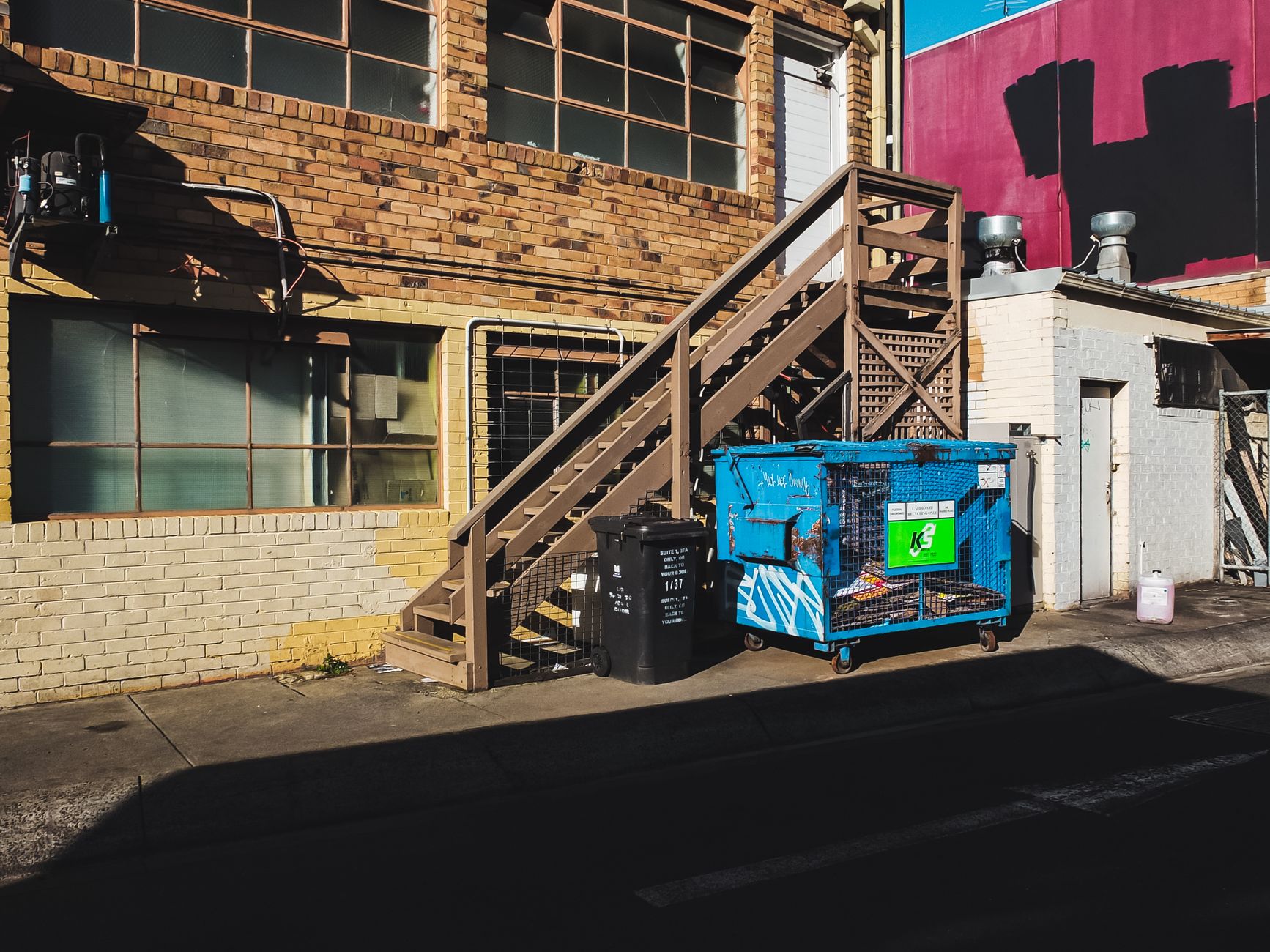 Blue dumpster and black wheelie bin in an alleyway at the foot of a wooden staircase
Which species actually travel during a house move
Not all species hitch a ride the same way. Identifying the vectors saves you wasting time on the wrong measures.
| Species | Main vector | Where it hides during transport | Time before detection in the new home |
|---|---|---|---|
| Bed bug | Mattresses, bed bases, headboards, sofas, books, removed skirting boards, suitcases | Grooves in wood, seams, bed-base screws, corrugated cardboard | 2 to 6 weeks |
| German cockroach | Appliances, food boxes, electronic devices, packed crockery | Motor compartment, circuit boards, cardboard flutes | 1 to 4 weeks |
| Clothes moth | Woollen textiles, rugs, coats, cushions | Eggs and larvae in fibres, hems, linings | 1 to 3 months |
| Pantry moth | Kitchen cupboards: flour, rice, dried fruit, pet seed | Pierced packaging, opened bags | 3 to 8 weeks |
| Mice | Rare, but possible via storage units and lock-ups | Boxes kept in storage for long periods, upholstered furniture | Immediate to a few days |
Corrugated cardboard deserves a special mention. Its fluted structure offers dark galleries 3 to 5 mm wide, insulating material and a rough surface to which bed bug eggs adhere perfectly. A box salvaged from behind a supermarket, stored in a stockroom or a bin store, is a documented vector for German cockroaches. It's one of the most expensive savings you can make on a move.
Step 1 — Survey the home you're leaving, not the one you're moving into
The rule is counter-intuitive: the serious inspection takes place in the property you are leaving, two to three weeks before the move-out date. That's where you can still act without contaminating anything.
The useful checkpoints, in order:
- The bed, dismantled. Remove the mattress, turn the base over, unscrew the headboard. You're looking for pinpoint black stains (droppings), translucent shed skins, and white 1 mm eggs in grooves and screw heads.
- Seating. Sofa, armchairs, floor cushions: go through the seams and under the webbing.
- Skirting boards and wall sockets in the bedroom, within 1.5 m of the bed.
- The kitchen. Behind the fridge, under the dishwasher, in the recesses of wall units, and above all around appliance motors.
- Textile cupboards. Wool coats, jumpers stored away since winter: look for silken galleries and the irregular holes typical of Tineola bisselliella.
For bed bugs, placing bed bug detector traps under bed and sofa legs three weeks before departure gives you objective information, where a single visual inspection always leaves room for doubt. It's an investment of a few euros that determines everything that follows: move as things stand, or treat first.
In its recommendations on bed bug control, France's Haut Conseil de la santé publique stresses this principle: a treatment started in a property that is in the process of being emptied has a far better chance of succeeding than one carried out after the furniture has been scattered across two addresses. In other words, the worst possible time to move is in the middle of an untreated infestation.
If the property you're leaving is infested
Only two scenarios are honest:
- Postpone moving the at-risk furniture and have the property treated while still furnished. Bed bug treatment generally requires two visits two to three weeks apart; half-emptied rooms make the job less effective, not more.
- Give up on the contaminated furniture. A divan base, an upholstered headboard or a heavily infested fabric sofa almost never justify the cost and risk of transport. They go to the tip, wrapped and sealed, with visible labelling to prevent anyone salvaging them from the street — that's exactly how infestations jump from one building to the next.
In either case, notifying the landlord in writing is not a mere formality. Under the ELAN Act and Article 6 of the Act of 6 July 1989, rented accommodation must be free of infestation by pest species and parasites when the keys are handed over. A move-out inventory that records the problem also protects the next tenant.
Step 2 — Pack so that nothing travels with you
Packing is the only moment at which you genuinely control what passes from one home to the other.
Ban salvaged cardboard. New boxes only, or rigid plastic crates with clip-on lids — reusable and easy to inspect. Plastic storage crates with lids offer three advantages: no fluting, a smooth surface a bed bug cannot lodge in, and a closure that is genuinely insect-proof against crawling pests.
Textiles go through the washing machine or tumble dryer. This is the most effective and least expensive step in the whole protocol. The figures cited by ANSES and Assurance Maladie (Ameli) are consistent: 30 minutes at 55–60 °C in a tumble dryer kills every life stage, eggs included. A 60 °C wash does the same job. For items that can't be washed (wool, leather, down jackets), the freezer at -18 °C for 72 hours in a sealed bag is the fallback.
The sequence to follow, without exception:
- Sorted laundry → wash/tumble dry → plastic bags sealed immediately → transport → opened only in the vetted destination property.
- Never put treated laundry back down on a bed, sofa or floor in the property you're leaving.
- Label the bags "treated" so you don't mix them up on moving day, when everything happens fast.
Books and papers are a blind spot. Bed bugs lay eggs in the spines of bindings and between glued pages. A bookcase coming out of an infested bedroom is treated box by box, or placed in extended quarantine. Large freezer bags are genuinely useful here.
Appliances travel with the casing open. Before loading a fridge or built-in oven, remove the rear grille, vacuum the motor compartment and inspect the circuit board. That is precisely where German cockroaches survive transport, sheltered from any surface insecticide. A powerful handheld vacuum cleaner with a narrow nozzle, reserved for this purpose and emptied into a sealed bag outdoors, avoids scattering eggs and droppings.
 Two wheelie bins, one green and one white, standing against a light-coloured wall at the roadside
Step 3 — Second-hand furniture, the main risk when moving in
Furnishing an empty home naturally pushes people towards peer-to-peer selling sites, flea markets and bulky waste left on the pavement. Statistically, this is the second most common way bed bugs enter a clean home, just after travel.
The risk hierarchy is clear:
| Type of furniture | Risk level | Sensible decision |
|---|---|---|
| Second-hand mattress, divan base | Very high | Avoid without exception |
| Fabric sofa, armchair | High | Only if a full inspection is possible |
| Wooden bed, frame, headboard | Medium to high | Dismantling and inspection of grooves essential |
| Chest of drawers, bookcase, table | Medium | Inspect drawers, backs and joints |
| Metal, glass or plastic furniture | Low | A simple clean is enough |
The one habit that changes everything: never take a second-hand item of furniture straight into the bedroom. It stays in the hallway, the garage or on the balcony, dismantled if possible, until it has been inspected with a torch. A narrow-beam LED torch reveals shed skins and eggs in grooves far better than a ceiling light — professionals never work any other way.
And a simple principle, as true in the Paris region as anywhere else: a mattress dumped on the pavement is very likely there for a reason. Picking it up means signing up for an €800 treatment to save €200.
Step 4 — Quarantine on arrival
A new or empty property is a health asset: no eggs, no harbourage, no established resistance. Protecting it during the first four weeks costs very little.
On moving day:
- Inspect the empty property before unloading: skirting boards, cable ducts, under the sink, bathroom seals, ventilation grilles. Photograph any evidence — that's your proof that the problem pre-dated your arrival, as far as the landlord is concerned.
- Unload into a single buffer zone (hallway, living room) rather than scattering boxes through every room.
- Open and empty the boxes in that zone, then remove the empty boxes from the property immediately. An empty box stored in a cupboard for a month is a harbourage, not storage.
The first two weeks:
- Protect the new or cleaned mattress with a full bed bug mattress encasement with a full-length zip. It does two things: it prevents the mattress being colonised, and it makes any bed bug immediately visible against the white fabric.
- Leave the detector traps under the bed legs for another month. A detection at three weeks is resolved in a single visit; at six months, it requires a full treatment of the property.
- In the kitchen, transfer flour, rice, pasta, dried fruit and pet food into airtight glass jars. This is the only measure that keeps pantry moths at bay for good: an original paper bag may already contain eggs at the point of purchase, and the moths chew through thin plastic.
- Fit rodent-proof mesh over low air inlets if the property is on the ground floor, in a basement or above a cellar.
After one month, carry out a final inspection: mattress seams, bed legs, behind the fridge, textile cupboards. If nothing shows up, the move has been a clean one.
What we most often see go wrong
Three mistakes crop up in almost every post-move case.
- Treating the new property "as a precaution" with off-the-shelf products. Spraying insecticide in a clean home provides no useful preventive protection and needlessly exposes the occupants. ANSES regularly points out that misused aerosol products — and above all banned products circulating outside legal channels, several serious cases of which were flagged by health authorities in 2026 — pose a genuine health risk. Prevention relies on mechanical means (heat, cold, vacuuming, sealing), not on chemistry.
- Mixing "treated" and "untreated" boxes on moving day, under time pressure. Hence the value of clear labelling and a separate loading area.
- Waiting to see several insects before calling. A two-week delay on an emerging infestation multiplies the number of harbourages and the cost of treatment. A bed bug found in a home you moved into a month ago is almost never alone — but it is still very easy to eradicate.
In summary
| When | Key action |
|---|---|
| 3 weeks before | Inspect the property you're leaving + fit detector traps |
| 2 weeks before | Decide: treat, postpone, or give up the at-risk furniture |
| 1 week before | Wash/tumble dry all textiles, seal in bags |
| Moving day | New boxes, vacuumed appliances, buffer zone on arrival |
| Week 1 | Full unpacking, empty boxes removed, mattress encasement fitted |
| Weeks 2 to 4 | Monitoring via traps, airtight jars in the kitchen |
| Week 4 | Final check inspection |
A well-managed house move is one of the rare opportunities to start from scratch in hygiene terms: the furniture is dismantled, the textiles are washed, every single item is handled once. That is exactly what a conventional treatment can never offer. But the decisions have to be made before the boxes, not after the first bites.
Concerned about the home you're leaving or the one you're moving into? A pre-move survey costs a fraction of a curative treatment — and saves you from moving a problem to two addresses instead of one.
Got a pest problem?
Our certified technicians are available 7 days a week. Free quote within 24h.
Read also
- Firewood Brought Indoors in October: The Trojan Horse for Longhorn Beetles, Bark Beetles, Carpenter Ants and Field MiceRead the article
- Clothes Moths: Why October Is the Month They Ruin the Woollens You've Just UnpackedRead the article
- Move-Out Inspections and Pests: Who Pays What Between Tenant and Landlord (2026 Guide)Read the article