

The call never starts with the building work. It starts with a sentence of sheer bewilderment: "We've lived here for eleven years, we've never had a single rodent, and for the past three weeks there have been droppings in the bike store and something running around in the false ceiling of the entrance hall." Then, almost without fail, the same question back from us: "Is there any construction work on your street?" And then, silence. "Ah… yes. They opened up the road at the beginning of September for the gas mains. But that's got nothing to do with it, it's fifty metres away."
It has everything to do with it. Fifty metres is the bullseye. An adult brown rat (Rattus norvegicus) normally lives within a radius of 30 to 50 metres of its burrow, and only ventures further when forced to. A trench, a demolition, a sewer cleaning operation or the clearing out of cellars ahead of a façade renovation are precisely that kind of force.
A displaced brown rat colony does not disappear: it redistributes itself. Scattered individuals search within a widened radius of 150 to 300 metres for a new harbourage offering the same three resources — water, food and quiet darkness. In a dense urban fabric such as the Paris region, that almost invariably means the bin rooms, cellars and crawl spaces of the adjoining buildings.
This article describes the actual mechanism behind this transfer of infestation, the two-to-four-week timeline that stops residents from making the connection, the clues that allow the origin to be confirmed, and above all the concrete levers — technical and legal — available to a managing agent, a landlord or a tenant faced with a neighbouring worksite.
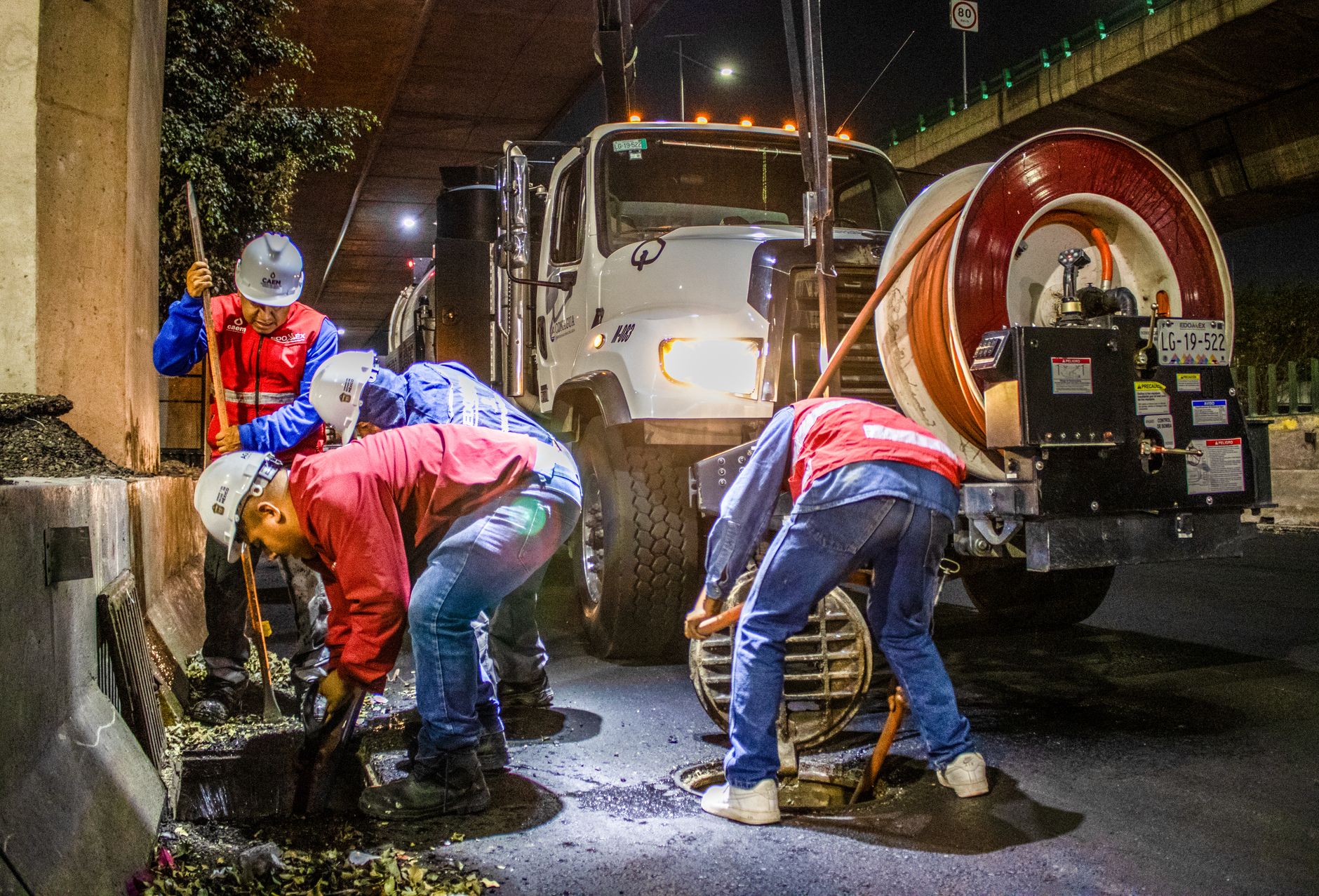 Workers in hard hats opening a manhole at night, next to a sewer-jetting truck
Why a worksite displaces rodents rather than killing them
The common assumption is that construction work "scares pests away" and that this is actually good news. The opposite is true: the worksite destroys the harbourage but not the population, and it sets in motion animals that had until then been settled and invisible.
Five types of operation are particularly implicated in the urban environment of the Paris region.
| Type of work | What is destroyed or disturbed | Typical lag before neighbours notice |
|---|---|---|
| Road trench (gas, water, fibre, district heating) | Burrows under the pavement, galleries running alongside utility lines | 10 to 25 days |
| Cleaning or rehabilitation of a sewer main | Harbourages on sewer benching, underground colonies | 5 to 15 days |
| Demolition of a building or warehouse | Nests in crawl spaces, partition walls, raised floors | 3 to 10 days |
| Façade renovation involving cellar clearance and scaffolding | Cellar harbourages, plus the creation of a vertical route | 2 to 6 weeks |
| Refit of commercial premises (restaurant, convenience store) | Nests behind refrigeration units, food sources | 7 to 20 days |
The demolition mechanism is the most brutal: the population is evicted within a few hours. The façade renovation mechanism is more insidious. Scaffolding displaces nothing, but it provides a continuous structure between the ground and the roofs, with footholds every two metres. A black rat (Rattus rattus), a far better climber than the brown rat, finds it a motorway. Protective sheeting adds shelter and shade.
The aggravating factor of autumn
All this unfolds in October against an already strained backdrop. Night-time temperatures drop, outdoor food becomes scarce, and rodents naturally begin their seasonal movement towards heated buildings. Construction work right at the start of the winter influx does not create the phenomenon: it accelerates it and concentrates it on a handful of addresses.
The two to four weeks that blur everything
This is the most important point for understanding why nobody makes the connection. The lag between the start of the work and the first visible signs at the neighbours' is not immediate, for three cumulative reasons.
First, prospecting comes before settling in. A displaced rodent explores at night for several days without taking up residence. At that stage there is no evidence at all: no clustered droppings, no noise, no smell.
Second, the first harbourages chosen are not the ones you can see. The bin room, the crawl space, the service riser and the cellar footings are occupied well before any visible areas. A managing agent generally receives the first reports only once the colony saturates these zones and pushes subordinate individuals up towards the flats.
Third, breeding does the rest. A female brown rat can produce 5 to 6 litters a year, of 6 to 12 young each, with sexual maturity reached at around 10 to 12 weeks. Two or three pairs that settle in during September produce a distinctly noticeable presence by November.
The result: as far as residents' perception goes, the infestation appears "overnight", three to four weeks after an event nobody is talking about any more.
Confirming the origin: the six-point survey
Before taking anything up with a project owner or an insurer, you need documentation. A solid file rests on six factual elements, which can be gathered in an hour.
- The worksite start date. It appears on the highway permit displayed on site (street works permit, traffic order) or on the planning permission board. Photograph it: it carries the project owner's registered name and the dates.
- The exact distance. Measured, not estimated. Beyond 300 metres the link becomes hard to sustain; under 100 metres, it is highly likely.
- The date of the first signs at your address. Note it down, even approximately, and keep the residents' messages that corroborate it.
- The nature of the evidence. Droppings (3 to 5 mm for a mouse, 15 to 20 mm and spindle-shaped for a brown rat), grease marks along skirting boards, gnawing on ducting and doors, burrows at the foot of walls on the courtyard side.
- Suspected entry points. Cellar ventilation grille, basement window, unsealed pipe penetration, dried-out floor gully, lift shaft.
- Dated photographs. Automatic phone timestamp, with a recognisable contextual feature in the frame.
For areas where you can see nothing but can hear something — the hall's false ceiling, a service riser, a loft slope — an infrared wildlife motion detector provides far more convincing proof than testimony: it dates and locates the night-time runs. Simply dusting 30 cm of skirting board with talc or flour and photographing it in the morning also works very well for revealing tracks.
Telling mice and rats apart straight away
This distinction changes the diagnosis. An influx of house mice in October is most often a normal seasonal movement from inside the building fabric or from green spaces. A sudden arrival of brown rats at basement level, with burrows and bulky droppings, points very strongly to the displacement of an outdoor colony — and therefore to a cause of the worksite or sewer type.
| Criterion | House mouse | Brown rat |
|---|---|---|
| Dropping | 3–5 mm, scattered grains | 15–20 mm, spindle-shaped, clustered |
| Initial location | Kitchens, partition walls, upper floors | Basement, bin room, courtyard |
| Outdoor sign | Rare | 6–9 cm burrow at the foot of walls |
| Likely origin in October | Internal movement / garden | Sewer, roadworks, neighbouring worksite |
What the regulations entitle you to demand
This is the aspect most residents' committees overlook, and it is far more favourable than people think.
The obligation to carry out rodent control beforehand. Many French departmental public health regulations, following on from the model Departmental Sanitary Regulation (circular of 9 August 1978, the articles on rodent control), require the project owner to arrange rodent treatment before any demolition, earthworks or operation liable to displace rodents. In Paris, this requirement is set out in the specifications of the Service Parisien de Santé Environnementale (SPSE) and is a condition of certain authorisations. In practical terms: a worksite that opens up the ground without a prior rodent control certificate is in breach.
The owner's general maintenance obligation. Article 1719 of the French Civil Code and Decree no. 2002-120 of 30 January 2002 on decent housing require the landlord to provide accommodation free from infestation by pests and parasites. The Act of 6 July 1989, as amended by the ELAN Act, has strengthened this reading: the arrival of rodents in privately held parts of a building is not automatically the tenant's fault.
Abnormal neighbourhood nuisance. Codified in Article 1253 of the Civil Code since the Act of 15 April 2024, it allows action against a neighbour — including a contractor or a project owner — whose activity causes damage exceeding the normal inconveniences of neighbourhood life. A documented, dated infestation linked to an identified worksite falls within this framework.
The steps, in order
- Written report to the managing agent (or to the landlord), with the six-point survey attached. Registered letter or email with read receipt.
- Letter from the managing agent to the project owner, requesting disclosure of the certificate of rodent control carried out before the works. This is the document that unlocks everything.
- Referral to the municipal hygiene and health department (SCHS) at the town hall, or to the regional health agency where there is no SCHS. In Paris: the SPSE.
- A quotation from a Certibiocide-certified firm for treatment of the common parts, to be put to a vote at the general meeting or commissioned urgently by the managing agent under the duty to preserve the building.
- Notification to the building's insurer: since 2026, several multi-risk policies have included a "pest" cover, a point noted by the 2026 Ipsos study on the average cost of infestations in France.
Protecting your building while the work goes on
Curative treatment is a job for a professional — bait in secured stations, mechanical trapping in food areas, documented monitoring. But physical exclusion is in your hands, and it is what determines the final outcome. Baiting without sealing up merely creates a vacancy.
Priority points to address, working from the ground up:
- Basement windows and cellar grilles. Replace plastic or corroded grilles with a stainless steel grille with a mesh of 6 mm maximum. A brown rat can get through a 2 cm opening.
- Pipe penetrations. Pack them with stainless steel wool, then seal with mortar. Polyurethane foam on its own is gnawed through in a single night.
- Bottoms of bin room and bike store doors. Fit a metal threshold strip or an aluminium door bottom with a brush seal; the maximum acceptable gap is 6 mm.
- Cellar floor gullies. Keep them water-filled; a dried-out trap is an open door onto the sewer system.
- Compost bin, container store, tree pits. Remove every accessible food source for the duration of the works, and switch waste to bins with lockable lids if the store is shared.
- The base of the scaffolding. Ask the contractor to fit protective plates at first-platform level and to clear away rubble and food waste daily.
For cellars and plant rooms, a humidity detector and a few steel mechanical rodent traps, checked daily, let you measure how things are developing rather than simply suffer it. One caveat, however: mechanical trapping in common parts must be signposted and kept out of reach of children and animals, and it is no substitute for a professional control plan once the population is established.
For individual households in flats above suspect premises, a set of stainless steel ventilation grilles screwed over the low-level kitchen and bathroom vents takes care of an entry point nobody ever looks at, in twenty minutes.
The ten-day window you must not miss
There is a moment when the problem is sorted out for a few hundred euros, and a moment when it costs several thousand. The dividing line falls around the tenth day after the first clear signs.
Before that: the established population consists of a few individuals, with no litters and no structured burrows. Targeted treatment of the common parts plus sealing of entry points is generally enough in two visits.
After three to four weeks: breeding has begun, harbourages are multiple, and treatment becomes a three-to-six-month control plan with monitoring, sometimes accompanied by a requirement to investigate the drainage system. It is also the point at which the expensive collateral damage appears — gnawed electrical ducting, soiled insulation, the smell of a carcass inside a partition wall.
A report of rodents in the common parts must never wait for the next general meeting. Under Article 18 of the Act of 10 July 1965, the managing agent has the power to commission the urgent measures necessary to preserve the building. A rat infestation is one of them.
And on the health risks, the reminder remains worthwhile: commensal rodents are vectors of leptospirosis — Santé publique France records several hundred cases a year in mainland France — of salmonellosis and of indirect contamination through urine and droppings. Any wound sustained in soiled premises warrants medical advice, and immediate washing with soap and water followed by disinfection is the baseline. The Ameli factsheets and the ANSES recommendations on the use of anticoagulant rodenticides also serve as a reminder of why buying products in supermarkets and scattering bait loose is both ineffective and dangerous for children, pets and predatory wildlife.
In summary
Nearby construction work is no coincidence: it is the first hypothesis to check when a rodent infestation appears with no explanation in a building that has been trouble-free for years. Record the date, the distance and the nature of the evidence. Ask the project owner for the certificate of rodent control carried out before the works — it is often legally required and rarely produced. Seal up before you bait. And act within ten days, because it is that interval, not the number of rats, that determines the final cost of the affair.
If you notice signs in the common parts or in commercial premises in the Paris region, an on-site survey with identification of entry points and a documented control plan is the only response proportionate to an infestation of external origin.
Got a pest problem?
Our certified technicians are available 7 days a week. Free quote within 24h.
Read also
- Dead animal smell in a wall: how to locate and remove a dead rodent inside a partitionRead the article
- Closing Up Your Holiday Home in October: 9 Checks That Stop You Finding a Nest of Rodents in SpringRead the article
- Voles, Wood Mice and Water Voles in the Garden: Why October 2026 Is the Month They Move from the Vegetable Patch into Your HomeRead the article