

There is one moment in the year when our switchboard changes rhythm overnight: the last week of August. Calls about bed bugs and cockroaches don't disappear, but they are drowned out by a single question, repeated a hundred times over: "there's a wasp nest right above the front door, we can't go outside anymore." And every single time, the same remark: "yet in June, there was nothing there."
That's true. In June, the nest already existed — but it was the size of a golf ball and housed some thirty discreet workers. By September, that same nest holds several thousand individuals, it's the size of a rugby ball, and the colony is entering its terminal phase: the most unpredictable one. Understanding this biological tipping point is understanding why the end of the season is by far the most accident-prone period of the year.
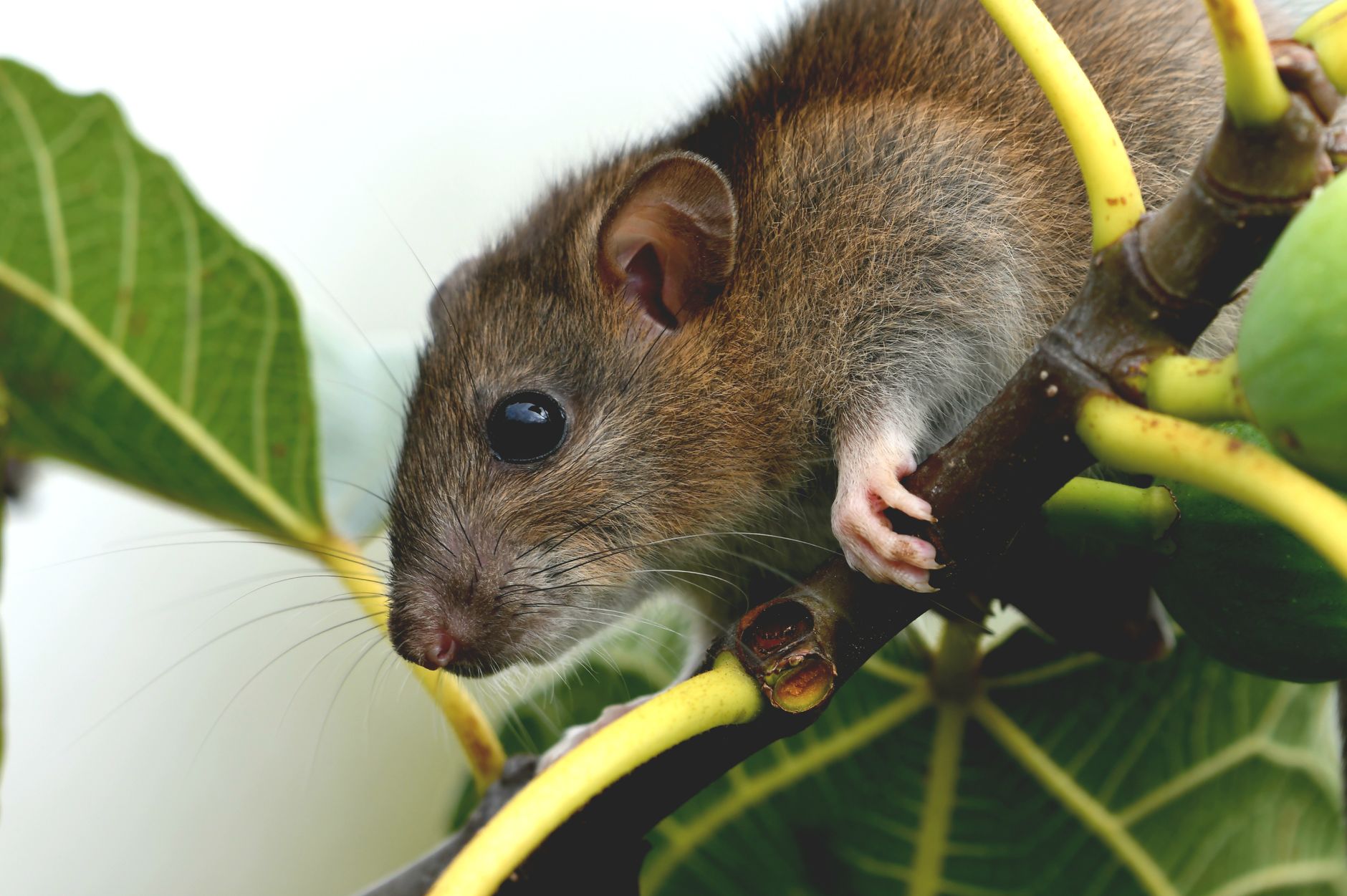 Brown rat clinging to a fig tree branch, close-up among green leaves
Why wasps turn aggressive at the end of the season
The annual cycle of a colony, in one minute
A colony of common wasps (Vespula germanica, Vespula vulgaris) or European hornets (Vespa crabro) is annual. Everything starts from scratch each spring:
- April–May: a fertilised queen emerges from hibernation, builds an embryonic nest on her own and raises the first workers.
- June–July: exponential growth. The workers hunt insects to feed the larvae; in exchange, the larvae secrete a sugary liquid that the adults consume. The balance is perfect, the colony is focused on its work and superbly indifferent to humans.
- Late August–September: the queen stops laying workers and produces reproductives (future queens and males). There are no more larvae to feed — and therefore no more sugary secretion.
- October–November: the colony dies out. Only the young fertilised queens survive, hidden under bark or in a woodpile, ready to start again in spring.
The tipping point: thousands of workers with nothing to do
That's where everything plays out. In September, several thousand workers find themselves with no larvae to feed and no internal source of sugar. So they head out to look for carbohydrates elsewhere: fallen fruit, ripe grapes, jam, soda cans, ice creams, pastries, terrace bins. And they do so with a new determination, with a much lower tolerance threshold.
Add to that the defence of the nest: the colony contains reproductives, in other words the entire genetic future of the lineage. The defensive radius widens. A lawnmower, a drill in a façade, a shutter slammed three metres from the nest can trigger a group attack. In mid-season, the same vibration would have gone unnoticed.
The nest hasn't turned "nasty". It has become overcrowded, starved of sugar and busy protecting its offspring. It's a biological state, not a personality trait.
Finally, add the weather factor: hot, dry Septembers, such as those the Île-de-France region is experiencing more and more frequently, extend colony activity by two to three weeks compared with historical averages, and make water and nectar scarcer. Bigger colonies, a longer season, scarcer resources: the three ingredients of a tense September.
Knowing what you're dealing with: wasp, European hornet, Asian hornet
Identification is not an entomologist's detail. It determines where the nest is located, the level of risk and the intervention method.
| Species | Adult size | Appearance | Typical nest | Behaviour |
|---|---|---|---|---|
| Common wasp (Vespula sp.) | 12–17 mm | Bright yellow and black, very narrow waist | Grey paper ball: under roofing, in a roller shutter box, a cavity wall, or underground | Highly attracted to sugar and protein; frequent stings on terraces |
| European hornet (Vespa crabro) | 25–35 mm | Reddish brown, yellow, russet head | Bulky nest in a cavity: attic, hollow trunk, chimney, cladding | Impressive but not very aggressive away from the nest; attracted to light at night |
| Asian hornet (Vespa velutina) | 20–30 mm | Matt black thorax, yellow legs, orange band on the abdomen | Spherical nest high up (tree, hedge, eaves), side entrance | Defends its nest over a wide radius; preys on honeybees |
Two simple field markers:
- The legs. The Asian hornet has very distinct yellow leg tips, visible in flight — it's the most reliable criterion for a non-specialist. The European hornet has reddish-brown legs.
- The nest entrance. An Asian hornet nest in full growth has an opening on the side; a ball-shaped wasp nest opens from below.
The Asian hornet (Vespa velutina nigrithorax), introduced into France in 2004, is now present in almost the entire mainland territory, Île-de-France included. It is classified as an invasive alien species and appears on the list of second-category health hazards for the honeybee (ministerial order of 26 December 2012). The Muséum national d'Histoire naturelle, through the Inventaire national du patrimoine naturel, centralises reports; the beekeeping health defence federations and groups (GDSA) organise nest destruction locally.
 Brown rat with grey fur sitting among orange dead leaves, looking towards the camera
Where the nests hide that you only spot in September
A large share of our back-to-school call-outs concerns nests that had been there since May, but were only detected when the worker traffic became impossible to ignore, or when falling leaves revealed a grey mass in a hedge.
The locations we most often find in the Île-de-France region:
- Roller shutter boxes. The absolute classic in flats: a few millimetres of clearance are enough, the space is dry, insulated and protected.
- Lofts and roof spaces. The European hornet's favourite territory. The characteristic sound — a deep, continuous murmur in the ceiling — often comes before the visual discovery.
- Wall cavities and air vents. A completely invisible nest, betrayed by constant coming and going at a single air vent.
- The ground. German wasps readily take over an old vole burrow, a bank or a lawn edge. This is the scenario behind mowing and brush-cutting accidents.
- Dense hedges, wisteria, ivy, tall standard trees. The signature of the Asian hornet, with nests sometimes 10 or 15 metres up.
- Compost bins, garden sheds, barbecues, cushion boxes. Opened once a month in summer… and slammed shut in September.
Risk-free spotting: watch the traffic, not the nest
The right method is never to approach, but to watch where the insects leave from and return to. Stand at a distance, ideally indoors behind a window, and follow the flight path for two or three minutes. A pair of compact binoculars makes this spotting far easier than approaching on foot, especially for a nest high up. At the end of the day, as the light fades, the inbound flow intensifies and the flight line becomes obvious.
Note down what you see before calling a professional: estimated height, support (tree, façade, ground), approximate diameter, direction of the opening, intensity of the traffic. These five pieces of information determine the equipment, the pole, the product and the time window for the intervention.
What you must never do when facing a nest
Every season, we intervene after "DIY" attempts that went wrong. Here is the list of actions that send people to A&E:
- Spraying the nest with an over-the-counter insecticide aerosol. The range is short, the lethal effect only partial, and you find yourself a few metres from an entire colony on high alert. On an end-of-season nest, that's the typical set-up for multiple stings.
- Burning, smoking out, scalding. Major fire risk in a roof and zero effectiveness: the nest's paper casing protects the heart of the colony.
- Blocking the entrance hole of a wall cavity. The insects look for another way out — often towards the inside of the home, through a false ceiling or an electrical conduit.
- Using a pressure washer jet or a pole from a ladder. The nest falls, the colony is on the ground, and you're balancing three metres up.
- Mowing or brush-cutting "just to see". Vibrations are the number one trigger of underground nest attacks.
- Intervening in broad daylight. The maximum number of workers are out and will return to a destroyed nest; the intervention is carried out at dusk or dawn, when the colony is gathered and barely mobile.
There is one reasonable exception: a very small primary nest (golf-ball size, fewer than ten insects) found in spring on an exposed support can be removed by a properly equipped and cautious individual. In September, that window has closed. A mature nest is a job for a specialist firm, with a certified full-body suit, a telescopic pole and professional products.
 Brown rat with grey fur foraging on gravel along a wooden wall
Stings: telling the harmless from the emergency
According to Ameli and Vidal, the vast majority of hymenopteran stings cause a local reaction: immediate sharp pain, redness, swelling of a few centimetres, itching, which subsides within 24 to 48 hours.
What to do after an isolated sting:
- Move calmly away from the area — wasps chemically mark a target and other workers may follow.
- Remove any sting left behind (this applies to bees, not wasps) by scraping it out with a fingernail or a rigid card, without squeezing the venom sac.
- Bring a heat source close (the tip of an extinguished cigarette held at a distance, a hairdryer) for a few seconds: the venom is heat-sensitive, and the pain decreases.
- Wash with soap and water, then apply cold wrapped in a cloth for 15 minutes. An instant cold pack in the family first-aid kit saves you from improvising with a bag of frozen peas.
- Remove rings and bracelets if the sting is on the hand.
- Keep watch for several hours.
Call 15 or 112 immediately in the event of:
- a sting in the mouth, throat or on the neck (risk of obstructive swelling);
- multiple stings, particularly more than about twenty, or any multiple sting in a child or an elderly person;
- systemic signs: widespread hives, swelling of the face or eyelids, difficulty breathing, wheezing, vomiting, faintness, a sense of impending doom. This is an anaphylactic reaction, an absolute life-threatening emergency.
People already identified as allergic to hymenopteran venom are prescribed an adrenaline auto-injector pen; the allergist may suggest desensitisation (allergen immunotherapy), whose effectiveness is well documented. If someone in the household is affected, check the pen's expiry date before each summer season and keep it within easy reach, not at the back of a drawer.
Prevention: making your outdoor space less attractive
You can't stop a queen from choosing your shutter box in April, but you can sharply reduce visits and the risk of conflict in September.
On the terrace and in the garden
- Always cover sugary drinks and use a straw outdoors: every year, accidents happen with a wasp that has got inside a can.
- Pick up fallen fruit (apples, pears, figs, grapes) every couple of days.
- Keep bins tightly closed, rinse sugary packaging, don't leave a pet bowl outside.
- Bring in leftovers quickly rather than leaving the table uncleared for a long time.
- On accessible balconies and windows, a magnetic window screen limits intrusions and makes for calmer nights when a nest is active nearby.
- Avoid very sweet perfumes and hairsprays during meals outdoors, and favour light-coloured, plain, covering clothing.
On the building — the work that really counts
Lasting prevention is mechanical. After a nest has been destroyed, or during winter, once all activity has ceased:
- Screen loft entrances, cat flaps and air vents with fine stainless mesh.
- Fill in façade cracks and cable passages with a suitable sealant; a cartridge of exterior façade sealant and a caulking gun are enough to deal with the most common entry points.
- Have the seals on roller shutter boxes checked.
- Prune hedges, wisteria and ivy in spring rather than in September.
As for shop-bought wasp traps, let's be honest: used badly, they capture huge numbers of non-target insects (bees, butterflies, hoverflies) without significantly reducing the pressure from a mature nest. ANSES and beekeeping bodies point out that trapping is only worthwhile when it is targeted, selective and carried out at specific times. A trap is never a substitute for removing the nest.
Nest detected: the right procedure, from the phone call to the intervention
- Don't attempt anything. Ban access to the area: close off a door, put up markers, warn children and neighbours.
- Identify and locate from a distance (the five pieces of information listed above).
- Check who should intervene. In the Île-de-France region, the fire brigade generally only turns out if there is a proven and immediate danger to people; nests on private property are a matter for a pest control firm. For an Asian hornet nest, some municipalities and inter-municipal authorities cover all or part of the cost: check with your town hall before ordering the work.
- In a co-ownership or a rental, a nest on a common area (façade, roof, external box) is the responsibility of the managing agent or the landlord. Report it in writing, with a photo and a date: this record is decisive in the event of a dispute.
- After destruction, leave the empty nest in place if it is out of reach: it will not be reoccupied the following year. The cavity, however, may well be — hence the importance of sealing work.
In September, every week counts: the colony remains dangerous until the first sustained frosts, and an intervention carried out now also eliminates the future queens before they disperse. It's the only time of year when removing a nest has an effect that is both immediate and felt the following season.
This article is for information purposes and is not a substitute for medical advice. In the event of a sting with systemic signs, call 15 or 112.
Got a pest problem?
Our certified technicians are available 7 days a week. Free quote within 24h.
Read also
- Wasps and Hornets in September 2026: The Late-Summer Weeks When Colonies Turn Aggressive — and What to Do About a StingRead the article
- Asian Hornets in September 2026: The Month of Peak Aggression and Nests Found Too LateRead the article
- Aggressive Wasps in Late August 2026: Why Terraces and Gardens in Île-de-France Are Under PressureRead the article