

There is one call we receive almost exclusively between 25 September and mid-November, and it always begins with the same sentence, spoken in a low voice as if something must not be woken: "we can hear something running above the bedroom ceiling, around 11 p.m., and it starts again around 5 in the morning." Then, invariably, the question: "could it be a bird?"
It is almost never a bird. Birds are diurnal and noisy at daybreak, not at midnight. What the client is hearing is a rodent — most often a house mouse (Mus musculus), sometimes a black rat (Rattus rattus) in older houses and buildings with accessible roof timbers — which has just found, in the attic, the best accommodation on the market: warm, dry, quiet, and already furnished with ideal nesting material. Your insulation.
This colonisation of attics is the least discussed and most expensive issue in domestic pest control. People worry a great deal about rats in cellars and bin rooms, and talk very little about what is happening three metres above their heads — where a problem can quietly develop over two winters before being detected, and where the bill is no longer measured in treatment but in a complete insulation replacement.
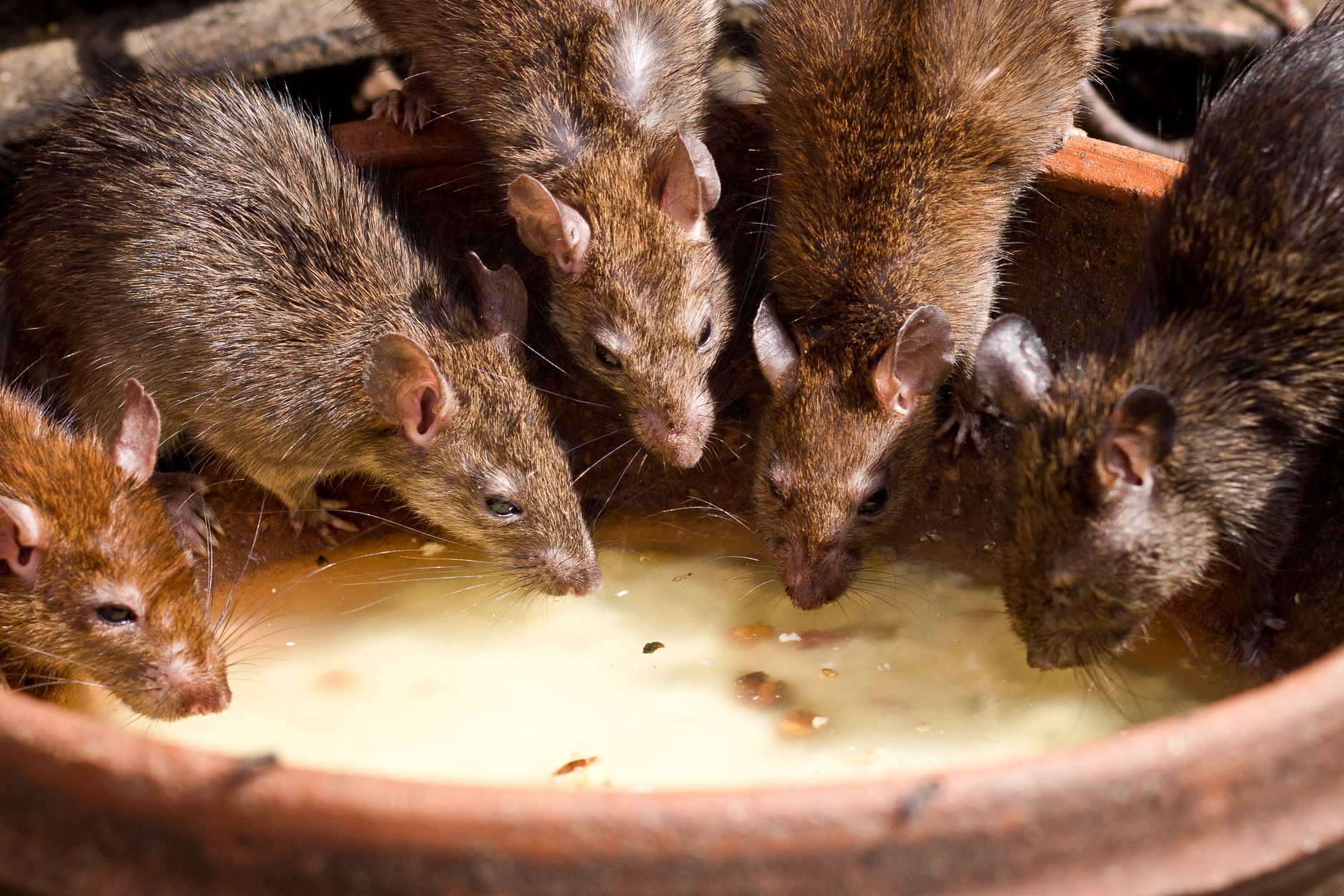 Group of brown rats feeding from a terracotta container filled with liquid
Why October is the tipping point
Thermoregulation, not food
We tend to assume rodents come into houses because they are hungry. That is true of sewer rats, far less so of the mice that colonise roof spaces. The October trigger is thermal.
A house mouse weighs between 15 and 25 grams. At that size, the surface-to-volume ratio is disastrous: it loses body heat extremely quickly. Its thermal comfort zone sits at around 26 to 30 °C. Below 15 °C, it has to raise its metabolism — and therefore eat more — just to maintain its temperature. Below 10 °C outdoors, surviving outside becomes a full-time job.
So what happens in your home in late September? Two things at once:
- Night-time temperatures drop below 10 °C, often as early as the last week of September in the Paris region.
- You switch the heating back on. Heat from the home rises, passes through the ceiling and warms the underside of the attic insulation. A warm, dry, wind-sheltered zone forms just a few centimetres above your ceiling.
For a rodent, that is not a loft: it is a radiator with a mattress on top.
Insulation: the perfect nesting material
The three most common insulation materials in French housing stock are, to a rodent, three grades of bedding:
| Insulation | Behaviour with rodents |
|---|---|
| Glass wool / rock wool | Very easily tunnelled through, permanently compacted, retains urine odours |
| Blown cellulose wadding | The favourite material: light, fibrous, easy to carry, reshaped into a nesting ball |
| Polystyrene / polyurethane | Gnawed to dig tunnels; debris scattered everywhere, insulation locally ruined |
No common insulation material is repellent. Some are treated against fire or mould, none against mammals. A mineral wool panel does not "sting" a mouse: it will dig a network of galleries through it within a few nights.
The consequence is twofold, and it is what clients most often discover too late: colonised insulation loses its insulating value (compacted, compressed, torn open) and becomes a reservoir of urine, droppings and hair. Loft insulation with two winters of rodent presence invariably ends in complete removal and replacement.
How to know whether your attic is occupied
The noises: reading the timing and the type
Acoustic diagnosis is surprisingly reliable once you know what to listen for.
- Quick little scurrying, light scratching, between 10 p.m. and 2 a.m. then around 5 a.m.: mice. The activity peak of Mus musculus is at dusk and just before dawn.
- Heavier noises, decisive movements, creaking timber, sometimes a "rolling" sound (a rodent carrying or rolling an object): black rat. It happily moves at height, along roof timbers and cables.
- Scratching along a vertical duct, mainly at dawn and dusk: edible dormouse or garden dormouse in peri-urban and rural areas — protected species, handled quite differently.
- Daytime rustling, cooing, wingbeats: pigeons or starlings, a different subject and a different treatment.
The physical signs to look for
Armed with a powerful rechargeable torch and an FFP2 mask, a methodical inspection of the attic usually gives an answer within twenty minutes:
- Droppings. Mouse droppings are 3 to 6 mm, shaped like a pointed grain of rice. Black rat droppings are 8 to 12 mm, spindle-shaped. They cluster along walls and runways, never at random.
- Runs. Dark, shiny grooves in the insulation or on the beams: the greasy, dusty mark of repeated passage.
- Nests. Balls 8 to 15 cm across made of shredded insulation, paper and bag plastic, often against a gable wall or a warm duct.
- Tooth marks. On soft timber, electrical conduit, PEX pipes, stored cardboard.
- Smell. An established infestation gives off a characteristic ammonia odour, unmistakable the moment you open the hatch.
Unsure whether the activity is current? The talc method remains unbeatable: sprinkle a fine layer of flour or talc, 30 cm wide, across a suspected runway, and come back 48 hours later. The footprints and tail drag mark are unambiguous. For borderline cases, an infrared motion-detection surveillance camera placed in the attic settles the matter for good — and avoids unnecessary treatments.
The real risks: this is not just a comfort issue
The electrical risk, widely underestimated
A rodent's incisors grow continuously, by around 12 cm a year in rats. It has to wear them down constantly, and an electrical conduit or PVC-sheathed cable is a perfect grinding surface. That explains the classic call-out: a lighting circuit tripping for no reason, a socket that stops working, an RCD that trips in damp weather.
The real danger is not the fault: it is damaged electrical insulation, exposed against a combustible material, in an unventilated space that is never inspected. Fire prevention bodies regularly list rodents among the possible causes of electrical fires of undetermined origin in attics. The exact share attributable to them cannot be quantified — which is precisely the problem, since the origin disappears in the fire. But every electrician who has worked on older buildings has seen conduit gnawed down to the copper.
Practical consequence: when we find marked cables during a job, we systematically recommend an electrical inspection. That is not excessive caution.
The health risk: leptospirosis, hantavirus, allergens
Direct contact with a rodent is rare. The risk comes via urine, droppings and, above all, dust.
- Leptospirosis. A bacterium excreted in rodent urine, surviving several weeks in damp conditions. Santé publique France has recorded a rising number of cases over the past fifteen years in mainland France. A dry attic is less risky than a flooded cellar, but handling soiled insulation without gloves or a mask is far from harmless.
- Hantavirus (haemorrhagic fever with renal syndrome). In France, the Puumala virus circulates mainly in the north-east quarter of the country via the bank vole. Contamination occurs by inhaling aerosolised droppings — typically while sweeping out a loft with a broom. That is precisely the thing never to do.
- Allergens. Mouse urinary proteins (Mus m 1) are recognised respiratory allergens, documented notably in occupational settings by the INRS. In a home, they drift down through recessed spotlights and poorly sealed hatches, and can sustain night-time coughing and asthma attacks in children.
Absolute cleaning rule: never a broom, never a domestic vacuum cleaner. Dampen the area using a sprayer containing a detergent-disinfectant, allow it to act, then collect with a dustpan while wearing nitrile gloves, an FFP2 mask and a disposable coverall. Dry sweeping means putting allergens and pathogens into the air you are breathing.
 Bare mattress on a bed in a bright bedroom, with a round mirror, chandelier and wooden floor
The method that works: exclusion first, trapping second
This is where 80% of amateur attempts fail. The instinct is to set traps or bait blocks and wait. A few individuals are killed, quiet returns for three weeks, then the noises start again. Logically so: the accommodation has remained vacant and attractive, and other applicants turn up.
The correct order is the other way round.
Step 1 — Find and seal the entry points
A mouse gets through an opening of 6 mm — the diameter of a pencil. A young black rat, through 20 mm. The classic roof entry points:
- Verges and roof edges: the junction between the roof covering and the gable wall, often open by several centimetres.
- Ungrilled ventilation tiles and ridge closures.
- The passage of cables, aerials and electricity supply drops through the façade.
- Roller shutter boxes connecting with the insulated dry lining.
- Overhanging tree branches: a black rat easily jumps 1 metre horizontally from a branch to a gutter. Pruning back to at least 2 m from the roof is part of the treatment.
Sealing must be done with materials the rodent cannot gnaw through: fine-mesh stainless steel mesh at 5 or 6 mm, metal plate, reinforced mortar. Expanding foam alone is useless — it is gnawed through in one night. So is silicone.
Step 2 — Eliminate the population present
Once the attic is sealed, you trap. In a private home, in an occupied space, metal mouse traps with a wide treadle set at right angles to the walls, baited with peanut butter or sunflower seeds, remain the most effective, fastest and most controllable solution. Place them in pairs, every 2 to 3 metres, along the identified runs.
On rodenticides, an important regulatory reminder: since 2018, second-generation anticoagulants have been subject to strict restrictions, and ANSES as well as European regulations require their use in secured bait stations, out of reach of children and non-target animals. Outdoor uses are regulated, and permanent baiting is prohibited. In an attic, the other problem is mechanical: a poisoned rodent dies inside the insulation, out of reach, and you then live with the smell for three weeks — plus a secondary infestation of flies and carpet beetles.
We therefore systematically favour mechanical trapping in attics, and reserve baits for the outdoor surroundings and identified feeding points, in secured stations.
Step 3 — Clean, disinfect, restore
After confirming there is no more activity (talc, no new droppings for 15 days):
- Removal of soiled materials — often the insulation in nesting areas.
- Disinfection of surfaces and roof timbers.
- Odour neutralisation: pheromones and urine are an attraction signal for the next rodents. An enzymatic deodorising cleaner works better here than bleach, which masks without destroying the organic markers.
- Installation of new insulation, once the building has been sealed — not before, or you will have to do it all over again.
What does not work (and what we get asked about every week)
- Ultrasonic repellents. No serious independent study has shown any lasting effectiveness. Rodents habituate within a few days, and the sound passes through neither insulation nor partition walls.
- The cat. Excellent against a lone mouse in the kitchen, no effect whatsoever on a population established in an attic it never climbs into.
- Peppermint, bay leaves, mothballs. Weak and very temporary repellent effect, and naphthalene brings its own toxicity issues.
- Blocking one hole and considering the matter closed. There are always at least two. A rodent maintains several routes.
Preventive steps to take this month
September is the right window: colonisation has not yet happened, or is just beginning.
- Walk around the house with binoculars to inspect the verges, gutters and verge tiles.
- Mesh over all air inlets and ventilation tiles with stainless steel rodent-proof mesh.
- Prune back branches and ivy in contact with the roof.
- Store bird seed, pet food and garden bulbs in airtight metal storage containers, never in paper sacks in the garage.
- Do not feed birds within 5 m of the house: a bird feeder is a vending machine for rodents.
- Check that the attic hatch is properly sealed — a foam seal is enough to stop allergens spreading into the living space.
When to call a professional
One or two individuals, an accessible attic, visible entry points: dealing with it yourself is feasible.
On the other hand, call without delay if there is: daily noise for more than three weeks, confirmed presence of rats (not mice), marked cables, an inaccessible attic or a prefabricated trussed roof, an apartment building (the problem is then structural and concerns the whole co-ownership), or an infant or immunocompromised person living in the home.
At ProDeratisation, an attic job always starts with the same step: a full survey of the entry points on the façade and roof, backed up with photographs. Because killing the rodents present without closing the door simply frees up accommodation for the next ones — and they will come back at exactly the same moment next year, on the first night below 10 °C.
Got a pest problem?
Our certified technicians are available 7 days a week. Free quote within 24h.
Read also
- Refuse Chutes and Bin Rooms in Apartment Buildings: The No. 1 Starting Point for Rat and Cockroach Infestations This AutumnRead the article
- Leptospirosis in France: 886 cases in 2024, peak expected in August 2026 — the risk rats pose to your familyRead the article
- Rats biting children at school: what the Littré school case (Paris 6th) reveals in July 2026Read the article