

The letter from the residents' committee ran to four lines: "We found a blue block lying straight on the floor in the cellar hallway, next to the bike store, with no housing and no markings whatsoever. A dog sniffed at it." The contractor had been there eleven days earlier. His report mentioned "14 stations placed in the common areas". Of those fourteen, three were bare blocks, five housings were not fixed down, none carried a label, and no placement plan existed.
That particular case ended without an accident. But it illustrates the most widespread weak point of rodent control in residential blocks and commercial premises across Île-de-France: not the choice of active substance, but the way baits are placed, secured, documented and removed. That is precisely where biocide regulations bite, where inspectors look, and where the liability of the managing agent, the landlord or the employer can be engaged.
This article sets out what a bait station must be in order to be compliant, what the contractor must hand over, the mistakes that invalidate an entire campaign, and the cases where chemical bait must give way to mechanical trapping.
 Inner courtyard of a residential building with white walkways and apartment doors on several floors
What a rodenticide bait really is in the eyes of the law
A biocidal product, not a "box of rat poison"
Anticoagulant rodenticides (bromadiolone, difenacoum, brodifacoum, difethialone, flocoumafen) fall under European Regulation (EU) No 528/2012 on biocidal products, product type 14. Their marketing authorisations are issued in France following assessment by ANSES (the French Agency for Food, Environmental and Occupational Health & Safety), and each product carries conditions of use that are not recommendations: they are part of the authorisation.
Three very concrete consequences for a residential block or business premises:
- most professional formulations may only be used in secured stations, inaccessible to children, pets and non-target wildlife;
- use by a professional requires those applying or supervising the treatment to hold the Certibiocide certificate (in the relevant category);
- permanent baiting, once commonplace, is now regulated and restricted; recent authorisations impose capped treatment durations and removal of baits at the end of the campaign.
A bait station left in place "just in case", six months after an infestation has ended, is not a precaution: it is a non-compliance, and a recognised factor in the development of resistance in rodent populations.
Why the departmental sanitary regulations apply on top of this
The departmental sanitary regulations (règlements sanitaires départementaux) of Île-de-France require the owner — and, in a co-owned building, the owners' association through its managing agent — to keep buildings free of pests and to arrange whatever rodent control operations are needed. The obligation relates to results and due diligence, not to installing a given number of boxes. A managing agent who produces an invoice for fourteen stations but no plan, no bait consumption records and no evidence that the infestation has ended has not demonstrated due diligence. That is the angle found in nuisance and loss-of-enjoyment disputes, covered in detail in our article on compensation and rent reduction where there are rats in the home.
What a compliant bait station looks like
Four non-negotiable criteria
| Criterion | What is expected | What you see far too often |
|---|---|---|
| Strength | Rigid housing, not openable without a tool or dedicated key | Flexible plastic box, clip-on lid |
| Fixing | Fixed to the floor or wall, or weighted, so it cannot be moved | Sitting loose behind a bin, moved during cleaning |
| Identification | Label: product, active substance, date of placement, contractor, phone number, station number | No details at all, or an illegible label |
| Positioning | Along runways, against walls, away from traffic routes and away from foodstuffs | In the middle of a corridor, in an open food store |
Labelling is not cosmetic. If a pet accidentally ingests bait, the label is what allows the vet to identify the active substance and administer the antidote (vitamin K1) at the right dose and for the right duration — second-generation anticoagulants have a long half-life, so several weeks of treatment are sometimes needed. The animal poison control centre and human poison control centres systematically ask for this information.
The placement plan: the document that makes the job exist
A placement plan is a drawing of the levels concerned (cellars, bin store, meter room, service ducts, courtyards, loading bays, storerooms) with a number for each station. Without it, three things become impossible:
- checking that a station has not gone missing — and stations do go missing, through theft, hosing down during cleaning, or an irritated occupant;
- interpreting bait take: an "empty" station only means something in relation to where it is;
- proving complete removal at the end of the campaign.
The plan must be attached to the report, and the report must be readable by a non-specialist. We set out the details to insist on in our article on how to check a pest control intervention report.
The six mistakes that ruin a baiting campaign
1. Baiting before cutting off the food supply
A brown rat with access to torn bin bags and food waste will take only marginal amounts of bait. The bin store, refuse chutes and surrounding areas must be dealt with before or at the same time as the stations go in — otherwise the campaign mostly measures the relative popularity of the food on offer.
2. Multiplying stations instead of placing them
Twenty stations dotted around at random give poorer results than six placed on the actual runways, identified from smears, runs, droppings and gnawing marks. Before placement, a low-angled torch inspection and blocks of tracking paper — or tracking dust — reveal the routes used. Professionals also use non-toxic rodent tracking papers at the survey stage.
3. Leaving stations in place without checks
An unchecked station provides no information and becomes a reservoir of product inside the building. During an active infestation, the expected rhythm is a visit every 7–10 days, spaced out as bait take drops. Stopping is decided on two consecutive checks with no bait take and no fresh signs, not on a commercial schedule.
4. Forgetting the service room
Water, gas and electricity risers are the rodents' internal motorway. Baiting confined to the cellars without treating the service ducts leaves the colony intact — a point we developed in our article on the meter room as the forgotten black spot.
5. Not proofing the gaps
Bait reduces one population; it does not stop the next one arriving. Sealing openings larger than 6 mm (mice) and 20 mm (rats) is the only lasting measure: stainless steel wire wool packed into drilled holes, metal plates, brush-strip door seals, grilles over air bricks, mortar once packed out. Expanding foam on its own is gnawed through within days.
6. Not removing the baits at the end
Removal is a condition of use and sound environmental practice. The carcasses of poisoned rodents expose predators (owls, hedgehogs, cats) to secondary poisoning, documented by ANSES and by wildlife surveillance networks. Collecting carcasses is part of the service.
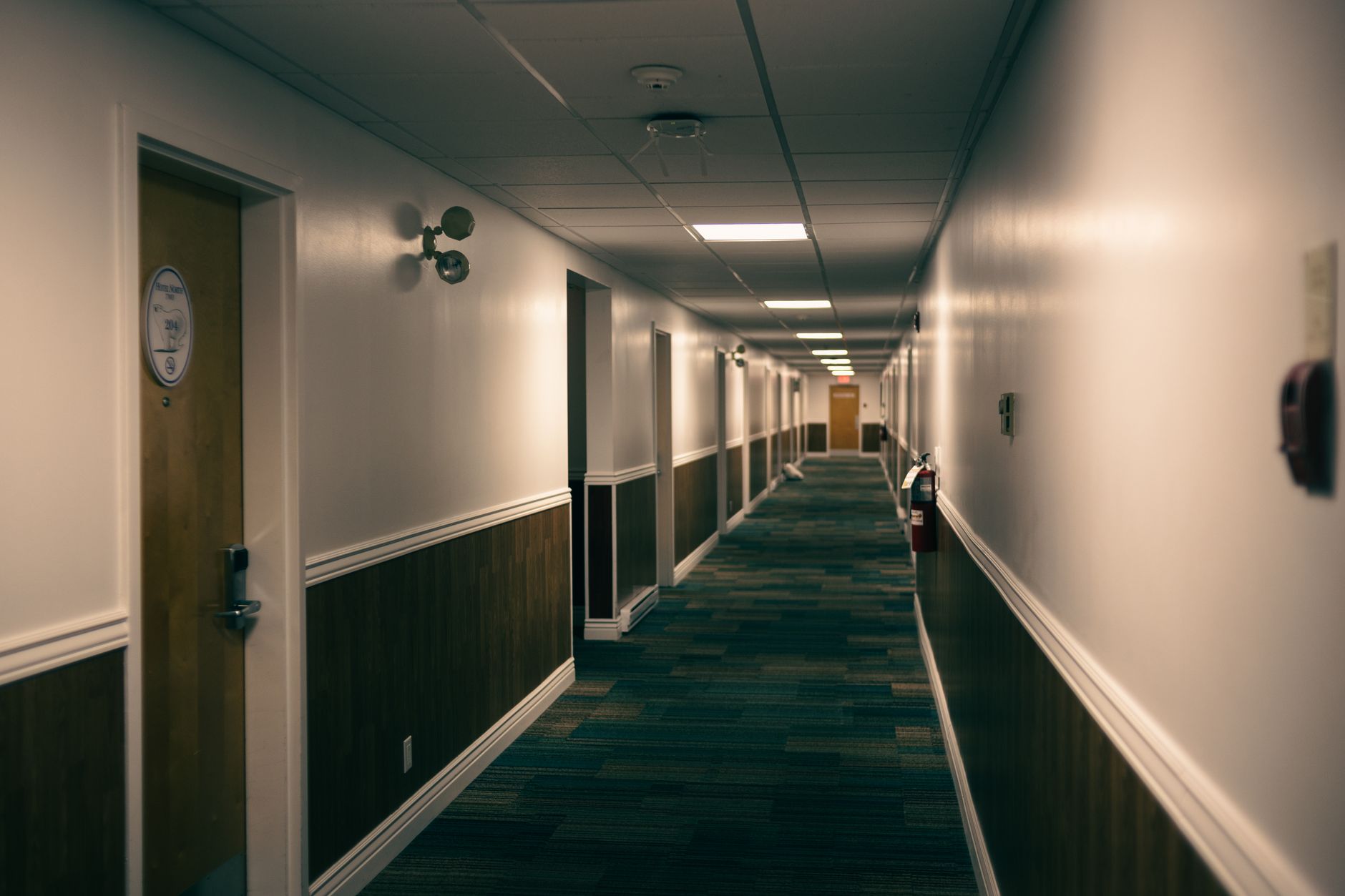 Corridor of a residential building with apartment doors, carpet and a wall-mounted fire extinguisher
Children, pets, occupants: the awkward question in co-owned buildings
Prior notice: mandatory in practice
No legal text sets out a standard notice, but failure to inform is systematically held against the managing agent or the landlord in the event of an incident. The defensible minimum:
- notices in the entrance hall and at the door of every treated room, 48 hours before and throughout the campaign;
- the product, the active substance, the contractor and a phone number to call;
- an explicit instruction: do not open, do not move, keep pets on a lead in the common areas.
In buildings with a crèche, day nursery, school or doctor's surgery at street level, the choice of device must be reviewed: areas used by the public, mandatory tamper-resistant stations, or even dropping chemical bait altogether in favour of mechanical control.
When mechanical trapping must take over
Trapping is not a fallback option. It is technically superior in several situations:
| Situation | Preferred device |
|---|---|
| Commercial kitchen, food store, laboratory | Mechanical traps, box traps, capture stations |
| Premises with pets or vulnerable members of the public | Secured traps in a closed housing |
| Occupied offices, raised floors | Mechanical traps checked daily |
| Low-density mouse activity | Multiple mechanical traps (mice range very little) |
| End of campaign, monitoring | Non-toxic monitoring stations |
In food areas, hygiene standards (Regulation (EC) No 852/2004, the Order of 21 December 2009) and client audit checklists effectively rule out toxic bait inside handling areas. Fast-trigger mechanical rodent traps are the norm there, supplemented by external stations. The subject is covered from a logistics angle in our article on rats in warehouses and client audits.
For businesses handling part of the monitoring themselves, a bound and paginated pest control logbook remains the document most often requested during an inspection: it records dates, stations, bait take, anomalies and corrective actions.
The logbook and traceability: what the file must contain
A defensible rodent control file for a co-owned building, social housing or business premises contains six items:
- the initial survey: suspected species (brown rat, house mouse), infested areas, signs recorded, contributing factors;
- the placement plan, dated and numbered, distinguishing toxic from non-toxic devices;
- the safety data sheets and marketing authorisations for the products used, with authorisation numbers;
- proof of Certibiocide certification for the operatives;
- the visit reports with bait take per station, carcasses collected, anomalies (station missing, damaged, inaccessible);
- the end-of-campaign statement: bait removal, proofing recommendations and waste management.
This file is not administrative luxury. It is what allows a managing agent to demonstrate due diligence to a disgruntled co-owner, a landlord to respond to a report made to the municipal hygiene and health department, and a restaurant operator to prove control during an inspection. Where premises are already contaminated, baiting never replaces cleaning: see the disinfection protocol after a rodent infestation.
Waste, the point that is always overlooked
Removed baits, packaging and carcasses are waste that has to be managed. Rodent carcasses are handled with disposable nitrile gloves and sealed bags, never bare-handed: leptospirosis, hantavirus and salmonella spread through urine and droppings. Leftover product goes back to the contractor, who is responsible for disposing of it — a point that belongs in the contract, not in a conversation.
What a managing agent, landlord or employer should insist on at quotation stage
At quotation stage, five questions are enough to separate a serious contractor from someone who merely drops boxes around:
- How many visits, at what intervals, and on what criterion do you stop? An answer along the lines of "3 visits, fixed price" with no stopping criterion is a red flag.
- Is the placement plan provided and updated at every visit?
- Are the devices fixed down and labelled, and who removes them?
- Are proofing recommendations priced separately? A company that never tells you what to seal is selling you repeat visits.
- What proportion of the treatment is mechanical in sensitive areas?
Competitive tendering and the drafting of the documents need preparation: our article on the specification for a pest control service contract details the clauses to include, and the quotation page helps frame a priced request. For buildings under a managing agent, the managing agents hub brings together the obligations and the decision-making process, with the vote on the contract at the general meeting covered here.
Three things to remember
- Bait with no plan, no label and no fixing is not rodent control: it is a hazard placed inside a building. Have every station photographed and numbered at the first visit.
- Baiting has an end point. Two consecutive checks with no bait take, then removal, proofing, then non-toxic monitoring. Permanent baiting manufactures resistance and secondary poisoning.
- In food areas and near vulnerable members of the public, mechanical control comes first. This is not a concession: it is what hygiene standards and audits require.
In Île-de-France, most campaigns that fail do not fail because of the active substance. They fail because of a bin store that was never dealt with, a service duct that was never opened, a 3 cm hole behind a water heater, and a file incapable of proving anything six months later. The four sheets of paper that make up a proper placement plan cost less than a second contract.
Sources and references
- Regulation (EU) No 528/2012 concerning biocidal products (product type 14, rodenticides)
- ANSES — marketing authorisations and opinions on anticoagulant rodenticides, primary and secondary poisoning risks
- Order of 9 October 2013 on the conditions for practising as a professional user of certain biocidal products (Certibiocide)
- Regulation (EC) No 852/2004 on the hygiene of foodstuffs; Order of 21 December 2009
- Departmental sanitary regulations of Île-de-France — rodent control obligations of owners and owners' associations
- Santé publique France — leptospirosis and rodent-borne zoonoses
Got a pest problem?
Our certified technicians are available 7 days a week. Free quote within 24h.