

There is one sentence we hear at the end of almost every rodent control job, and it is usually spoken with relief: "so that's it, we can put the boxes back." No. The treatment dealt with the rodent population; it dealt with none of what that population left behind.
A colony of house mice settled in a utility room since the start of winter deposits between 50 and 80 droppings per individual per day, urinates continuously as it moves around — urine marking is how they navigate — and leaves behind hair, nesting material, the carcasses of其 own kind and food debris. A brown rat, for its part, leaves greasy smear marks along skirting boards and droppings 15 to 20 mm long. All of it stays exactly where it is after the last bait has been eaten. And this is precisely the stage that the pest control contracts signed by managing agents and landlords across Île-de-France forget to provide for: restoring the premises to a sanitary condition.
This article sets out what needs to be done, in what order, with what equipment, and at what level of soiling it is no longer reasonable to handle it yourself.
 Close-up of a house mouse on wood shavings, next to a pale object, in dim light
Why disinfection is not an optional extra
What droppings and urine actually contain
Commensal rodents are recognised reservoirs of pathogens. The French health authorities — Santé publique France, ANSES, the Institut Pasteur — document several transmission routes that persist after the animals are dead:
- Leptospirosis. Leptospires are excreted in rat urine and survive from several days to several weeks in damp environments. Santé publique France records around 600 to 900 cases a year in mainland France, with probable under-reporting. Contamination occurs through contact between broken skin or a mucous membrane and contaminated water or surfaces. A damp cellar floor where rats have urinated remains a risk after the rodent treatment.
- Hantaviruses. In France, the Puumala virus (reservoir: the bank vole) causes nephropathia epidemica, mainly in the north-east of the country, but the mechanism is instructive: inhalation of aerosols generated by dry sweeping of dried droppings. That is precisely why brooms and air blowers are strictly prohibited.
- Salmonella, E. coli, Campylobacter, Listeria. Carried on paws and in droppings, they explain the non-compliances recorded during hygiene inspections in food retail businesses and catering kitchens.
- Rodent mites and fleas. When the host dies, ectoparasites leave the carcass and look for a new blood source: this is the classic mechanism behind the unexplained bites that appear ten days after a successful treatment.
- Allergens. Mouse urinary proteins (Mus m 1) are respiratory allergens documented by the INRS, well known in animal laboratories and implicated in asthma in substandard housing.
Odour: a symptom, not just a nuisance
The characteristic ammonia smell of infested premises is not "dust". It is degraded urea, soaked into porous materials: plaster, bare timber, glass wool, concrete screed, polyurethane foam. It will not go away with an air freshener, nor with bleach — which masks it for a few hours and then lets the smell return, while releasing chlorine in a confined space.
That odour is also a homing signal. Pheromones and urine marking tell the next rodents that a safe harbourage exists here. Premises that have not been disinfected are re-colonised far faster than premises that have been cleaned: this is the most concrete argument to put to a general meeting when disinfection is presented as an "optional extra".
The three levels of soiling (and who should handle them)
| Level | Typical situation | Who can deal with it |
|---|---|---|
| 1 — Light | A few droppings in a cupboard, an office kitchen corner, a storeroom; smooth, washable surfaces | 在-house staff with training and PPE |
| 2 — Moderate | Bin store, cellar, meter room, service duct: widespread droppings, greasy smear marks, identified nest | Pest control (3D) firm or specialist cleaning company |
| 3 — Heavy | Loft or crawl space with soiled insulation, multiple carcasses, hoarding/squalor situation, food premises closed down by the authorities | Specialist contractor, waste disposal, written report |
In a block of flats, level 2 is by far the most common — and it is also the one most often only half dealt with: a quick blast of the pressure washer in the bin store disinfects nothing, it just aerosolises.
The six-step protocol
1. Make sure the population really has been eliminated
Disinfecting while rodents are still active is a waste of effort. Cleaning should only begin after a monitoring phase with no bait consumption and no new signs: no fresh droppings on a dust marker, no new smear marks, no night-time noise. Allow two to three weeks after the consumption peak, with a documented verification visit. In an annual contract, this stage should normally appear in the service report.
2. Remove carcasses and sources of odour
A rodent dead inside a partition wall continues to produce decomposition fluids and attracts flies (Fannia, Piophila). It has to be located, the wall opened if necessary, the body removed, and the spot treated. Only then do you move on to general cleaning.
3. Kit yourself out properly — this is not negotiable
The INRS recommendations for work involving contact with animal droppings and biological dusts are clear, and they apply just as much to a building caretaker or a maintenance employee:
- A disposable FFP3 mask (FFP2 is the bare minimum; FFP3 is what you need in a confined, dusty space).
- Long-cuff nitrile gloves, and above all no unprotected skin lesions.
- A disposable type 5/6 hooded coverall.
- Goggles or a full-face visor when working at ceiling level or in a crawl space.
The order in which you take the kit off matters as much as the kit itself: outer gloves, coverall, then the mask last, outside the zone.
4. Dampen down, never sweep
This is the heart of the protocol, and the rule everyone breaks. First spray a detergent-disinfectant onto the droppings and surfaces, leave it to act for 10 to 15 minutes, then pick up wet using disposable paper or a squeegee. The objective: zero airborne dust.
For larger volumes, vacuuming must be done with a HEPA-filter vacuum cleaner and never with an ordinary household vacuum, which blows fine particles straight back into the room's air. Waste goes out in sealed bags, double-bagged, via the household waste stream for a home, or as clinical/commercial waste for business premises depending on the volume and nature of the material.
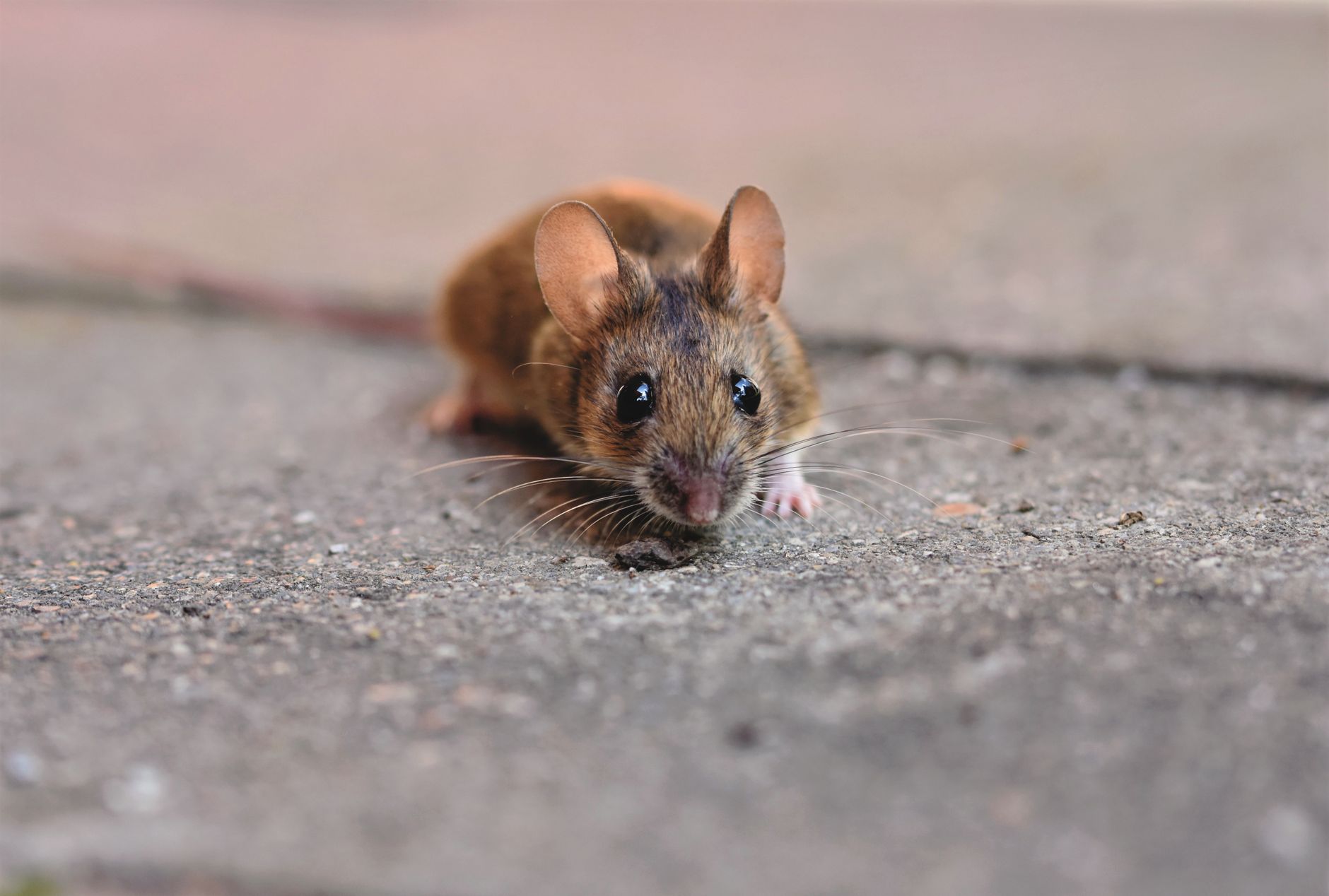 Small brown big-eared mouse crouching on pavement concrete, seen head-on
5. Clean first, then disinfect — two separate operations
This is the most widespread confusion of all. A disinfectant applied to a dirty surface is deactivated by organic matter: you first have to degrease and strip (rat smear marks are greasy), rinse, then apply the disinfectant for the contact time stated by the manufacturer.
The right instinct on the product side: choose a virucidal detergent-disinfectant to EN 14476, or a product claiming the bactericidal EN 1276 and fungicidal EN 1650 standards, rather than a supermarket "antibacterial" cleaner with no reference standard at all. For food premises, the product must be compatible with food-contact surfaces and rinsed as per the instructions. And for large areas — cellars, car parks, bin stores — a 5 to 8 litre pre-pressurised sprayer saves a considerable amount of time compared with a trigger spray.
Bleach can still be used on concrete floors or tiling, diluted and on a clean surface, but it is corrosive, ineffective in the presence of organic matter, and must never be mixed with an acidic detergent.
6. Dealing with porous materials and anything that cannot be cleaned
This is the cost item nobody plans for.
- Glass wool or cellulose insulation soiled in a loft cannot be disinfected. It has to be removed and replaced. Over 60 m² of loft space, the cost of stripping out and reinstalling far exceeds that of the treatment itself.
- Plaster soaked with urine has to be scraped back, treated and then covered over; a shellac-type odour-blocking primer is often necessary before painting.
- Mattresses, sofas and cardboard from a home in a state of squalor go to the tip: no treatment is economically defensible.
- Foodstuffs that have been in contact with soiling, or merely stored in the infested area, are destroyed — including intact packaging if external contamination is established. Regulation (EC) No 852/2004 and the EU hygiene package leave no room for interpretation in the catering sector.
After disinfection, an enzymatic odour-removal treatment — of the kind used for pet accidents — gives good results on residual urine odours in timber and concrete, where a conventional disinfectant has no effect.
Who pays, who orders the work, and how to get it in writing
In a block of flats (copropriété)
Disinfecting the common parts (bin store, cellars, meter room, service ducts) falls under common charges, decided by the managing agent as routine maintenance or voted at a general meeting when it falls outside the current contract. The point to watch: most annual rodent control contracts cover the placing and monitoring of baits, not restoration works. If the specification does not explicitly mention "cleaning and disinfection of soiled premises", the work will be invoiced as an extra — better to have a price for it before the vote.
In rented housing
The landlord must provide a dwelling that is fit for habitation and free of pests, an obligation reinforced for infestations by the ELAN Act of 23 November 2018 (article 6 of the Act of 6 July 1989). The usual dividing line: treatment and structural remediation fall to the landlord where the cause lies in the building itself (common parts, ducts, defective weatherproofing); routine cleaning falls to the tenant. The departmental public health regulations in Île-de-France also require the owner to control rodents and maintain the sanitary condition of communal areas.
In businesses and shops
Employers have a duty of care under article L4121-1 of the French Labour Code: exposing an employee to rodent droppings without PPE or a protocol is a clear-cut breach. For a food business, the food safety management plan must include both the pest control element and the cleaning and disinfection procedures, with records available for inspection by the veterinary services. In a ground-floor commercial unit, the split between operator and landlord depends on the lease and on the origin of the infestation — something to sort out before the inspector calls, not after.
 A brown mouse and a white mouse emerging from a glass jar against a black background
What a serious disinfection quote must contain
A quote consisting of a single line — "disinfection of premises: €450" — is not a quote. Before signing, insist on:
- The exact scope: list of rooms, floor areas in m², ceiling height for the volumes to be treated.
- The method statement: prior mechanical cleaning, products used with their standards (EN 1276, EN 14476, EN 13697…), contact times, cold fogging or wet application.
- The standard the work is benchmarked against, in particular NF T72-281 where airborne surface disinfection is proposed: it governs the method for validating the efficacy of such processes. A contractor who offers "fogging" with no reference standard guarantees nothing.
- Waste management: volumes, disposal route, consignment note where applicable.
- The re-occupation period for the premises and the ventilation instructions.
- The service report: before/after photographs, products and batch numbers, technician's name, up-to-date Certibiocide certification.
- The terms for verification: surface swabs or contact plates for food and healthcare premises, where the stakes justify it.
A piece of practical advice: have the disinfection carried out by the firm that treated the infestation, or at the very least coordinate the two. Cleaning done too early destroys the monitoring evidence (fresh droppings, dust markers, bait consumption) and makes it impossible to assess whether the treatment worked.
The five mistakes that make the problem worse
- Dry sweeping or blowing. Puts allergens and pathogens into the air: the single most dangerous action on this list.
- Pressure washing in an enclosed space. High pressure throws aerosols everywhere, including over the operator, and drives the contamination deeper into cracks.
- Neat bleach with no prior cleaning. Ineffective on organic matter, corrosive, and masks the odour instead of removing it.
- Sealing up before cleaning. You shut a source of pathogens and odours inside the wall. Blocking entry points — with stainless steel wool and mortar, never expanding foam on its own — comes afterwards.
- Putting nothing in writing. With no report, no photographs and no itemised invoice, the landlord can prove nothing in a dispute and the food business operator has nothing to show at inspection.
Key takeaways
Rodent control stops a population. Disinfection makes premises fit to be occupied again. These are two services, two skill sets, two lines on a quote — and in almost every case we handle in Île-de-France, it is the absence of the second that explains the lingering smell, the post-treatment bites, the hygiene inspection failures and the re-infestation of the same premises the following winter.
For a cupboard or a storeroom with a few droppings, good protective equipment and a proper method are enough. As soon as there is a nest, soiled insulation, food premises, a carcass inside a wall or an exposed employee, the question is no longer whether to call a professional, but whether their quote genuinely describes what they are going to do.
Got a pest problem?
Our certified technicians are available 7 days a week. Free quote within 24h.
Read also
- Rats and Mice in the Meter Room: The Forgotten Blind SpotRead the article
- School Canteens and Institutional Kitchens: Why Rodent Reports Spike After the October Half-Term BreakRead the article
- Rats in the Underground Car Park: Why They Move Into Cars in Autumn (and What Insurance Won't Cover)Read the article