

The call almost always comes on the same day: the Monday of the November return, between 7 and 9 a.m. On the line, a school catering manager or the head chef of a care home, voice strained: "We found droppings on the cutting board and a 10-kilo bag of rice torn open in the dry store. Lunch service is in four hours. What do I do?"
There is nothing surprising about this timing. An institutional kitchen that closes for ten to fifteen days over the October half-term break brings together, within the same window, every condition a rodent has been waiting a month for: no human presence, no noise, no light, no trolleys coming through — but food stocks still in place, a bin room that keeps receiving waste from technical staff, and outdoor temperatures dropping below 10 °C at night. For two weeks, the kitchen becomes the best winter shelter in the neighbourhood.
In a working kitchen, rodents are confined to dead zones: service ducts, crawl spaces, suspended ceilings, the backs of cold rooms. Fifteen days without human activity is enough to tip a peripheral population into an established one, with nesting in storage areas and movement right across the production zone. The problem isn't discovered on reopening: it is created during the shutdown.
This article sets out the exact mechanism of that colonisation, the signs to look for in the first hour of reopening, the legal and HACCP reading of the issue (who is responsible, what documentation must exist), and the point-by-point reopening protocol to put in place right now, before the holidays begin.
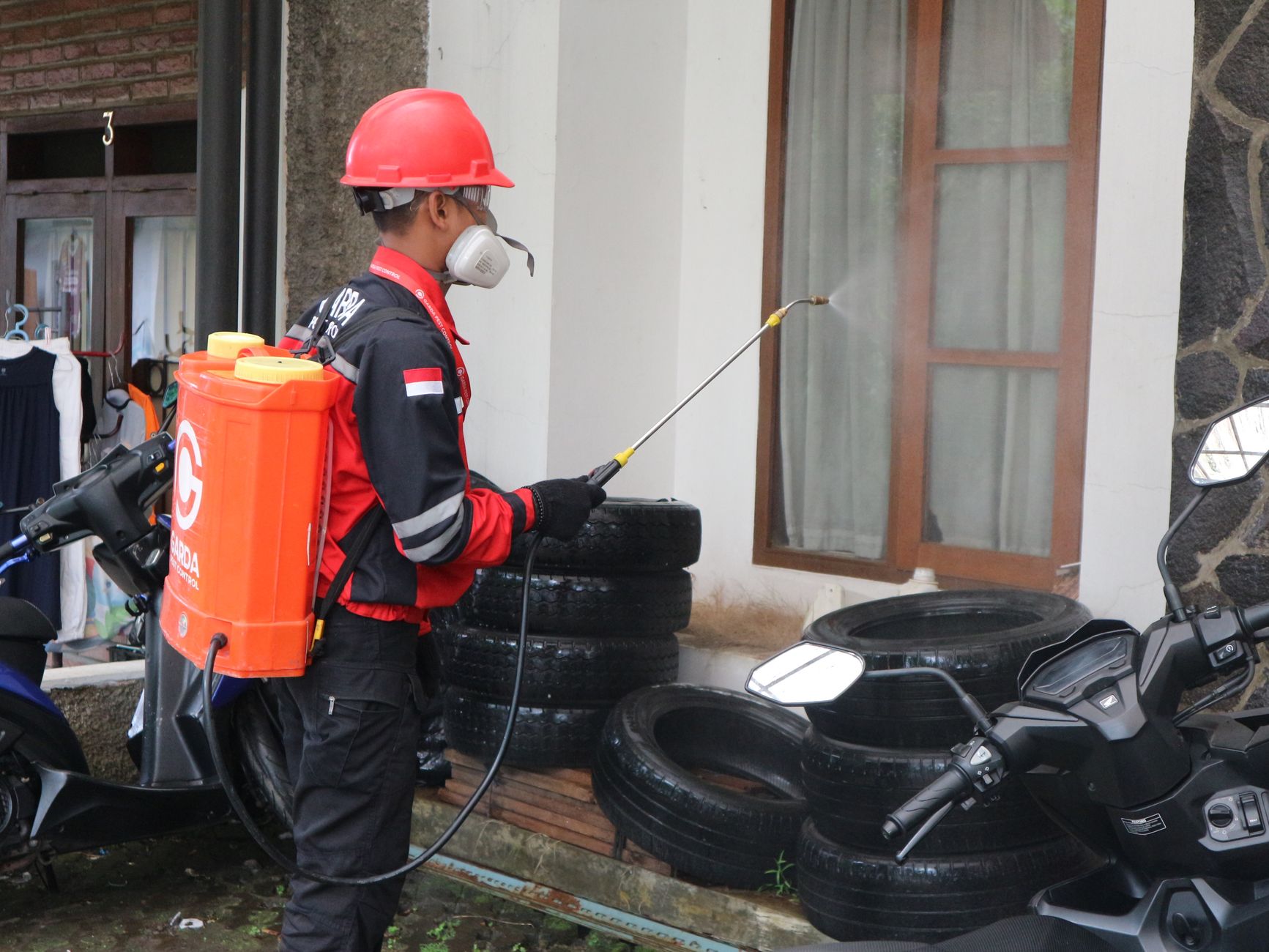 Technician in a red hard hat and mask spraying insecticide with a backpack sprayer along the side of a house
Why the October half-term shutdown is the worst of the year
Institutional kitchens also close at Christmas and in August. Yet it is at the October half-term that reports peak. Three factors overlap.
It coincides with the autumn migration. The house mouse (Mus musculus) and the brown rat (Rattus norvegicus) do not hibernate. Between late September and mid-November, as outdoor resources dwindle and nights turn cold, colonies move towards heated buildings with a food supply. Institutional kitchens top the list. The October half-term shutdown falls exactly on this prospecting peak.
Stocks stay on site. Unlike the summer closure, which is often accompanied by a complete clear-out and a deep clean with a contractor on site, the October break is too short to justify emptying the stores. Pallets of tinned goods, sacks of flour, semolina and pulses, boxes of biscuits for afternoon snacks all stay in the dry store. Ten days of peace and quiet with 300 kg of foodstuffs is an open invitation.
The heating stays on. Local authorities rarely turn the heating off completely for ten days, for reasons of thermal inertia and humidity control. The building therefore stays at 15–18 °C — the ideal range for mice to nest. For reference, a female Mus musculus can produce a litter of 5 to 8 young roughly every three weeks: the holiday window is long enough for a whole generation to be born on the premises.
The myth of "closed premises = protected premises"
An adult mouse can get through a 6 mm gap. A young brown rat through 20 mm. Most French institutional kitchens, in their real-world condition, have around a dozen access points of this size: unsealed electrical duct penetrations behind refrigeration units, damaged floor-to-wall joints under sinks, floor drains with unsecured grates, worn-out delivery door thresholds, suspended-ceiling access hatches left improperly closed after maintenance work. These defects are invisible while the kitchen is in service, because human traffic deters passage. They become functional again the moment the kitchen empties.
The signs to look for in the first hour of reopening
Before switching on a single oven, you need to read the building. The inspection order matters: start with the coldest and quietest areas and finish with the production zone.
| Area | Signs to look for | Severity level |
|---|---|---|
| Dry store, bottom of pallets | Droppings, pierced sacks, grain on the floor, ammonia smell | Critical: nesting likely |
| Behind and underneath cold rooms | Droppings lined up along walls, black greasy smear marks | High: established travel route |
| Bin room and delivery bay | Burrows at the base of walls, runs in the soil, torn-open bags | High: active external source |
| Suspended ceilings, service ducts | Scratching noises, shredded insulation, gnawed cables | Critical: electrical hazard |
| Sinks, floor drains | Displaced grates, damp traces, hairs | Moderate to high |
| Production zone, worktops | Droppings on raised surfaces | Critical: direct contamination |
Three technical points that are often misread:
Fresh or old droppings? A fresh mouse dropping is soft and shiny; after 48 to 72 hours it becomes dry, grey and crumbles when pressed with a gloved finger. This distinction changes everything: droppings that are all old indicate activity during the shutdown, while fresh droppings indicate an established population that is still there.
Tooth marks. A mouse leaves pairs of parallel incisor marks around 1 mm wide on packaging; a brown rat leaves 3 to 4 mm gouges, often on hard materials (door bottoms, PVC ducting). Photographing these marks with a ruler in frame is good practice: it becomes part of your documentation.
Urine fluorescence. Rodent urine trails react under ultraviolet light. With the kitchen lights off, a UV black light will reveal, within minutes, the travel routes along skirting boards and on low shelves where the naked eye sees nothing. It is the most cost-effective diagnostic tool for a site manager, and it prevents treating at random.
What the regulations say: you have no choice
Pest control is not an optional extra in institutional catering, it is a documented obligation.
European Regulation (EC) No 852/2004, Annex II, requires food premises to be designed and maintained so as to prevent the presence of pests, and that adequate pest control procedures be put in place. In France, the order of 21 December 2009 on the sanitary rules applicable to retail trade and institutional catering activities restates this requirement. The food safety management plan (plan de maîtrise sanitaire, PMS), the centrepiece of any HACCP file, must therefore include a "pest control" section comprising:
- a plan of numbered baiting and trapping points, with installation dates;
- safety data sheets and marketing authorisations for the products used;
- the contractor's visit reports, with findings and recommendations;
- traceability of the corrective actions taken after each finding;
- proof of the operator's qualification (Certibiocide certificate for the professional use of biocidal products, in line with the regulations deriving from Regulation 528/2012).
During an inspection, an officer from the DDPP (departmental directorate for the protection of populations) does not simply check that there are no rodents: they verify that the monitoring system exists, that it is up to date, and that previous non-conformities have been resolved. The results of these inspections are published on the Alim'confiance platform, which is open to the public — something many canteen managers discover too late.
Where serious findings are made, the range of measures runs from a warning to a formal notice, and as far as administrative closure. For a central production kitchen supplying several schools under a hot-delivery system, that means switching overnight to cold substitute meals, with immediate media fallout.
 Clean white kitchen with metro tile backsplash, wooden worktop, oven and fridge
The real health risk, beyond non-compliance
Rodents are not just a reputational problem. Their droppings and urine contaminate foodstuffs and surfaces. Santé publique France and Anses regularly highlight the role of the brown rat in the circulation of leptospirosis, a bacterium excreted in urine that survives in damp environments. Salmonellosis, hantaviruses and cross-contamination with Escherichia coli also feature among the documented risks linked to the presence of rodents in food environments.
In a kitchen serving vulnerable groups — young children in nursery school, care home residents, patients in healthcare facilities — there is no margin for error. Any foodstuff stored in premises where rodent activity has been observed must be treated as potentially contaminated, including tinned goods if the outside of the cans is soiled (the risk then arising from contact when opening them). The operational rule is simple: if there is any doubt about a batch, withdraw and destroy it, with written traceability. The cost of discarding a pallet bears no comparison to that of a collective foodborne outbreak.
The reopening protocol, step by step
Before the shutdown (to be done this week)
- Clear out as much stock as possible. All opened dry goods either leave the premises or go into airtight containers. Food-grade plastic storage containers with airtight seals in 5 to 10 litre sizes solve the problem for flour, rice, pulses and sugar. Cardboard and paper sacks are not long-term storage containers.
- Empty the bin room completely and arrange for collection the day before you leave.
- Raise pallets off the floor and clear a visible 30 cm walkway along the store room walls: that is the condition for an inspection on your return to mean anything.
- Set non-lethal detection traps, numbered and mapped, in at-risk areas. Detection plates or mechanical snap traps for mice, deployed in sufficient numbers, let you know on your return whether there has been activity and where.
- Seal the access points you have identified using stainless steel wool combined with patching mortar: rodents cannot cut through it, unlike expanding foam alone, which they get through in a single night.
On your return, before any production
- Full inspection before switching anything on, following the order in the table above, in pairs, with a camera and a UV lamp.
- Immediate quarantine of any questionable foodstuff: "blocked" label, physical isolation, entry in the non-conformity register.
- Call the contractor if even a single sign of nesting is found. A professional diagnosis answers the questions of species, point of entry and population size — three things improvised baiting cannot assess.
- Cleaning, then disinfection of the affected surfaces. The order matters: detergent first (organic residue neutralises disinfectant), then a virucidal-bactericidal disinfectant certified to EN 1276 / EN 13697. Wear disposable nitrile gloves and an FFP2 mask while collecting dry droppings, as airborne dispersal is the main route of exposure.
- Do not start service until the production zone has been declared clean. A cold substitute meal is an inconvenience; a report of a foreign body on a school lunch plate is a crisis.
The three mistakes that come up every time
- Baiting without closing off access. Unconsidered baiting in an open building draws rodents in from outside and moves carcasses into ducts and wall cavities, with the smell that follows for the next three weeks.
- Using consumer products in food areas. In premises open to the public and in professional kitchens, the use of rodenticidal biocides is subject to specific regulations and, for most products, requires a Certibiocide holder. Blocks bought at a garden centre and laid straight on the floor of a store room are a non-conformity in themselves.
- Writing nothing down. A finding that isn't recorded doesn't exist as far as an inspector is concerned. A simple bound food safety logbook, filled in by hand, dated and signed, carries more weight during an inspection than an incomplete digital file.
The structural issues to tackle before winter
Beyond the November shutdown, four projects will durably reduce the pressure:
- Delivery door bottoms: brush seals or metal threshold strips, replaced as soon as they wear out. This is the number one entry point by volume.
- Floor drain grates: sealed in place, not merely laid on top, with a mesh of less than 6 mm.
- Suspended ceiling hatches: closed and checked after every maintenance visit. A plumber who leaves a hatch open on a Friday evening opens a corridor for the next fifteen days.
- The immediate surroundings: a cleared mineral strip at least 50 cm wide at the base of the façade, trimmed hedges, bins on a clean slab with lids closed. Populations don't build up inside the kitchen — they get in from outside.
 Brown rat with grey fur moving between tree trunks and wood debris
Key takeaways
The colonisation of an institutional kitchen during the October half-term holidays is not an accident: it is the predictable consequence of a seasonal migration meeting a food premises left without activity. The right time to act is not the Monday of the return, it's the week before the shutdown.
For a site manager, three habits are enough to change the outcome: clear out stock and move it into airtight containers, install a mapped detection system before leaving, and carry out a formal inspection before switching anything on when you return. The rest — species identification, treatment, lasting sealing of access points and updating the pest control section of the food safety management plan — is a job for a certified professional, whose reports will also be the strongest item in your file the day the DDPP turns up unannounced.
For central production kitchens, canteens, care homes and corporate restaurants across the Île-de-France region, our teams carry out a pre-shutdown survey and a reopening intervention that works around your service constraints. Free quote, 7 days a week.
Got a pest problem?
Our certified technicians are available 7 days a week. Free quote within 24h.
Read also
- Rats in the Underground Car Park: Why They Move Into Cars in Autumn (and What Insurance Won't Cover)Read the article
- Rats, hornets and bed bugs in the 2026 French local election campaign: how to read your candidate's promisesRead the article
- Building work or façade renovation next door: why rats show up in your building three weeks after the job startsRead the article