

In a residential building, a rodent infestation comes to light through a complaint. In a warehouse, it almost always comes to light through a third party: a forklift driver reporting a torn-open bag of pet food, a customer refusing a pallet because the stretch film has been gnawed through, or — the worst-case scenario — an auditor who opens a bait station and finds an intact, dusty block with no record of any inspection for eight months.
Warehouses and industrial premises in the Paris region combine every risk factor: buildings with metal cladding set on a concrete slab, docks left open for hours each day, grassy surroundings, ditches and retention basins, and a turnover of goods that makes visual inspection next to impossible. On the platforms of Gennevilliers, Bonneuil, Wissous, Garonor or Marne-la-Vallée, the question is not whether there are rats around the building: there are. The question is whether your control plan stops them at the property line, and whether you can prove it on paper.
This article sets out what a rodent control plan in a warehouse must contain, who is legally accountable for it, and what an auditor actually looks at when they ask for "your pest file".
 Technician in a white coverall, mask and blue gloves making a stop gesture with his hand
Why a warehouse is invaded from the outside, never from the inside
The brown rat lives outdoors and works indoors
This is the key difference with a residential building. In a condominium, the brown rat (Rattus norvegicus) comes up from the sewer network and settles in the basements. In a warehouse, it most often nests outdoors: embankments, retention basins, hedges, the slab of a technical room, planting beds against the façade, wooden pallet storage areas. It comes in to feed, to warm up or to explore, then leaves again.
The practical consequence: a control plan focused solely on the inside of the building is structurally doomed to fail. It deals with transient individuals without ever touching the colony. Blocks get replaced every month for two years without ever reducing the pressure.
The house mouse (Mus musculus) follows the opposite logic: it settles permanently indoors, in the racking, the suspended ceilings of the offices, the partitions of the staff area, the electrical cabinets. It often arrives with a delivery. A serious control plan distinguishes between these two species, because the stations, the baits and the frequencies are not the same.
The five entry points found everywhere
In the site audits we carry out across the Paris region, the same defects come up in more than eight buildings out of ten:
- The joints at the base of the cladding: metal cladding is installed with a gap of a few centimetres above the concrete ground beam. A mouse gets through 6 mm, a young rat through 20 mm.
- Dock levellers and their pits: the space beneath the deck, the ram openings, worn dock seal bumpers. This is entry point number one in logistics.
- Poorly adjusted sectional doors: a torn-off door-bottom brush seal or a threshold deformed by a forklift impact is all it takes.
- Service penetrations: cable runs, water ducts, drains, sprinkler pipework sleeves left unsealed after works.
- Service doors propped open in summer or for ventilation, with no anti-intrusion device.
To these entry points must be added the buried networks: non-watertight wastewater inspection chambers, hydrocarbon separators, dock drainage channels. Inspecting the inside of the chambers is part of a proper inspection — that is often where the first smear marks are found.
Who is responsible: operator, owner or service provider?
The operator carries the obligation, even as a tenant
The departmental sanitary regulations require the occupant to keep their premises clean and to control rodents. Depending on the activity, this is compounded by:
- the French Labour Code and the employer's general safety obligation (article L. 4121-1): rodents create a biological risk, a fire risk through gnawed cables, and a slip risk linked to droppings on smooth floors;
- for any warehouse handling foodstuffs, Regulation (EC) No 852/2004 and its Annex II, which requires "adequate procedures to control pests" and premises designed to keep them out. This is the text the DDPP relies on during an inspection;
- the prefectural ICPE orders for classified warehouses (headings 1510 et seq.), which frequently mention a rodent and insect control plan.
The landlord, for their part, remains obliged to deliver a compliant building and to cover the building envelope: cladding, doors, flooring, buried networks. This is precisely the fault line in deadlocked cases: the tenant pays for monthly rat control visits, the landlord refuses to fund the sealing of the cladding base, and nobody breaks the cycle. The logic is the same as for rodents in a ground-floor retail unit: treatment falls under operations, physical exclusion falls under the building fabric.
In a commercial lease or an industrial premises lease, check the works allocation clause carefully (article 606 of the Civil Code and R. 145-35 of the Commercial Code). A clause transferring all works to the tenant does not automatically transfer works made necessary by the building's dilapidation.
The service provider is not responsible for your building
A point often misunderstood during tenders: the pest control company is responsible for the compliance of its service (authorised products, traceability, station safety, certibiocide certification of the applicators), not for an absolute result in a building it is not allowed to seal. A serious contract therefore always includes a section of written recommendations — and your audit file must show what you did with those recommendations.
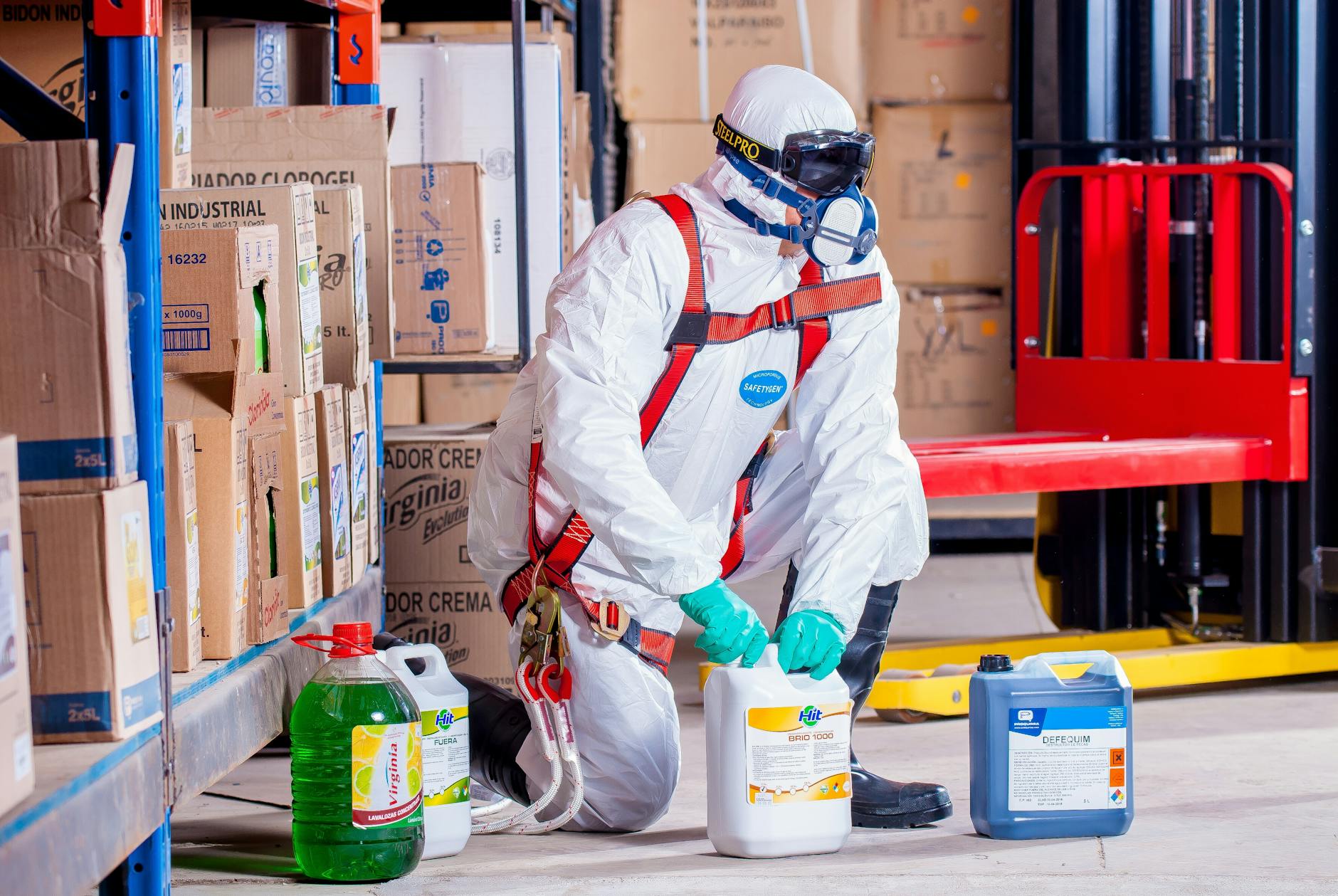 Technician in a white coverall, mask and gloves handling chemical drums in a warehouse
The expected control plan: what an audit-proof file contains
Whether the audit is conducted by a major customer, by an IFS Logistics or BRCGS Storage and Distribution certification body, or by the DDPP, the list of documents requested is remarkably consistent.
| Document | What the auditor checks |
|---|---|
| Dated station layout plan | Station numbering, consistency with the site, indoor/outdoor distinction, area covered |
| Service contract | Frequency, scope, pests covered, emergency response times |
| Technicians' certibiocide | Validity on the date of the intervention |
| Safety data sheets and marketing authorisations | Products actually used, authorisation numbers |
| Visit logbook | Signature, date, station-by-station findings, consumption |
| Intervention reports | Non-conformities identified, recommendations, photos |
| Corrective action tracking | Who, what, by when — and proof of completion |
| Risk zone map | Docks, storage areas, waste zone, staff area |
The station layout plan: the document that reveals everything
A good layout plan reads like a diagnosis. Outdoor stations form a perimeter belt along the fence line and the façade, spaced 15 to 30 metres apart depending on pressure, with higher densities at corners, near the waste area and near the basins. Indoors, stations follow walls, corners and rodent runways, at 10–20 metre intervals in food zones.
Two classic mistakes:
- "Decorative" stations placed where they don't get in the forklift's way, rather than where the rodent travels. A station in the middle of an open wall, far from any cover, will never be visited.
- A plan that hasn't changed since the site opened. Works, changes in flows, the construction of a canopy or a new waste area all alter the risk map. A station layout plan must be reviewed at least once a year.
Baits, traps and regulations: what has changed
Since ANSES revised the conditions of use for anticoagulants, permanent outdoor baiting is no longer the norm: second-generation anticoagulant products are subject to usage restrictions, with an obligation to justify the presence of rodents, remove uneaten bait and limit campaign duration. In practice, a modern warehouse control plan relies on:
- non-toxic monitoring stations (non-baited indicator blocks, detection pastes, counting plates) during business-as-usual periods;
- a switch to curative baiting only upon evidence of activity, with a start date, a removal date and a summary report;
- mechanical traps in food zones and wherever the risk of secondary poisoning or an inaccessible carcass is high. Steel snap-action rodent traps, set perpendicular to the wall inside a lockable housing, are devastatingly effective along racking;
- connected devices on sensitive sites, which send a notification on every trigger: extremely useful in a 20,000 m² warehouse where a full manual check takes half a day.
ANSES and the French Ministry for Ecological Transition also remind us that every professional applicator must hold a valid certibiocide certificate: it is the first document an auditor asks for, and a missing one is enough to generate a major non-conformity.
Docks, the waste area and outdoor storage: the three worthwhile projects
The docks
A dock leveller is a machine, not a door. Between the deck and the pit, gaps always remain. The solutions that hold up: reinforced door-bottom seals, dock bumpers in good condition, metal plates screwed over the side gaps, and above all operational discipline (doors closed outside operations, no pallet left waiting in front of an open dock overnight).
For service entrances and technical rooms, an aluminium brush door-bottom seal solves in twenty minutes a problem otherwise treated for years with bait. Stainless steel rodent-proof grilles on ventilation outlets and condensate drains are in the same category: a few dozen euros versus months of visits.
The waste area
This is food source number one. The rules that work:
- compactor and skips on a washable concrete slab, more than 10 metres from the building where the layout allows;
- no cardboard stored directly on the ground or against a wall;
- washing and disinfection of the slab according to a dated, signed cleaning schedule;
- food waste in containers with closed lids, never in bags left on the ground.
The same logic as in residential bin rooms, detailed in our article on rubbish chutes and bin rooms in condominiums, applies on an industrial scale.
Outdoor storage of pallets and packaging
A pile of wooden pallets is a perfect harbourage: dry, sheltered, impossible to inspect. Stacks must be raised off the ground, aligned, at least 50 cm away from the cladding and rotated regularly. The same goes for film reels, empty big bags and out-of-service racking: anything that stays motionless for more than three months becomes a nest.
 Technician in a white coverall wearing a blue respirator mask with filters, in profile
The logbook and the reports: what wins or loses you points
A pest file is judged on its traceability, not on the complete absence of rodents. A site that detects activity, documents it, acts and closes out its corrective action scores better than a site showing twelve months of flawless "nothing to report" — the latter is suspicious, and the auditor knows it.
What needs to be kept up to date, ideally in a single binder or an online client portal:
- the visit logbook with station-by-station records (activity / no activity / consumption / station damaged or missing);
- the consumption curve by zone and by month: this is the tool that proves a campaign is working or that a source persists;
- building non-conformities, with photo, location and date;
- the corrective action plan, with a named internal owner and a deadline;
- staff training and awareness sessions (reporting, storage rules, cleanliness of break areas);
- the technicians' competence certificates.
One detail that carries a lot of weight in an audit: the consistency of dates. A report signed on a Sunday, a certibiocide that expired three months before the visit, a station no. 34 still being monitored even though it was removed during works — these inconsistencies, far more than the rodents themselves, are what drag a score down.
For teams that handle monitoring themselves between visits, a powerful rechargeable torch and a simple field record notebook transform the quality of observations: fresh droppings, dark smear marks along skirting boards and tooth marks on packaging only show up under grazing light. To make monitoring more objective, a digital thermometer-hygrometer in technical rooms also helps identify the warm, damp spots rodents favour in winter.
Frequencies, costs and contract structure
There is no single regulatory frequency, but there are well-established practices in the Paris region:
| Site type | Monitoring frequency | Notes |
|---|---|---|
| Dry non-food warehouse | 4 to 6 visits per year | Reinforced in autumn and after works |
| Food warehouse / IFS, BRCGS | 8 to 12 visits per year | Monthly often required by major customers |
| Parcel hub, multiple docks | 6 to 12 visits | Strong external pressure |
| Industrial premises < 1,000 m² | 3 to 4 visits per year | With an annual building fabric audit |
The contract must explicitly name: the scope (indoors, outdoors, surroundings, inspection chambers), the pests covered (rats, mice, and if needed crawling and flying insects), the emergency response time (24 to 48 working hours on sensitive sites), the number of additional visits included in case of activity, the provision of the digital station layout plan, access to the paperless logbook, and the provider's presence on the day of the audit if you request it. The details of sizing and pricing are developed in our guide How much does rat control cost? Prices, quotes and factors in 2026, and our regular monitoring packages are presented on the annual contracts page.
A useful benchmark during a competitive tender: two quotes that differ by 40% almost never cover the same thing. Compare the number of stations, the number of visits, whether the surroundings and inspection chambers are included, and whether the audit file is provided. In a warehouse, a low price that excludes the outdoors is money wasted.
The autumn schedule: why October and November decide the winter
Rodents start migrating towards heated buildings as soon as night-time temperatures drop below 10 °C — in other words, right now in the Paris region. Embankment mowing and roadworks accelerate the movement by driving colonies out of their outdoor harbourages — the same mechanism we describe for construction sites near a building.
The sequence that works in a warehouse:
- October: full audit of the building fabric (cladding, docks, penetrations, inspection chambers), review of the station layout plan, reinforcement of the outdoor perimeter belt.
- November: prioritised sealing works, clean-up and reorganisation of outdoor storage, awareness training for dock teams.
- December to February: close indoor monitoring, mechanical traps along racking and in technical rooms, inspection of electrical cabinets.
- March: quantified annual review, updating of the file ahead of the audit season.
Sites that follow this sequence get through winter with two or three isolated findings. Those that wait for the first torn-open bag in December spend January firefighting — and lose far more along the way in management time and downgraded goods than they ever would have spent on rodent control.
If your site is already showing signs of activity (droppings along walls, gnawed packaging, stripped cables, detection triggers), have a diagnosis carried out before ordering visits: it is the diagnosis, not the bait, that determines the outcome. You can describe your building and your audit context via our quote page.
Got a pest problem?
Our certified technicians are available 7 days a week. Free quote within 24h.