

The intervention report always reads the same way, and it is always read too quickly. Out of 48 flats in one stairwell to be treated against bed bugs, 39 were done, 5 postponed for lack of preparation, and 4 marked "occupant absent / access refused". The manager approves the invoice, considers the job done, and files the case away. Six to ten weeks later, the reports start coming in again — often in the flats next door to the four doors that stayed shut.
This is the most common breaking point of building-wide treatments in the Paris region, far more so than the choice of product or the operator's competence. A properly designed protocol assumes simultaneity: every flat within the same structural module (service ducts, party walls, shared skirting boards) treated within the same window. Each missing flat becomes a reservoir that reseeds the others through pipe runs and suspended ceilings.
The difficulty is that the home is legally protected. Nobody — not the landlord, not the managing agent, not the pest control company, not even the mayor in most cases — can force an apartment door open in order to apply an insecticide gel. But the law is not powerless for all that: there is a proven, graduated sequence that produces results in the vast majority of situations. It simply has to be started at the first refusal, not three campaigns later.
 Yellow, blue and black waste containers lined up in a private car park in Paris on a grey day
Why a single locked flat makes the whole building fail
The biology behind the relapse
The three pests that justify a building-wide treatment do not behave as colonies neatly confined to one flat.
- Bed bugs: they migrate along skirting boards, electrical ducts, roller-shutter housings and lightweight partitions. An untreated flat, especially one in the middle of a landing, re-feeds its neighbours as soon as the residual effect of the applied products wears off — in practice between six and ten weeks.
- German cockroaches: they travel through waste stacks and hot-water pipe runs. A flat left out keeps females carrying egg cases; each case releases 30 to 40 individuals.
- Rats and mice: refusal of access concerns private living areas less than it does cellars and individual lock-up storage units, which are often the main harbourage.
What it actually costs
A second full campaign costs, on the sites we treat, between 70 and 100 % of the price of the first — the fixed costs (travel, inspection, logistics) cannot be split. Across a 120-flat development, the gap between a successful campaign and one that has to be redone represents several thousand euros, charged against a service-charge budget that has already been voted. On top of that comes the erosion of the manager's credibility with the occupants and, in rented housing, the litigation risk under the decent-housing rules.
In practice, the tipping point sits at around 5 % of inaccessible flats within a treated module. Beyond that, it is better to postpone the campaign by a fortnight and spend that time securing access rather than treating 95 % of the doors.
What the occupant is legally required to accept
In rented housing: the Act of 6 July 1989
Article 7 of Act no. 89-462 of 6 July 1989 requires the tenant to "allow access to the let premises for the preparation and execution of works to improve the common parts or the private parts of the same building, and of works necessary to keep the let premises in good condition or in normal repair".
An insect- or rodent-control treatment falls unambiguously within "normal repair" and within keeping the dwelling in good condition. The ELAN Act of 23 November 2018 also added the absence of pests to the criteria for decent housing (amended Decree no. 2002-120): the landlord therefore has not only the right but the obligation to arrange treatment. A tenant who refuses access is in breach of their own contractual obligations.
In a condominium: the Act of 10 July 1965
Article 9 of Act no. 65-557 of 10 July 1965 requires every co-owner to allow access to their lot for the execution of works duly decided by the general meeting, provided those works concern the common parts or the collective interest. A combined pest-control treatment voted at a general meeting as part of an overall control plan meets that condition — on the precise condition that the resolution was drafted to say so. We set out that drafting in our guide to getting a rodent-control contract voted through at a general meeting.
What the occupant is not obliged to accept
It is worth being honest about the limits, because that is often where refusals find their legitimacy:
| Contractor's requirement | Enforceable against the occupant? |
|---|---|
| Allowing entry during working hours by notified appointment | Yes |
| Emptying cupboards, pulling furniture away from walls | Yes (necessary preparation) |
| Throwing out furniture with no report or compensation | No |
| Accepting an intervention announced the previous evening | No |
| Leaving an operator alone in the flat in their absence | No, unless written authorisation is given |
| Paying for the treatment as a tenant | No, except where damage is proven |
Many refusals are not refusals on principle: they are refusals of conditions. Notice that is too short, preparation instructions that an elderly person cannot possibly follow, no information about the product being used.
The sequence that works: five steps, six weeks
Step 1 — Written notice, dated and evidenced
A notice pinned up in the lobby is worth nothing in the event of litigation. Every flat concerned must receive an individual letter stating:
- the nature of the operation (rodent control, insect control, both) and the pest targeted;
- the exact date and time slot, with at least 8 days' notice (15 days is safer);
- the preparation expected, in short numbered sentences;
- the legal basis (article 7 of the 1989 Act or article 9 of the 1965 Act);
- a phone number and email address for rescheduling;
- an explicit statement that the treatment is free of charge for the occupant.
For campaigns covering more than 50 flats, sending everything by registered post is expensive; hand delivery against signature, or distribution with a sign-off sheet per stairwell, is generally enough. A self-inking date stamp and a duplicate receipt book are, prosaically, the two tools that save cases six months down the line.
Step 2 — The operator's visit and the record of failed access
On the day, the technician must produce usable evidence: date, time of the visit, number of rings, time-stamped photo of the door, and a calling card left in the letterbox. A report that merely says "access refused" with no physical evidence is useless before a judge. Require this item in your specification for pest-control services: it is a two-sentence line that changes everything.
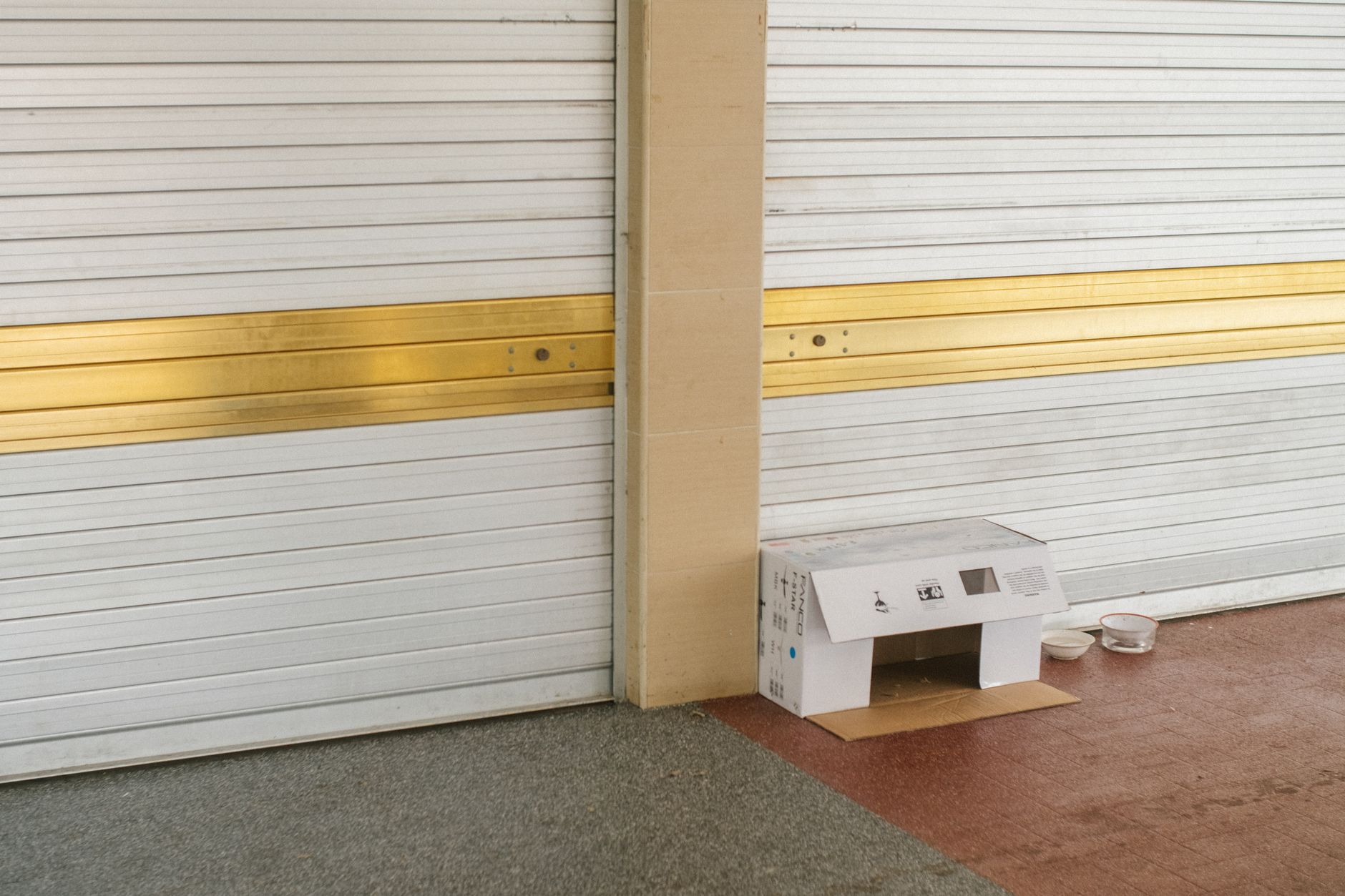 Cardboard box set down at the foot of a metal shutter, with small dishes on the pavement
Step 3 — The phone call and the second date
This is the step everyone skips, and it is the one that resolves 60 to 70 % of cases. A caretaker or area officer who calls, listens to the objection and proposes an alternative date — including a Saturday morning — obtains access with no formalities at all. The three most frequent objections and how to answer them:
- "I work, I can't be there" → offer two slots, one of them outside the working week, or arrange the visit in the caretaker's presence with written authorisation from the occupant.
- "I don't have bed bugs, I don't want chemicals in my home" → explain the perimeter treatment of the neighbouring flats; offer a simple inspection, possibly with canine detection, with no product applied if the inspection comes back negative.
- "I can't move my furniture" → identify the need for help (advanced age, disability, Diogenes syndrome) and bring in the landlord's social services department or a clearance contractor. In those flats, a folding sack truck and a few bed-bug mattress encasements supplied by the landlord settle more refusals than a solicitor's letter.
Step 4 — Formal notice
After two documented missed visits, the formal notice goes out by registered post with acknowledgement of receipt. It must:
- recall the two dates proposed and the records of failed access;
- cite the applicable legislation and, in rented housing, the clause of the tenancy agreement dealing with access;
- set a third, mandatory date at least 15 days away;
- announce what happens in the event of a further refusal: application to the court, and possible recharging of the cost of the catch-up campaign;
- in a condominium, be signed by the managing agent in their capacity as representative of the co-owners' association.
A copy to the municipal hygiene and health department (SCHS) is useful when the infestation has been reported to the town hall: it shows that the manager is taking action, and lays the groundwork for a possible official order.
Step 5 — The emergency application for "useful measures"
Where refusal persists, the protection litigation judge (rented housing) or the president of the judicial court (condominium) can be seised in emergency proceedings on the basis of article 835 of the Code of Civil Procedure, to order the occupant to allow access, subject to a daily penalty, and where appropriate to authorise the intervention with the assistance of a judicial commissioner and, if necessary, of the police.
Practical timescales in the Paris region: 3 to 8 weeks to obtain an emergency hearing, depending on the court. That is a long time on the scale of an infestation, but simply serving the summons often produces access before the hearing. Decisions handed down in recent years on bed bugs in social housing show a consistent judicial position: the collective health interest prevails over personal convenience, provided the manager can prove that genuine appointment offers were made.
The cases that really do block progress
The vacant flat or the unreachable owner
In a condominium, a vacant lot belonging to a non-resident landlord, often an investor based outside the region, is a black hole. The managing agent must use the notification address shown on the co-owner's record, then, failing that, have the documents served by a judicial commissioner. If the lot is let without the managing agent knowing who the occupant is, the request goes through the co-owner, who alone owes the obligation under article 9.
The occupant without legal title, or squatting
The absence of legal title does not remove the protection of the home, but it does change who you deal with: it is for the owner to act, and the treatment is then handled as part of the occupancy proceedings, not as part of the control plan. In practical terms, the managing agent must isolate the lot: reinforced treatment of the common parts and adjoining flats, sealing of duct openings, installation of physical barriers. It is the same containment logic as the one described for bed bugs in an entire building.
The hoarded flat
Diogenes syndrome is the most serious cause of refusal, and the most poorly handled. An insecticide treatment in a hoarded flat is technically ineffective: the surfaces to be treated are inaccessible, and the harbourages remain intact. A prior clearance is needed, which is as much a medical and social matter as a technical one. The right reflex for the manager: refer the case to the SCHS and the social services department, document everything, and do not invoice three pointless visits. FFP3 respiratory protection kits for staff who have to enter these flats are no luxury: the INRS classifies exposure to rodent droppings and organic dust among the biological risks requiring suitable equipment.
 Technician in an orange coverall and mask, sprayer on his back, in front of residential buildings
Preventing refusal: what is decided before the campaign
Inform more, and better
Campaigns that achieve 95 % access on the first visit have three things in common: a one-hour information meeting in the lobby or the caretaker's lodge, a preparation document in pictograms translated into the languages spoken in the development, and a named, reachable contact person. The cost of those three elements is marginal compared with that of a campaign that has to be redone.
Put the catch-up visit in the contract
In the contract, provide for a "catch-up visit" clause: a second slot for the missing flats, included in the price, within 10 days of the main campaign. Without that clause, every catch-up visit has to be negotiated and is invoiced individually, and the manager gives up.
Equip the occupants
An occupant who understands what is being asked of them cooperates. Two supplies make all the difference in bed bug campaigns: transparent sealable plastic bags for treated laundry, and certified bed-bug mattress and base encasements, which make it possible to keep bedding clean after treatment rather than throwing it out. In rodent control, handing out airtight plastic storage boxes for cellars eliminates cardboard, the number one nesting material for rodents.
Document for the aftermath
Every campaign must leave behind a file: a plan of the building showing which flats were treated, postponed and refused, letters, acknowledgements of receipt, intervention reports. That file is your defence if a tenant claims the dwelling is not decent, and your argument at the general meeting for the next campaign. It usefully complements the disinfection side of things when the infestation has left soiling behind: see the disinfection protocol after a rodent infestation.
Key takeaways
- A building-wide treatment cannot tolerate more than 5 % of inaccessible flats within the same module: beyond that, failure is built in.
- The occupant has a legal obligation to allow access (article 7 of the 1989 Act in rented housing, article 9 of the 1965 Act in condominiums), but is not obliged to accept short notice or instructions that cannot be followed.
- The sequence that works: evidenced individual notice 8-15 days ahead → documented record of failed access → phone call and second date → formal notice by registered post → emergency application for useful measures subject to a daily penalty.
- 60 to 70 % of refusals are settled over the phone; most of the rest give way once the summons is served.
- Hoarded flats and vulnerable occupants are a social matter before they are a technical one: treating without prior clearance means paying for nothing.
Are you preparing a treatment campaign on a development or an entire building and dreading closed doors? Set out your situation in a quote request: the access plan, the template letters and the catch-up clause are built before the first visit, not after.
Got a pest problem?
Our certified technicians are available 7 days a week. Free quote within 24h.