

The residence was handed over in March. Twenty-eight apartments, an energy rating label displayed in the lobby, a tiled bin room, an underground car park still spotless. In October, three ground-floor buyers report night-time noises inside the kitchen boxing, and the caretaker finds droppings on the threshold of the plant room. The newly formed owners' committee's first instinct is to call in a contractor and vote a line into the budget. That is precisely the most expensive mistake.
In a recent building, a rodent infestation is almost never a maintenance issue: it is the signature of a construction defect still under warranty. Service conduits crossing a buried wall without a sealing collar, a riser opening left unsealed between the basement and the first floor, a crawl-space ventilation grille with too wide a mesh, a bin-room door threshold with a 2 cm gap, a gully without a backflow valve. These defects are the responsibility of the developer and the contractors, not of the building's operating budget.
This article explains how to characterise the defect, which warranties apply depending on the handover date, how to draft letters that genuinely bind the builder, and how to treat urgently without destroying your own evidence.
 Modern residential buildings with balconies, surrounded by lawn, shrubs and young trees
Why a new building becomes infested faster than an old one
The construction site had already attracted rodents before handover
An eighteen-month site is a larder: site-canteen facilities, food waste, earthworks that destabilise the brown rat colonies of the neighbouring sewer network. When the contractors pull out, the rodent population present on the plot does not disappear: it looks for new shelter, and the freshly sealed building is the best available. It is the same mechanism described for road works near a building, with one difference — here the infested building is the site's own.
Very few private contracts provide for pre-handover rodent control. The standard contract includes an end-of-works clean, rarely a pest control service with a report. The result: the building is handed over with an established population in the basement, invisible during the first months of low occupancy, revealed in the autumn when the communal heating starts up and the apartments fill.
A recent building's service runs are more numerous, not fewer
Counter-intuitive but consistent: a building to the latest energy standards has far more penetrations than a Haussmann-era block. Balanced mechanical ventilation, extract ducts, fibre conduits, electric-vehicle charging risers, district heating pipework, lifting pumps, sometimes a ground-air heat exchanger. Every service crosses several walls, and every crossing is a weak point if it has not been sealed with mortar or the specified fire collar. Sealing is often the last action of a trade that comes through at the end of the job, in the rush of handover.
A mouse gets through a 6 mm opening, a brown rat through 20 mm. A 15 mm gap around a 100 mm PVC conduit is enough to open up the whole building, following the vertical logic described in our article on service risers as a rat motorway.
The most common failure points in off-plan purchases
| Element | Typical defect | Consequence |
|---|---|---|
| Buried wall penetrations | Conduit without collar, expanding foam only | Direct entry from the surrounding soil |
| Crawl-space ventilation grilles | Mesh > 6 mm, non-galvanised sheet | Colonisation of the crawl space |
| Waste room door | Gap under the door, no metal kick plate | Night-time access to the food source |
| Floor gullies and drains | No backflow valve | Travel up from the sewer network |
| Openings between car park levels | Unsealed hatch, unfinished boxing | Vertical movement |
| Landing risers | Plasterboard not closed at the base | Nesting in the shaft |
A proper survey is done with torch in hand and tape measure: a powerful rechargeable LED torch and a set of inspection mirrors make it possible to photograph and document every perimeter gap, which carries far more weight in a file than a literary description.
Which warranty to invoke depending on the handover date
The framework is that of the French Civil Code and the Construction and Housing Code, in the versions applicable to off-plan sales. Three regimes overlap.
The one-year completion warranty: easiest to trigger
Provided for in article 1792-6 of the Civil Code, it runs for one year from practical completion and covers every defect reported, whether listed in the completion snag list or revealed during the year. Its advantage: no debate about how serious the defect is. An unsealed conduit reported within the year must be put right by the contractor, full stop.
This is the most comfortable window. It assumes that the managing agent — often an interim agent appointed by the developer, which creates a well-known conflict of interest — does the survey work. When the interim agent drags its feet, the handover of the file to the newly elected agent follows the same logic as that described for a change of managing agent with an ongoing pest file.
The ten-year structural warranty: ten years, but you must prove unfitness for purpose
Article 1792 of the Civil Code covers, for ten years, damage that compromises the soundness of the works or renders them unfit for their purpose. A chronic infestation linked to a defect in the building envelope has already been accepted by the courts on this basis, provided three things are demonstrated:
- the existence of a precise, localised construction defect (not "rats in the building");
- the causal link between that defect and the infestation (runs, smears, tracing);
- the fact that the space concerned is uninhabitable or unfit for its use.
In practice, the third point requires concrete evidence: occupants' statements, bailiff's reports, closure of a ground-floor business, a report from the municipal public health department. A general sense of discomfort is not enough.
The two-year warranty on equipment
Article 1792-3 covers, for two years, removable items of equipment: grilles, hatches, doors, valves. This is often the right basis for a ventilation grille with an unsuitable mesh or a failing backflow valve — defects that do not fall under the ten-year warranty but remain attributable to the contractor.
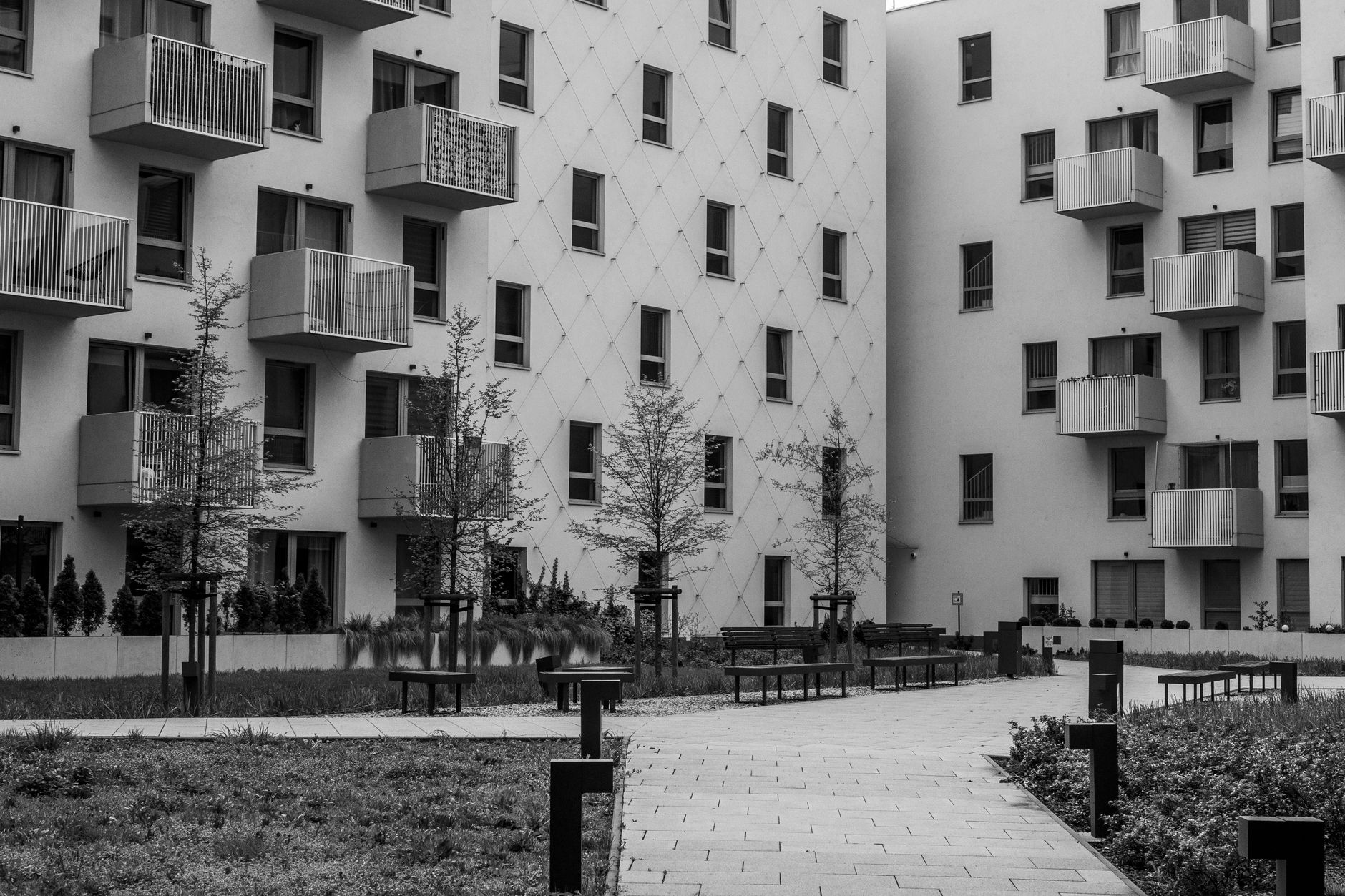 Inner courtyard of residential buildings with balconies, benches and a paved path, black-and-white photo
Building a file that holds up: the four-step method
1. Document before treating, not after
The most widespread mistake: calling a contractor, having the openings mortared up, then writing to the developer. The evidence has gone. The correct order is the reverse.
- Photograph every defect with something for scale (an extended tape measure, a €2 coin) and the camera's timestamp.
- Record the precise location: building, level, room, wall, approximate height.
- Compile occupants' reports by date, apartment and type (noise, droppings, damage, direct sighting).
- Obtain a written diagnosis from a certified pest control company, stating the species, an estimate of the pressure, the runs identified and, above all, the entry points observed. This document is the centrepiece of the file; our guide on reading an intervention report sets out what it must contain.
Tracking dust and a few consumption indicators make it possible to show activity over time, which is worth far more than an isolated photo.
2. Treat urgently without destroying anything irreversibly
There is obviously no question of waiting for an expert report before acting: the managing agent has a duty to maintain the common parts and keep occupants safe, and local public health regulations require rodent control in buildings. The answer is reversible treatment:
- secured bait stations and mechanical trapping in the basement, in line with the rules set out in our article on rodenticide baits in apartment buildings;
- temporary, identifiable sealing: stainless steel wire wool, 5 mm mesh fixed on the surface, a screwed-on brush door seal — all removable, all photographed before fitting;
- no permanent repair with mortar or resin on the disputed points before the expert inspection, unless there is a documented immediate health risk.
A roll of fine stainless steel mesh and an aluminium brush door seal cost a few tens of euros and block most access routes for the duration of the process. The full method is in our guide on sealing rodent entry points in a building.
3. Write to the right recipient, with the right wording
A standard letter saying "there are rats, do something" creates no rights. The useful letter, sent by registered post with acknowledgement of receipt to the developer-vendor, copied to the contractors concerned where they are identified, contains:
- identification of the development, the date of practical completion and the handover date of the units;
- a numbered list of the defects with locations and photos attached;
- the legal basis invoked (article 1792-6, 1792-3 or 1792 of the Civil Code);
- the precise request: repair of the penetrations, replacement of the grilles, fitting of backflow valves, and payment of the pest control work made necessary;
- a deadline for reply (fifteen to thirty days) and a mention that a claim will otherwise be filed with the structural damage insurer.
Filing a claim under the structural damage insurance policy is the most effective lever of the ten-year warranty: the insurer has sixty days to notify its position and, if it accepts, ninety days to offer compensation. That statutory timetable is far more binding than friendly reminders.
4. Get the owners to decide without holding up treatment
Two separate decisions must go to the general meeting, and confusing them costs a year:
- the remedial treatment and the maintenance contract, which fall under day-to-day management and can be committed by the managing agent within the limits of its delegated powers or voted by simple majority — the voting mechanics are detailed in our step-by-step guide to getting a pest control contract approved at a general meeting;
- legal action against the developer, which requires express authorisation of the managing agent by the meeting, with a budget for expert reports and legal fees.
Voting the second without the first leaves the building infested throughout the proceedings; voting the first alone means paying permanently for someone else's defective work.
 Low-angle view of a residential building's inner courtyard with red façades and a cloudy sky
The borderline cases that lose the case
When the way the building is run created the problem
The developer will invariably raise lack of maintenance, and sometimes rightly so. A correctly designed bin room left with its doors wedged open, containers not brought back in, cardboard stored in the cellars, animals being fed in the courtyard: these practices create an infestation that no construction defect explains. The file must therefore be twofold — demonstration of the defect and proof of normal operation, which requires a log kept since handover. The documents to keep in it are listed in our article on the building pest control log.
When handover snags were never cleared
Many handover reports already mention "openings not sealed" or "ventilation grille missing". A snag not cleared within the year is an asset, not a handicap: it dates the defect and proves the vendor was aware of it. You still have to find the document — another reason to recover the interim managing agent's archives in full.
When the infestation comes from the public sewer
Brown rats in the Paris region travel through the sewer network. If the entry point is a defective connection on the public side, liability shifts to the network operator, and a CCTV survey of the pipe becomes the decisive piece of evidence. Municipal hygiene and health departments have access to this kind of inspection and carry it out on request.
Key point: in a residence less than ten years old, the first useful expense is not a three-year pest control contract, it is a written diagnosis of the entry points. It determines who will pay for the next ten years.
The timetable for a well-run new building
A newly handed-over development should be inspected on a simple rhythm that any owners' committee can keep to without particular technical skills:
- Months 0 to 2: full visit of the basements, plant rooms, crawl space and waste room, with photographic records of all penetrations. Ideally with the appointed pest control contractor.
- Month 3: a consolidated notification letter to the developer for the defects observed, within the one-year completion warranty.
- Months 6 to 9: check that snags have been cleared, fit permanent sealing once the repairs are confirmed.
- Months 10 to 11: final reminder before the completion warranty expires, with formal notice.
- Year 2: check the removable equipment (grilles, valves, door seals) before the two-year warranty expires.
A building maintenance logbook with numbered pages and a camera with date stamps are enough to keep to this schedule; what matters is that documents are filed by location, not by date of arrival.
For older buildings, or managers who want to structure the service across several properties, the technical criteria to write into a contract are detailed in our guide to drafting pest control specifications, and the benchmarks for collective responsibility are set out on our managing agents and apartment building pages.
What to do this week if your residence is less than ten years old
- Find the date of practical completion and the handover date of the units: everything else depends on them.
- Go down to the basement with a torch and photograph every conduit, every hatch, every grille.
- Ask the contractor for a written diagnosis of the entry points, separate from the treatment quote.
- Write to the developer before any permanent repair, by registered post.
- Put two separate resolutions on the agenda of the next general meeting: treatment, and authorisation to take legal action.
An infestation in a new building is not an inevitable feature of Paris-region development. It is a workmanship defect whose cost can still be shifted back to whoever created it — provided you prove it before you repair it. For a technical survey of your residence, our team can draw up a diagnosis and treatment quote tailored to recently built developments.
Got a pest problem?
Our certified technicians are available 7 days a week. Free quote within 24h.