

The letter usually arrives in the seventh month. A 28 m² studio on the ground floor of a building in eastern Paris, scratching inside the bath panel since March, two reports to the caretaker, one pest control visit in April "in the common areas only". In October, the tenant sends a registered letter demanding a 40% rent reduction dating back to the first report, reimbursement for a chewed mattress and tumble dryer, and €1,500 for loss of quiet enjoyment. At that point the landlord discovers he has no intervention report whatsoever for the flat itself — only three invoices.
That is the moment the file becomes a financial matter. As long as the question is "who calls the rat catcher", it is settled in a few phone calls. The moment it becomes "how much does the landlord owe the tenant", it is decided on written evidence that almost nobody bothered to put together.
This article sets out what an occupant can realistically obtain when rodents make a home barely liveable, what the courts look at, and how a landlord, a managing agent or a property manager closes down that risk before it turns into a figure.
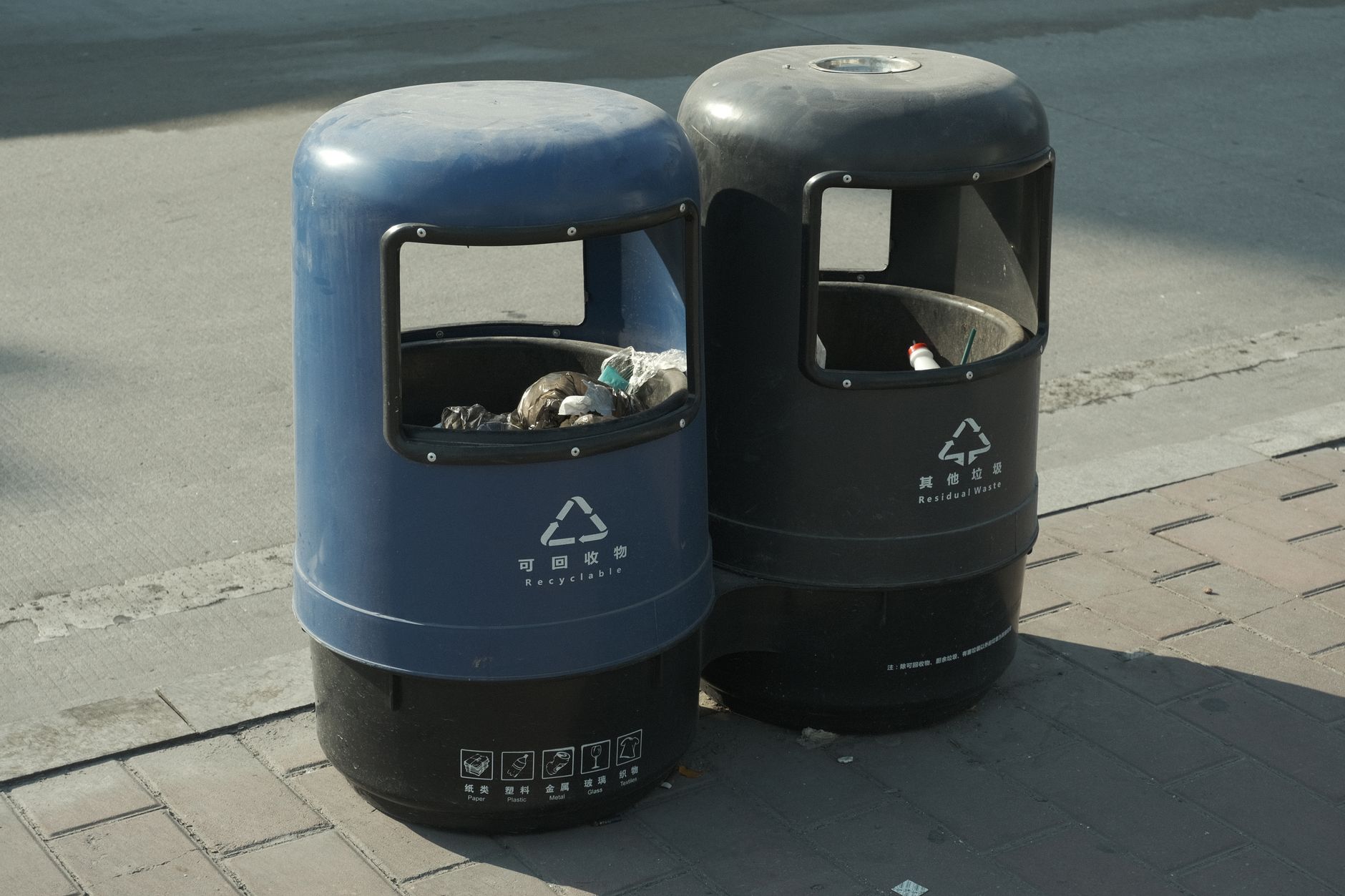 Two public bins, one blue and one black, overflowing with rubbish on a pavement
Why rats in a rented home are the landlord's liability, not the tenant's
Three sets of rules overlap
- The Act of 6 July 1989 (article 6) requires the landlord to provide a home that is "decent, presenting no obvious risk to the health and physical safety of the occupants" and free of any infestation by pests and parasites. That wording was added by the ELAN Act of 23 November 2018: since then, the absence of pests is a decency criterion in its own right, not a matter of general comfort.
- Decree no. 2002-120 on the characteristics of a decent home repeats the same requirement, which allows a judge to find a breach without needing an expert debate.
- The departmental public health regulations, applicable in every department of the Paris region, require the owner and the manager to keep buildings free of rodents and to carry out the necessary rat control operations, including in cellars, refuse chutes, plant rooms and service shafts.
On top of this sits the obligation to ensure quiet enjoyment: the landlord must guarantee the tenant normal use of the premises throughout the term of the lease. An active infestation, even one originating in the building as a whole, is a contractual breach by the landlord towards his tenant — even if the landlord then turns against the co-ownership.
The only serious exception
The tenant is liable only if the infestation is attributable to him: waste stored indoors, obvious failure to maintain the property, feeding animals, repeated refusal of access to the home for treatment. In practice these are the only situations that reverse the burden — and they must be proven, not assumed. Refusal of access in particular is a subject in itself, which we covered in our guide on the tenant who refuses access for treatment.
What the tenant can claim, item by item
Rent reduction or refund
This is the most common claim and the one most readily granted. The court's reasoning is straightforward: if part of the home is unusable or if occupancy is degraded, the rent paid no longer has full consideration behind it. Judgments from the civil courts of the Paris region routinely apply reductions of 10% to 40% of the rent over the period of infestation, sometimes more where the home becomes practically uninhabitable (a room abandoned, children moved out, bedding destroyed).
Two variables weigh heavily:
| Factor | What increases the reduction | What reduces it |
|---|---|---|
| Duration | Continuous infestation over several months | Treatment started within days |
| Landlord's responsiveness | No written reply to reports | Dated quotes, visits and reports |
| Extent | Living rooms, kitchen, child's bedroom | Cellar or outbuilding only |
| Damage | Food, textiles, cables gnawed | No material damage recorded |
Compensation for loss of quiet enjoyment
Separate from the rent, this compensates non-material harm and inconvenience: sleepless nights, fear, stress, smells, inability to have guests, poor hygiene. Awards observed range from a few hundred euros to several thousand depending on the duration and the make-up of the household. A file containing a medical certificate (sleep disorders, anxiety), time-stamped photographs and an exchange of letters left unanswered carries far more weight than a statement written after the event.
Replacement of destroyed belongings
Soiled mattresses, gnawed clothes and bedding, contaminated food, severed appliance cables: these items are proven by invoices and photographs. The tenant's home insurance rarely covers rodent damage — the exclusion is almost universal in standard policies — which pushes the claim back towards the landlord.
Costs incurred by the tenant
Where the landlord does nothing, a tenant who brings in a professional at his own expense can claim reimbursement, provided he first served formal notice on the owner. Keeping the quote, the invoice and the report is essential; a till receipt for shop-bought traps is not enough, and most of those devices fail anyway, for the reasons we set out regarding consumer rodent traps.
Termination of the lease at the landlord's fault
Reserved for serious situations: long-standing infestation, home officially declared unfit, an order from the town hall or the regional health agency. The tenant can then obtain judicial termination without notice, sometimes together with rehousing and removal costs.
 A person's hands assembling a wire rat trap resting on a wooden board
The false good idea: stopping rent payments
This is the most common and the most dangerous reflex. A tenant cannot unilaterally decide to reduce or suspend the rent: he remains liable until a judge rules. Withholding payment exposes him to proceedings to terminate the lease for non-payment, which will often conclude faster than the compensation claim.
There is a safe route: applying to the civil court (or the protection litigation judge) for an order to place the rent in escrow, which puts the money into a holding account until the works are carried out. The tenant stays up to date, and the pressure on the landlord is real.
Pay, write, prove, then claim. In that order. A case that is unanswerable on the merits is often lost over two months of unpaid rent.
The winning file: six documents and nothing else
For tenant and landlord alike, the dispute is decided on a small number of documents.
- Dated reports. Email or registered letter to the owner, the agency or the managing agent, stating the date of the first sighting. Phone calls and messages to the caretaker leave no usable trace.
- Physical evidence. Time-stamped photos and videos of droppings, gnaw marks, burrows and damaged property. Night-time shots inside a service shaft or a suspended ceiling are often decisive; a small rechargeable LED torch radically improves the quality of the images produced.
- A third-party assessment. A report from the municipal hygiene and health department, a visit from a public health inspector, a statement from a Certibiocide-certified professional, or a bailiff's report in significant cases.
- Intervention reports. The single most decisive document on both sides. A landlord who produces location-specific, signed reports with proofing recommendations demonstrates diligence; eleven identical "nothing to report" sheets mainly prove the opposite. We devoted a whole article to reading an intervention report critically.
- Proof of expenditure. Invoices for destroyed belongings, for treatments paid for, and for any hotel nights.
- Medical evidence. A certificate from the GP in the event of a bite, a scratch, sleep disorders or documented anxiety. Remember that urban rodents are documented carriers of leptospirosis, a point we covered in detail in our feature on leptospirosis transmitted by rats.
Useful bodies to approach before going to court
- The departmental conciliation commission, free of charge and contactable by simple letter: it deals specifically with disputes about housing decency and unblocks a significant number of cases.
- The municipality's hygiene and health department, or failing that the departmental office of the Île-de-France regional health agency, which can record the facts and serve formal notice on the owner.
- The national housing information agency (ANIL) and the departmental ADILs, for free and reliable legal information before putting anything in writing.
- The family allowance fund (Caisse d'allocations familiales): where a home is declared unfit, housing benefit can be retained and paid out under conditions, which provides additional leverage.
For landlords, managing agents and property managers: how to shut down the risk
Reply in writing within the week
The main aggravating factor is not the infestation, it is silence. A written reply within eight days, even without an immediate solution — "report logged on 12 October, technical visit scheduled for the 17th, treatment planned before the 24th" — defuses most compensation claims. A log of reports kept by the caretaker or the manager, with dates and the action taken, is worth far more than an exchange of text messages. A simple duplicate-book intervention register is enough and becomes evidence in its own right.
Never separate the flat from the common areas
Treating a flat without treating cellars, refuse chutes, bin rooms, service shafts and utility runs means paying twice for nothing. Rodents travel through the fabric of the building, not through leases. This collective logic is the same as the one described for rats and mice in the meter room, a recurring weak spot in buildings across the Paris region.
Vote through a contract, not one-off visits
In a co-owned building, stacking up isolated visits voted on case by case costs more than an annual contract and leaves gaps in the audit trail. The tendering and voting procedure is set out in our step-by-step guide to voting through a rat control contract at the general meeting, and the scope expected of a serious service provider in our article on the specification for a 3D pest control service.
Deal with exclusion, not just baiting
A defensible file shows that the causes were addressed: sealing entry points, stainless steel air vents, door bottoms and thresholds, filling in utility penetrations. The materials are ordinary — a stainless steel air vent, quick-setting repair mortar, a metal brush door strip — but it is the documented installation that turns an observation into proof of diligence. A rodent gets through a 20 mm opening in the case of a rat, 6 to 7 mm for a mouse: anything left open is an entry point.
 A row of green and blue wheelie bins lined up against a building's brick wall
Allocate the cost correctly
The "who pays" question is settled on three levels:
- Private area, private cause → the tenant.
- Private area, collective cause or building defect → the landlord, who can then act against the co-ownership.
- Common areas, utility runs, plant rooms → the co-ownership, with costs shared according to the regulations.
In practice, the landlord pays first and argues afterwards: the obligation to deliver the premises is owed to his tenant, not to the co-owners' association. The same logic applies to commercial premises, as set out in our article on rodents in a ground-floor shop.
After treatment: putting things right matters too
A finished infestation leaves droppings, urine and sometimes soiled insulation. A tenant moving back into a home that has not been cleaned restarts the whole case. Putting the property right falls to the landlord as soon as the contamination results from a building defect: removal of soiled materials, cleaning, disinfection of surfaces. The protocol and precautions — in particular never dry-sweeping dried droppings — are described in our guide to disinfection after a rodent infestation. For routine jobs, a disposable FFP3 mask and heavy-duty nitrile gloves are the bare minimum, and they do not remove the need for a professional where the volumes are significant.
The ballpark figures to bear in mind
| Situation | Most frequent outcome |
|---|---|
| Report dealt with in under 15 days, reports produced | No compensation |
| Infestation of 2 to 4 months, partial replies | Rent reduction of 10% to 20% over the period |
| Infestation of more than 6 months, landlord silent | 20% to 40% of rent + loss of quiet enjoyment + destroyed belongings |
| Home declared unfit, administrative order | Termination at the landlord's fault, works under penalty, rehousing |
The lesson is always the same: the cost of litigation almost invariably exceeds the cost of treatment. A full rat control campaign across a building, covering common areas and the flats concerned, remains far cheaper than a year of rent cut by 30% across several units, let alone the legal costs and management time.
What to do this week
If you are a tenant: write today, by registered post, stating the date of your first sighting, describing the rooms affected and asking for treatment within fifteen days. Take photographs. Keep paying your rent. Contact your municipality's hygiene department if nothing happens.
If you are a landlord, managing agent or property manager: check that every report received since the start of the autumn has a written reply and a documented follow-up. Ask your contractor for the reports from the last twelve months and read them. Get a price for mechanical exclusion, not just for baiting. A detailed, dated and carefully filed treatment quote is, legally speaking, the best insurance there is against a compensation claim.
Got a pest problem?
Our certified technicians are available 7 days a week. Free quote within 24h.